
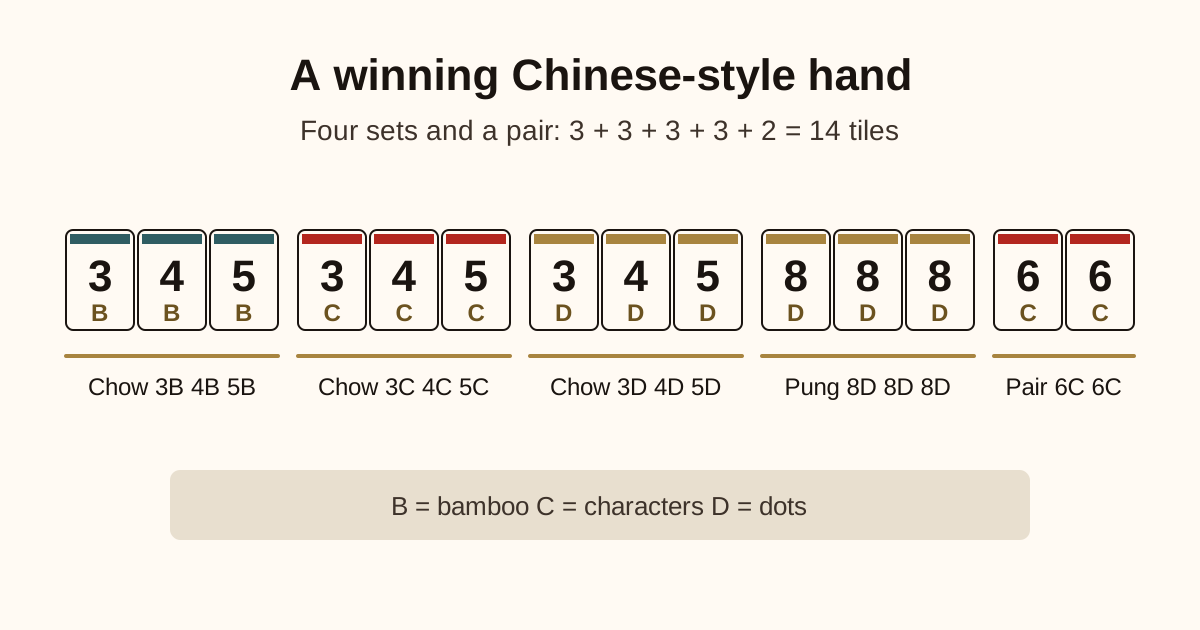
How to play mahjong, in brief: under the Chinese rules published by the World Mahjong Organization, four players each hold 13 tiles, take turns drawing and discarding, and race to complete a 14-tile hand of four sets and a pair (WMO 3.5.2, 3.4.29, 3.7.2). American mahjong, which the National Mah Jongg League calls a "rummy-like" game, adds Jokers and a tile swap called the Charleston, and you can only win with a hand printed on the League's card, which changes every year (NMJL).
Rules also shift from region to region (Pagat), so this guide sets the two big styles side by side, then teaches one full hand under the official Chinese rules. If your family plays Hong Kong style or its own home version, agree on scoring before the first deal.
First, find out which mahjong your table plays
Ask before anyone builds a wall, because the two styles disagree about what a winning hand even is.
| American mahjong | Chinese mahjong (official rules) | |
|---|---|---|
| Who sets the rules | The National Mah Jongg League, founded in 1937, which supplies new hands-and-rules cards every year (NMJL) | The World Mahjong Organization's Mahjong Competition Rules (WMO) |
| Tiles | More than a Chinese set, notably Jokers (NMJL) | 144: 108 suit tiles, 16 winds, 12 dragons, 8 flowers (WMO 3.5.5) |
| How a hand opens | The Charleston: players pass three unwanted tiles to one another (NMJL) | After flower replacements, the dealer, holding 14 tiles, discards (WMO 3.5.7) |
| What a winning hand is | One of the Standard Hands on the current card (NMJL) | Four sets plus a pair, or a special shape such as seven pairs (WMO 3.7.2) |
| Jokers | Used to complete "quints" and "sextets," groups of five and six identical tiles (NMJL) | None |
| Minimum to win | The hand must match the card | At least 8 points, flowers not counted (WMO 3.11.6) |
The card is the practical difference. American players need the current year's card from the League, and since it's the League's own publication, this guide doesn't reproduce its hands. Chinese rules need no card; the scoring patterns are in the rulebook (WMO 3.8).
What's in a Chinese mahjong set
A full set has 144 tiles (WMO 3.5.5; Pagat):
| Group | Faces | Copies | Tiles |
|---|---|---|---|
| Characters | 1 to 9 | 4 of each | 36 |
| Dots | 1 to 9 | 4 of each | 36 |
| Bamboo | 1 to 9 | 4 of each | 36 |
| Winds | East, South, West, North | 4 of each | 16 |
| Dragons | Red, Green, White | 4 of each | 12 |
| Flowers | Spring, Summer, Autumn, Winter, Plum, Orchid, Bamboo, Chrysanthemum | 1 of each | 8 |
| Total | 144 |
Set the eight flowers aside and 136 tiles remain (108 + 16 + 12). Winds and dragons together are the honor tiles, and the 1s and 9s of each suit are the terminals (WMO 3.4.15, 3.4.16). Flowers aren't part of any set: when you draw one, you can lay it face up beside your hand and take a replacement from the back end of the wall (WMO 3.4.20).
How to play mahjong: setting up the table
The official rules seat exactly four players at a square table (WMO 3.5.2). Steps 2 to 7 follow the rulebook's section 3.5.7 (WMO 3.5.7).
- Take seats. The dealer is East. The player on the dealer's right is South, the player opposite is West, and the dealer's left-hand neighbor is North (WMO 3.4.6).
- Mix. Turn every tile face down and shuffle them around with both hands.
- Build the walls. Each player stacks 36 tiles into a wall 18 stacks long and two tiles high, and the four walls are pushed together into a square.
- Break the wall. The rulebook throws the dice twice to pick where dealing starts.
- Deal. Moving away from the break, each player takes four tiles at a time until everyone has 12. Then the dealer takes two more and every other player takes one, so the dealer holds 14 and everyone else 13.
- Replace flowers. Sort your tiles, set out any flowers, and draw replacements from the back end of the wall, dealer first.
- Open. If the dealer can't declare a win on the spot, the dealer discards one tile and play begins.
Taking a turn
Turns run counterclockwise from the dealer (WMO 3.6.2), so the player on your left normally plays just before you.
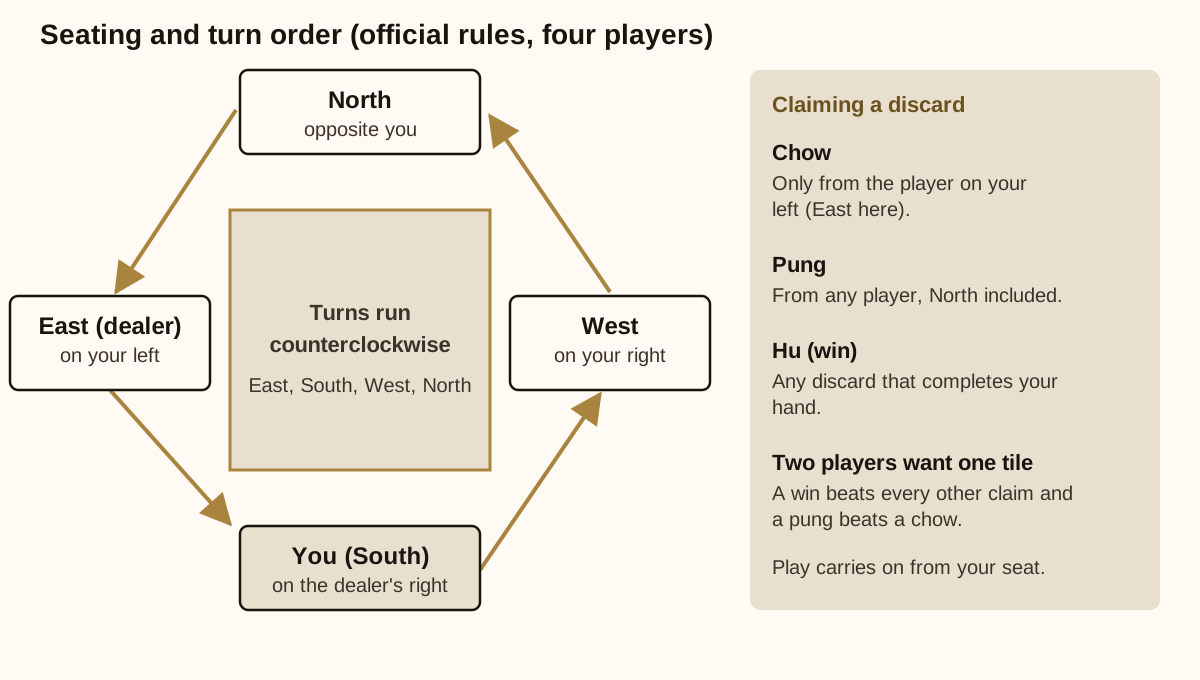
- Draw. Once the player on your left has discarded, take the next tile from the wall (WMO 3.6.3).
- Check for a win. If your 14 tiles form a complete hand, say "Hu" and lay them out (WMO 3.7.1).
- Discard. Otherwise, place one tile face up in the middle. The rulebook lays discards in rows of six so the whole table can read them (WMO 3.6.4).
Between turns you should hold exactly 13 tiles, not counting flowers or kong replacement tiles (WMO 3.4.10, 3.4.29). Count often. A wrong count means you can't win that hand.
Claiming a discard: chow, pung, kong or hu
Say the word before you reach for the tile (WMO 3.6.1).
- Chow ("Chi"): a run of three in one suit, such as 4-5-6 Dots. You may claim a tile for a chow only from the player on your left (WMO 3.4.12, 3.4.17).
- Pung ("Pung"): three identical tiles. Claim from any player (WMO 3.4.13, 3.4.18).
- Kong ("Kong"): four identical tiles. Claim a discard when you hold three matching tiles, or declare four you drew yourself; either way, take a replacement tile from the back end of the wall (WMO 3.6.8).
- Win ("Hu"): claim any discard that completes your hand (WMO 3.4.24).
After a chow, pung or kong, lay the set face up in front of your hand and discard (WMO 3.6.4, 3.6.5). Play carries on from your seat, so anyone between the discarder and you misses that turn. When two players want the same tile, a win beats every other claim and a pung beats a chow (WMO 3.6.7, 3.7.1). If two players both call a win on it, the one who comes next after the discarder takes it (WMO 3.7.2).
What counts as a winning hand
A standard winning hand is 14 tiles arranged as four sets plus a pair, each set being a chow, a pung or a kong; a kong's fourth tile doesn't count toward the 14 (WMO 3.7.2, 3.11.6). A few special shapes also win, such as seven pairs, or thirteen orphans: one of each 1, 9, wind and dragon, with one of them doubled (WMO 3.8.1).
The official rules add a value test. Your hand must be worth at least 8 points, counted from a list of 81 scoring patterns (called fan) worth 1 to 88 points each, and flowers don't count toward the minimum (WMO 3.4.22, 3.8, 3.11.6). Settling up works like this (WMO 3.9.1):
- Won on a tile you drew yourself: each opponent pays you 8 plus your hand's points.
- Won on a discard: the discarder pays you 8 plus your hand's points, and the other two pay 8 each.
One full hand, played turn by turn
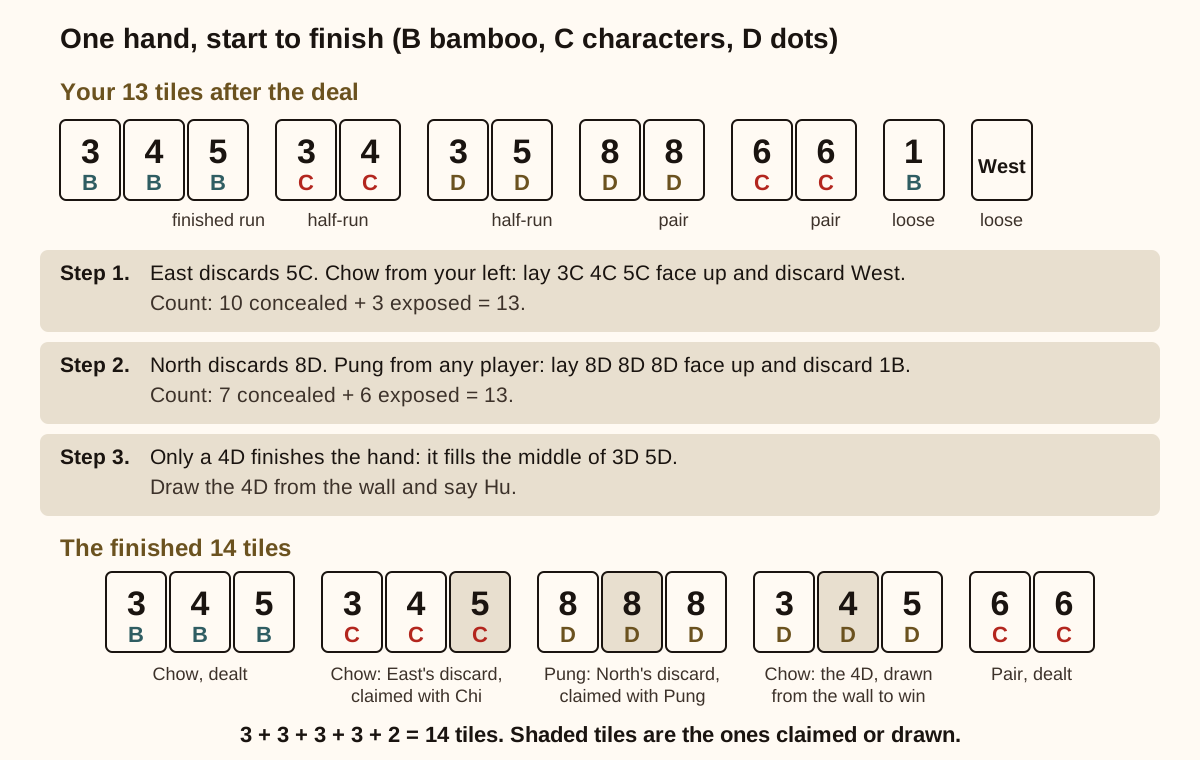
Here is an original example under the official rules. You sit South, so East, the dealer, is on your left and discards just before you; North sits opposite. Shorthand: B = bamboo, C = characters, D = dots.
Your 13 tiles after the deal, with no flowers: a finished bamboo run, two half-runs, two pairs and two loose tiles.
3B 4B 5B · 3C 4C · 3D 5D · 8D 8D · 6C 6C · 1B · West
- East opens by discarding a 5C. It finishes your 3-4-5 Characters, and East is on your left, so a chow is legal. Say "Chi," lay 3C 4C 5C face up, and discard the lone West wind. Count: 10 concealed plus 3 exposed is 13.
- North discards an 8D. You can't chow from North, who sits opposite, but a pung is fine from anyone. Say "Pung" and lay out 8D 8D 8D with the claimed tile in the middle, the rules' way of marking a tile taken from the player opposite (WMO 3.6.5). Discard the 1B. Play continues from you, so East misses that turn. Count: 7 concealed plus 6 exposed is 13.
- Read your wait. Your concealed tiles are 3B 4B 5B, 3D 5D and 6C 6C. Only a 4D finishes the hand: a 3D or 5D would strand the other Dots tile, and a third 6C would cost you your pair. The rulebook calls this a closed wait, one tile that fills the middle of a run (WMO 3.8.1).
- Keep drawing and discarding. Each turn, draw from the wall and throw back anything that doesn't help. When the 4D comes off the wall, say "Hu."
| Set | Tiles | Where it came from |
|---|---|---|
| Chow | 3B 4B 5B | Dealt |
| Chow | 3C 4C 5C | East's discard, claimed with "Chi" |
| Pung | 8D 8D 8D | North's discard, claimed with "Pung" |
| Chow | 3D 4D 5D | The 4D, drawn from the wall to win |
| Pair | 6C 6C | Dealt |
That's 3 + 3 + 3 + 3 + 2 = 14 tiles.
Does it clear 8 points? Yes. Three runs of the same numbers, one in each suit, is the pattern the rulebook calls Mixed Triple Chow, worth 8 by itself (fan 41) (WMO 3.8.1). Smaller patterns add to it: All Simples, for a hand with no 1s, 9s, winds or dragons, is worth 2 (fan 68), and drawing your own winning tile adds 1 (fan 80). Score the whole hand from the table before anyone pays.
Now change one detail: North throws the 4D instead. You still can't chow it, but you can win on it. Say "Hu" and nothing else, because calling "Chi" first and then "Hu" costs you that win (WMO 3.4.24, 3.11.6).
Playing American style: what changes
The League publishes the American rules and supplies its hands-and-rules cards each year, and every game is played against the card (NMJL league; NMJL game). Three things change for a newcomer:
- The Charleston. The game starts with players passing three unwanted tiles to one another (NMJL). Learn the order of passes from the League's rules or an experienced player.
- Jokers. They help complete quints and sextets in several card hands (NMJL). A Chinese set has at most four of any tile (WMO 3.5.5), so a group of five or six identical tiles needs a stand-in. That's the Jokers' job.
- The card. You win only with a hand printed on the current card, and the hands change annually (NMJL). A sensible first decision each hand is which two or three card hands your opening tiles lean toward; the Charleston is your chance to pass along tiles that fit none of them.
If you already know gin rummy's draw-and-discard rhythm, the League's "rummy-like" label will make sense quickly. For American specifics, the current card and the League's rules are the authority.
Mistakes that cost a beginner the hand
- Wrong tile count. More or fewer than 13 between turns, and you can't win that hand (WMO 3.11.6).
- Chowing from across the table. Chows come only from the player on your left (WMO 3.4.17).
- Calling "Chi" or "Pung" on your winning tile. Say "Hu" only (WMO 3.11.6).
- Showing your tiles before you declare. Reveal first and you forfeit that win (WMO 3.11.6).
- Skipping the replacement after a kong. Every kong earns a tile from the back end of the wall; forget it and you'll come up a tile short (WMO 3.6.8).
- Counting flowers toward the minimum. Each flower scores a point when you win but doesn't help you reach 8 (WMO 3.8.1, 3.11.6).
Short a player or two?
The official Chinese rules seat four at every table (WMO 3.5.2), and the walls and deal are built around that number, so a two- or three-player game means house rules. With two people tonight, a card game designed for two will run more smoothly; with three, pick from these standard-deck games for three or more players.
Written by the Golden Lab Games team, a small board and card game studio. The rules above are paraphrased from the NMJL and World Mahjong Organization texts listed below.
Sources
- National Mah Jongg League: The Game: the two styles, the annual card, the Charleston, Jokers
- National Mah Jongg League: The League: founding in 1937, yearly hands-and-rules cards
- World Mahjong Organization, Mahjong Competition Rules, 2006 English edition (PDF): tiles, seating, deal, claims, winning hands, scoring, fouls
- Pagat: Mah Jong: the 144-tile set and regional variation