
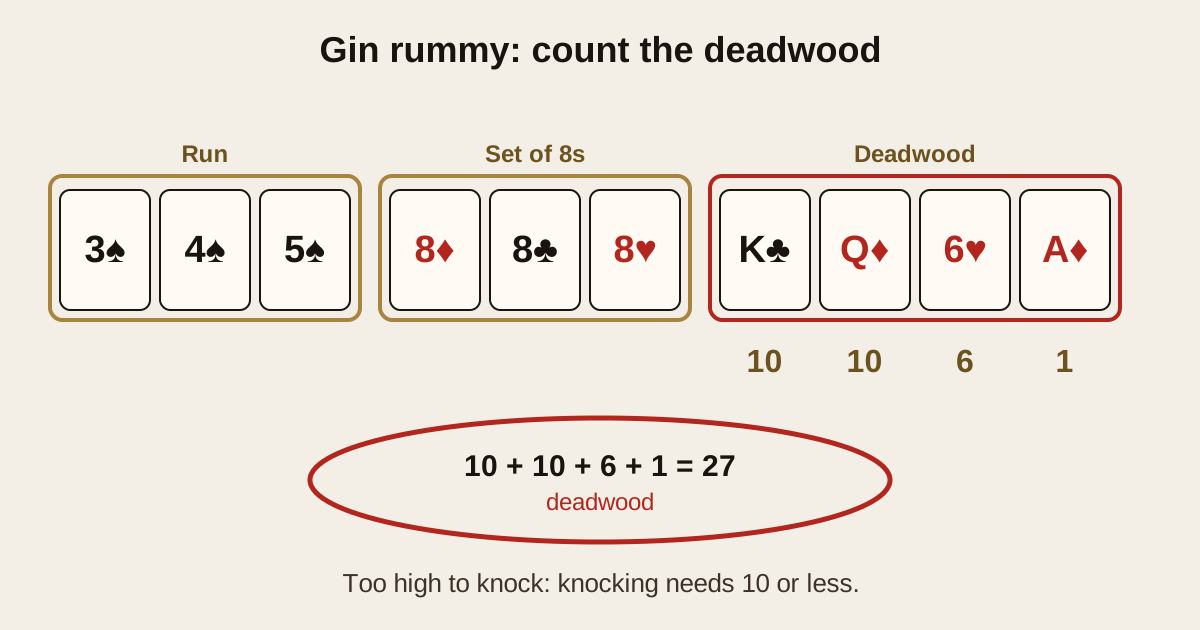
A gin rummy hand holding a spade run, three 8s and four loose cards worth 27 points can't end the hand yet; trim those loose cards to 10 points or less and it can. That's the heart of how to play gin rummy: two players hold ten cards each, draw and discard one card per turn to build sets and runs, and may knock once their unmatched cards, the deadwood, total 10 or less; a knocker with less deadwood than the opponent scores the difference, and the first player to reach 100 points wins (Pagat; Bicycle).
Deadwood: the number everything turns on
A meld is either a set, three or four cards of the same rank, or a run, three or more cards in sequence in one suit (Pagat). Aces are always low, so A-2-3 is a run and Q-K-A is not (Pagat). Every card outside a meld is deadwood and counts against you: aces 1, number cards their face value, and jacks, queens and kings 10 (Pagat; Bicycle).
Count this ten-card hand:
| Melds | Deadwood | Deadwood count |
|---|---|---|
| 3♠ 4♠ 5♠ (run); 8♦ 8♣ 8♥ (set) | K♣ Q♦ 6♥ A♦ | 10 + 10 + 6 + 1 = 27 |
Too high to knock. Trade the K♣ and Q♦ for the 2♣ and 3♥, which still don't meld with anything, and the count falls to 2 + 3 + 6 + 1 = 12: closer, but still 2 points over the knocking limit.
A card can belong to only one meld at a time (Pagat), so the way you arrange the hand matters. Hold 5♥ 6♥ 7♥ 7♣ 7♠ 7♦: put the 7♥ in the run 5-6-7♥ and the other three 7s still form a set, leaving zero deadwood among those six cards. Lay down all four 7s as a set instead, and the 5♥ and 6♥ become 11 points of deadwood.
How to play gin rummy: the deal and the first upcard
- Two players use one standard 52-card deck with no jokers (Pagat; Bicycle).
- Deal ten cards to each player, one at a time (Pagat).
- Turn the 21st card face up to start the discard pile. The rest of the deck is the stock (Pagat).
- The non-dealer gets first refusal on that upcard. If they pass, the dealer may take it. If both pass, the non-dealer draws from the stock and normal turns begin (Pagat).
- From then on, the winner of each hand deals the next; Pagat notes that some books have the loser deal instead (Pagat).
A turn: draw one, discard one
Pick up either the top card of the stock or the top card of the discard pile, then discard one card face up (Pagat; Bicycle). If you took the discard, you can't throw that same card straight back; a card picked up on an earlier turn is fair game (Pagat).
The stock can run dry. If it's down to two cards and the player who took the third-last card discards without knocking, the hand is cancelled: no score, and the same dealer deals again (Pagat).
Knocking, gin and laying off
Knock. When your deadwood is 10 or less after you draw, you may knock: discard one card face down and spread your hand as melds and deadwood. Exactly 10 is fine, and you may knock on any turn, including your first (Pagat).
Lay off. Your opponent then spreads their melds and may get rid of deadwood by adding it to your sets and runs, extending a run at either end. The knocker never lays off on the opponent's melds, and nobody lays off onto deadwood (Pagat).
Gin. Knocking with no deadwood at all is going gin. Your opponent may not lay off, and you can't be undercut (Pagat).
| How the hand ends | Who scores | Points |
|---|---|---|
| Knock, knocker's deadwood lower | Knocker | The difference |
| Knock, opponent's deadwood equal or lower (undercut) | Opponent | The difference + 10 |
| Gin | Player who went gin | 20 + opponent's deadwood |
| Stock down to two cards, nobody knocks | Nobody | 0; same dealer redeals |
Three hands, scored start to finish
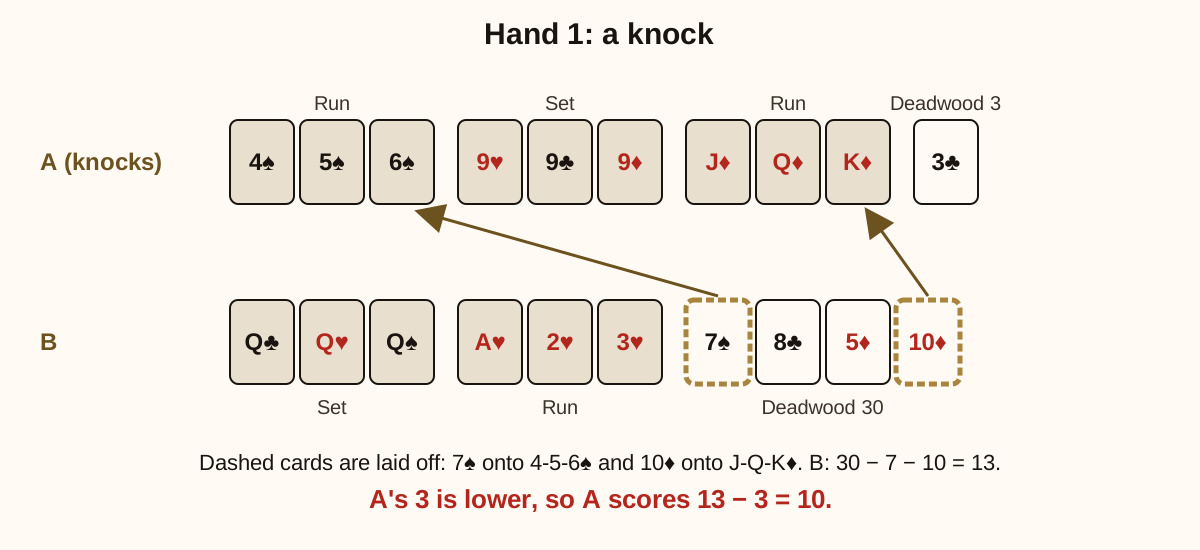
Hand 1: a knock
| Player | Melds | Deadwood |
|---|---|---|
| A (knocks) | 4♠ 5♠ 6♠; 9♥ 9♣ 9♦; J♦ Q♦ K♦ | 3♣ = 3 |
| B | Q♣ Q♥ Q♠; A♥ 2♥ 3♥ | 7♠ 8♣ 5♦ 10♦ = 7 + 8 + 5 + 10 = 30 |
B lays off the 7♠ onto A's 4-5-6♠ (making 4-5-6-7♠) and the 10♦ onto A's J-Q-K♦ (making 10-J-Q-K♦). B's deadwood drops to 8 + 5 = 13. A's 3 is lower, so A scores 13 − 3 = 10.
Hand 2: gin
| Player | Melds | Deadwood |
|---|---|---|
| A (gin) | 7♣ 8♣ 9♣ 10♣; 5♥ 5♠ 5♦; 2♦ 3♦ 4♦ | none = 0 |
| B | K♠ K♥ K♣ | A♣ 4♠ 6♥ 6♦ J♥ 9♠ 2♣ = 1 + 4 + 6 + 6 + 10 + 9 + 2 = 38 |
That's 4 + 3 + 3 = 10 cards for A, all melded. B's pair of 6s is not a meld, and B can't lay anything off against gin. A scores 20 + 38 = 58.
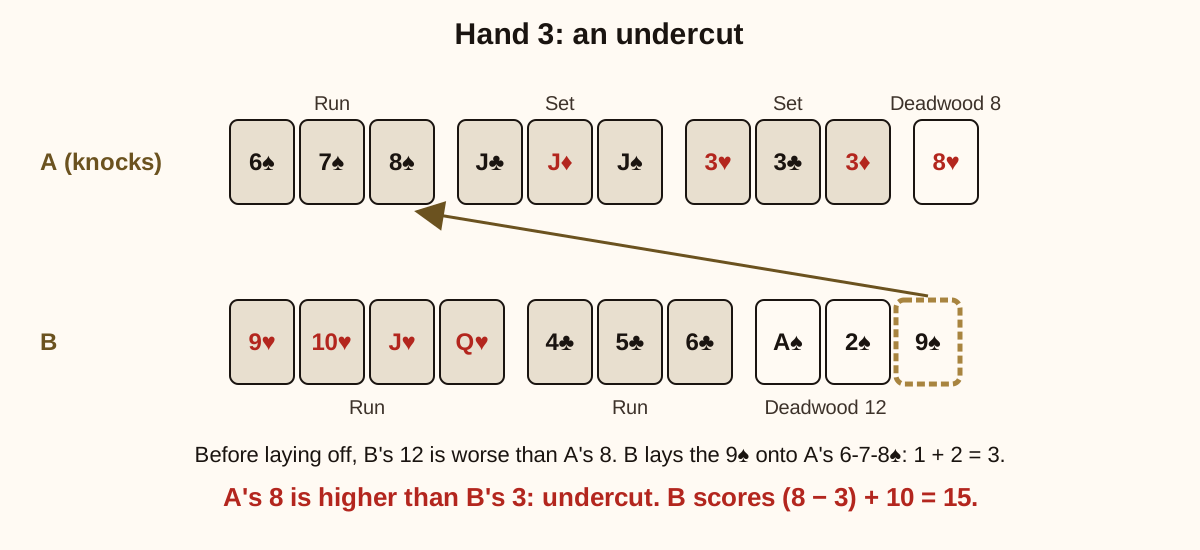
Hand 3: an undercut
| Player | Melds | Deadwood |
|---|---|---|
| A (knocks) | 6♠ 7♠ 8♠; J♣ J♦ J♠; 3♥ 3♣ 3♦ | 8♥ = 8 |
| B | 9♥ 10♥ J♥ Q♥; 4♣ 5♣ 6♣ | A♠ 2♠ 9♠ = 1 + 2 + 9 = 12 |
Before laying off, B's 12 is worse than A's 8. Then B lays the 9♠ onto A's 6-7-8♠, leaving 1 + 2 = 3. A's 8 is now higher than B's 3, so this is an undercut: B scores (8 − 3) + 10 = 15. Under the variants in the table further down, the same hand would be worth 5 + 20 = 25 or 5 + 25 = 30.
The lesson of Hand 3: a high knock is a bet that your melds won't hand your opponent easy lay-offs, and A's spade run was open at both ends.
If deadwood arithmetic is your kind of fun, cribbage counts a hand in even more ways, with fifteens, pairs and runs.
The tally: racing to 100
Here are those three hands carried into a full game, with two invented hands added to finish it:
| Hand | What happened | Points | Player A total | Player B total |
|---|---|---|---|---|
| 1 | A knocks with 3; B lays off down to 13 | A +10 | 10 | 0 |
| 2 | A goes gin; B holds 38 | A +58 | 68 | 0 |
| 3 | A knocks with 8; B lays off down to 3 (undercut) | B +15 | 68 | 15 |
| 4 | B knocks with 2; A holds 26 after laying off | B +24 | 68 | 39 |
| 5 | A knocks with 6; B holds 41 after laying off | A +35 | 103 | 39 |
A reaches 100, so the game ends after Hand 5. Now add the bonuses, which can't count toward reaching 100 (Pagat):
- Game bonus: A, as winner, adds 100 (Pagat).
- Box bonus: each player adds 20 per hand won (Pagat). A won hands 1, 2 and 5, so 3 × 20 = 60; B won hands 3 and 4, so 2 × 20 = 40.
- Final: A 103 + 100 + 60 = 263; B 39 + 40 = 79.
Had B scored nothing all game, A's game bonus would have been 200 instead of 100 (Pagat).
A blank tally to copy:
| Hand | What happened | Points | Player A total | Player B total |
|---|---|---|---|---|
| 1 | ||||
| 2 | ||||
| 3 | ||||
| 4 | ||||
| 5 | ||||
| 6 | ||||
| 7 | ||||
| 8 | ||||
| Game bonus (+100 to the winner) | ||||
| Box bonus (+20 per hand won) | ||||
| Final |
Bonus values: standard versus variants
The worked hands above use the standard values. Pagat also records alternatives, and any of them changes how much a gin or an undercut swings the game.
| Bonus | Standard | Variants Pagat lists |
|---|---|---|
| Going gin | 20 | 25 |
| Undercut | 10 | 20, or 25 |
| Box bonus, per hand won | 20 | 25 |
Standard values: Pagat; Bicycle uses the same 20 for gin, 10 for an undercut, 100 for the game and 20 per hand won (Bicycle). Variants: Pagat. Pagat also lists a deal variant in which the non-dealer gets 11 cards, the dealer 10, and no card is turned up (Pagat).
Gin rummy questions people ask
Can three people play gin rummy? Yes, with one person sitting out each hand. The dealer deals to the other two and doesn't play; the loser of each hand deals the next one, which is played between the winner and the previous dealer (Pagat).
Can four people play? As two partnerships. Pagat's rule is that the first team to reach 125 points or more wins (Pagat). Down to a pair again? Here are more two-player games for a single deck, and some board games made for two.
Is there a printable gin rummy score sheet? Copy the blank tally above. It already has rows for the game and box bonuses, so the end-of-game arithmetic is laid out for you.
Sources
- Gin Rummy, Pagat.com (John McLeod): deal and first turn, melds, deadwood values, knocking, gin, laying off, undercut, stock running out, game and box bonuses, variants, three- and four-player rules
- Gin Rummy, Bicycle Cards: deck, card values, deal, knock limit, gin and undercut scoring, game to 100, game and per-hand bonuses