
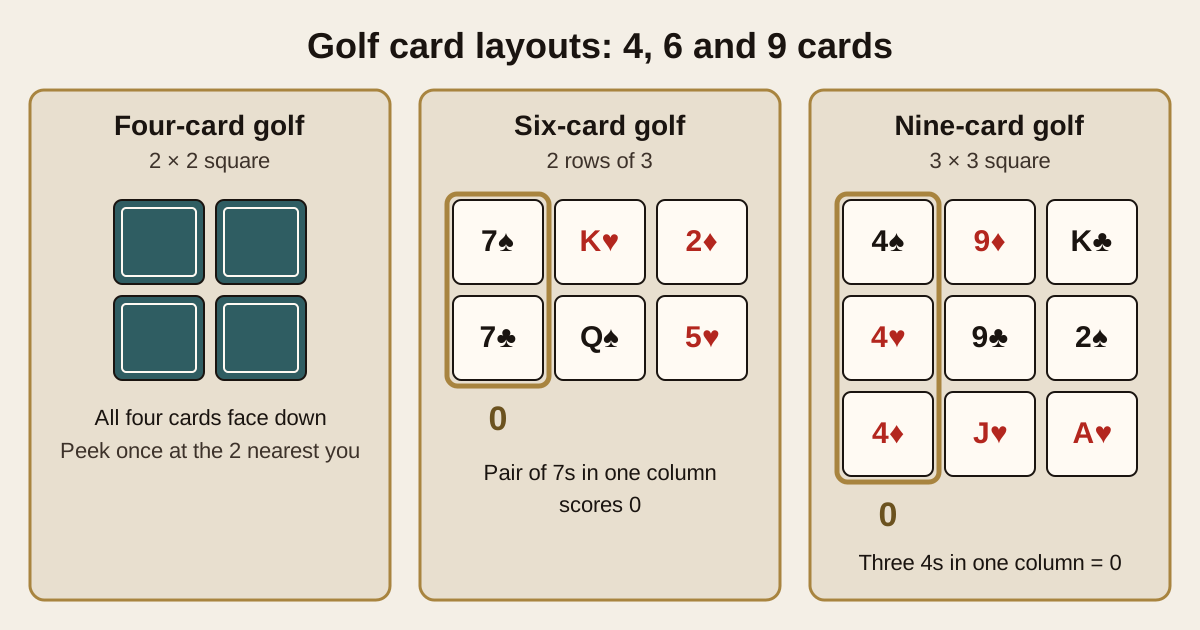
Deal everyone a small grid of face-down cards, then take turns drawing a card and either swapping it into your grid or throwing it away, chasing the lowest total. Those are the golf card game rules in one breath: a hole ends when one player's grid is entirely face up (or, in four-card golf, when someone knocks), and after nine holes the lowest total wins (Pagat; Bicycle).
The catch is that "golf" is a family, not one game. Pagat alone documents four-, six-, eight-, nine- and ten-card versions, each with its own list of variations (Pagat). Below are three of them side by side, four, six and nine cards, each pinned to one scoring standard.
Four, six or nine cards: the versions side by side
| Four-card golf | Six-card golf | Nine-card golf | |
|---|---|---|---|
| Layout | 2 × 2 square, face down | 2 rows of 3, face down | 3 × 3 square, face down |
| What you know at the start | Peek once at the 2 cards nearest you | Turn 2 cards face up | Turn 3 cards face up |
| How a hole ends | Someone knocks; every other player gets 1 more turn | The moment one player's last card is face up | Same as six-card |
| Ace / 2 / Jack, Queen / King | 1 / 2 / 10 / 0 | 1 / −2 / 10 / 0 | Same as six-card |
| Matching cards | No special rule in the basic game | A pair in one column scores 0 | Three equal cards in one column score 0; a pair doesn't cancel |
| Decks | 1 (2 may be shuffled together for 8 or more players) | 1 for 2–4 players; add a 2nd above 4 players, a 3rd above 8 | 2 or more |
| Game length | 9 holes | 9 holes | 9 (sometimes 18) holes is the common series |
Table sources: Pagat for all three versions; Bicycle for six-card golf.
Six-card golf is the version with full rules at both sources, so it's the default for the step-by-step rules below. The four- and nine-card sections cover only what changes.
Golf card game rules for six cards: the setup
- Use one standard 52-card deck for two to four players (Bicycle). Pagat adds a second deck above four players and a third above eight (Pagat).
- Deal six cards face down to each player, who lays them out in two rows of three without looking at them (Bicycle).
- Stack the rest face down as the stock, then turn its top card face up to start the discard pile (Pagat).
- Each player flips two of their six cards face up. The other four stay hidden, and nobody may look at them (Bicycle).
Play starts with whoever sits on the dealer's left and passes clockwise (Pagat).
Your turn: draw, then swap or toss
- Draw the top card of the stock or the top card of the discard pile (Pagat).
- Swap it for any one of your six cards, face up or face down. The new card sits face up, and the card it replaced goes face up onto the discard pile (Pagat; Bicycle).
- Or toss it, but only if it came from the stock. A card taken from the discard pile must be swapped in; grabbing the top discard and throwing the same card straight back is illegal (Pagat).
Each time you swap into a face-down spot, you're one card closer to ending the hole yourself. That's the tension: a fast finish locks in your total, but it also stops you from fixing a bad column.
When a hole ends
Under Pagat's main rule, play stops the moment any player's sixth card is face up; Bicycle likewise ends the round when all of one player's cards are face up (Pagat; Bicycle). Pagat notes that many people give every other player one more turn before scoring (Pagat). Settle which way you play before the first deal, because the extra turn makes racing to finish riskier: everyone else gets a last chance to improve.
Then everyone turns up any hidden cards and adds up their layout.
Scoring six-card golf, with an example
| Card | Points |
|---|---|
| Ace | 1 |
| 2 | −2 |
| 3 through 10 | Face value |
| Jack or Queen | 10 |
| King | 0 |
| Two equal cards in the same column | 0 for that column, even a pair of 2s |
Here's a finished layout:
| Left column | Middle column | Right column | |
|---|---|---|---|
| Top row | 7♠ | K♥ | 2♦ |
| Bottom row | 7♣ | Q♠ | 5♥ |
- Left column: 7 and 7 make a pair, so the column scores 0.
- Middle column: king (0) + queen (10) = 10.
- Right column: 2 (−2) + 5 = 3.
- Hole score: 0 + 10 + 3 = 13.
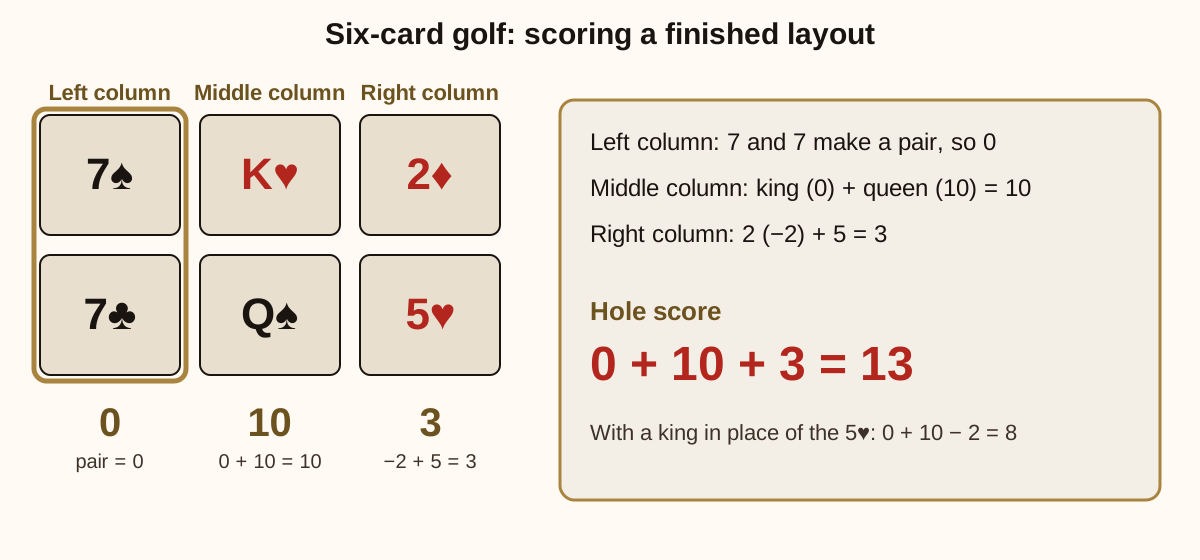
Had that 5♥ been swapped for a king, the right column would be −2 + 0 = −2 and the hole would score 0 + 10 − 2 = 8.
Notice what the pair rule does to 2s. Two 2s in different columns are worth −2 + −2 = −4, but stack them in one column and they cancel to 0 (Bicycle). A pair of 2s is the one pair you don't want.
Four-card golf: knock when you're low
The smallest version swaps the face-up starting cards for memory and adds a knock (Pagat):
- Deal four cards face down to each player, arranged in a square. Before play, each player looks once at the two cards nearest them. After that, you can't look at your layout cards again until they're discarded or scored.
- On your turn, take the top card of the stock or the discard pile and use it to replace one of your four cards, without peeking at the card you're replacing first. A stock card may be discarded unused; a card taken from the discard pile must go into your layout.
- Instead of drawing, you may knock. Knocking is your entire turn. Each other player then gets one more normal turn, and the hole ends.
- Turn everything up and score: aces count 1, twos count 2, other number cards face value, jacks and queens 10, kings 0. Lowest total after nine deals wins.
So a final layout of A♣, 8♦, K♠ and 3♥ scores 1 + 8 + 0 + 3 = 12. Note the two differences: in four-card golf a 2 is just 2 points, not −2.
Nine-card golf: three in a column
Nine-card golf uses two or more decks. Each player gets nine cards in a three-by-three square and turns three face up to begin; some groups turn up only two (Pagat). Pagat describes play and scoring as essentially the same as six-card golf, with one change: a column of three equal cards scores zero, and a mere pair doesn't cancel (Pagat).
| Left column | Middle column | Right column | |
|---|---|---|---|
| Top row | 4♠ | 9♦ | K♣ |
| Middle row | 4♥ | 9♣ | 2♠ |
| Bottom row | 4♦ | J♥ | A♥ |
- Left column: three 4s, so 0.
- Middle column: 9 + 9 + 10 = 28. The pair of 9s cancels nothing here.
- Right column: 0 + (−2) + 1 = −1.
- Hole score: 0 + 28 − 1 = 27.
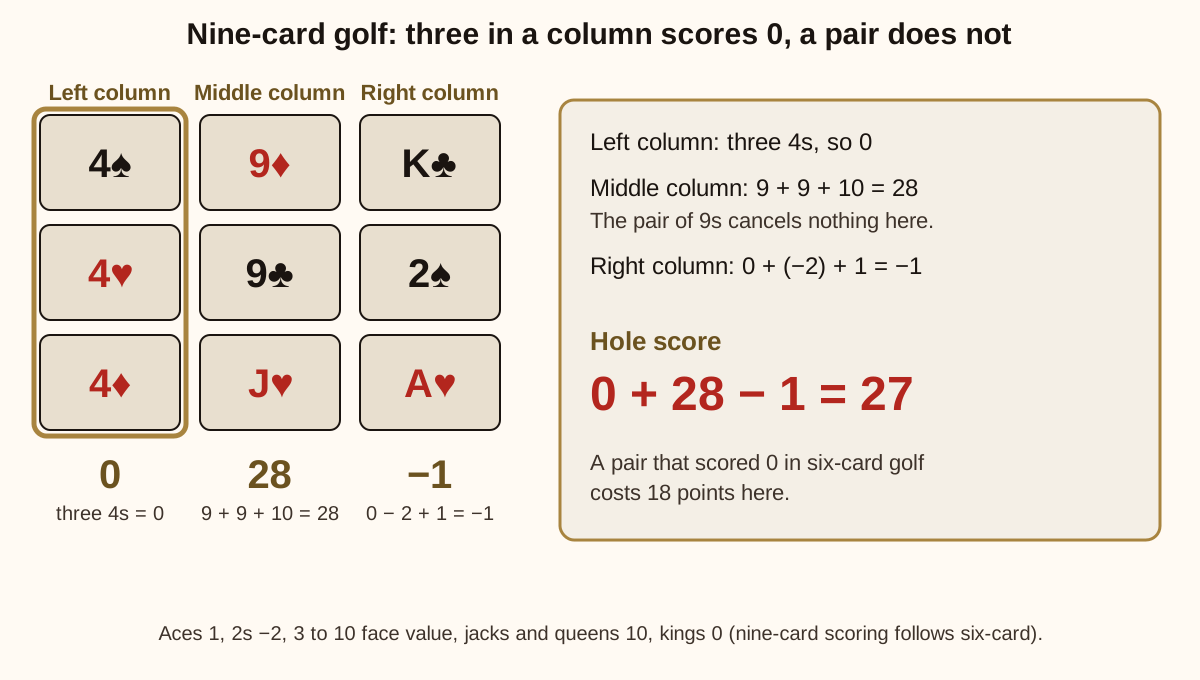
That middle column shows the nine-card trap: a pair that would have scored 0 in six-card golf costs you 18 points here.
A nine-hole scorecard
Here's a filled-in card for three players of six-card golf. The scores are invented; the arithmetic is the point.
| Hole | 1 | 2 | 3 | 4 | 5 | 6 | 7 | 8 | 9 | Total |
|---|---|---|---|---|---|---|---|---|---|---|
| Player 1 | 12 | 5 | 21 | 0 | 8 | −2 | 14 | 3 | 9 | 70 |
| Player 2 | 7 | 15 | 4 | 11 | 2 | 9 | 6 | 18 | −1 | 71 |
| Player 3 | 20 | 3 | 6 | 13 | 10 | 1 | 25 | 0 | 4 | 82 |
After five holes, Player 2 led with 39 (7 + 15 + 4 + 11 + 2) to Player 1's 46 (12 + 5 + 21 + 0 + 8). Over the last four holes, Player 1 scored −2 + 14 + 3 + 9 = 24 while Player 2 scored 9 + 6 + 18 − 1 = 32, so Player 1 finishes on 70 against 71 and wins, because the lowest total wins.
And a blank one to copy:
| Hole | 1 | 2 | 3 | 4 | 5 | 6 | 7 | 8 | 9 | Total |
|---|---|---|---|---|---|---|---|---|---|---|
Because Pagat simply adds a deck as the group grows, golf stretches to a bigger crowd than one deck would suggest; for other ideas when the table is packed, see these games for a big Thanksgiving gathering.
House rules to settle before the first hole
Pagat lists plenty of variations (Pagat). These change scores the most, so agree on them up front and write them at the top of the scorecard:
- Jokers. Neither source's standard six-card rules use them. Pagat's six-card variations score jokers at −5, −3, −2 or 0. Pick one value.
- The extra turn. Does everyone get one more turn after a player goes out? (See "When a hole ends.")
- Flipping instead of drawing. Some groups let you spend a turn just turning a face-down card up.
- Starting cards. Some require the two starting face-up cards to be in the same column, others forbid it.
- Game length. Eighteen holes instead of nine, or (from Pagat's four-card section) play until someone's total reaches 100.
If two of you want a standard-deck game with more back-and-forth than racing to a low score, look at these card games for two people; for three or more, there are plenty of other games for one standard deck.
Scoring slips that cost strokes
- Stacking 2s in one column (six-card). You throw away 4 points of credit.
- Undervaluing kings. A king is 0, so in six-card golf only a 2 beats it.
- Treating four-card 2s as −2. In four-card golf, a 2 is worth 2.
- Counting a nine-card pair as zero. Only three of a kind in a column cancels.
- Taking the discard and tossing it right back. That move is illegal (Pagat).
- Re-checking your four-card layout. After the opening peek, your cards stay unseen until they're discarded or scored.
Sources
- Golf, Pagat.com (John McLeod): four-, six-, eight-, nine- and ten-card golf, card values, column rules, round end, number of holes, variations
- Six Card Golf, Bicycle Cards: players, deal, turn, card values, column pairs, nine-hole game