
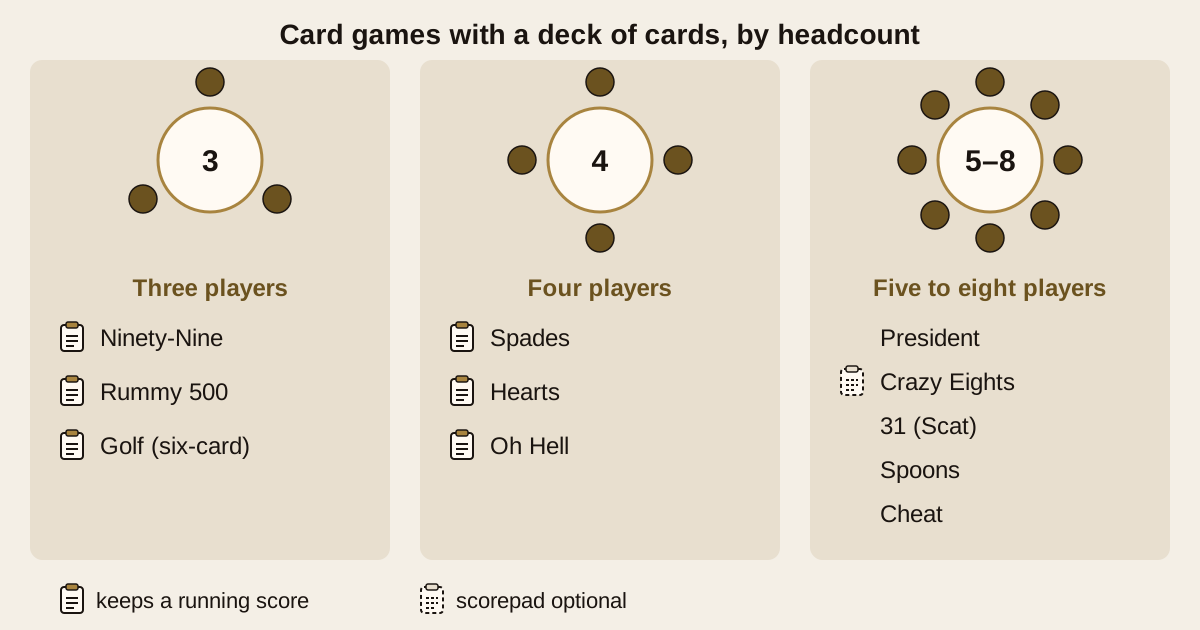
With one standard deck you can seat three for Ninety-Nine, four for Spades or Hearts, and five to eight for President, Crazy Eights, 31, Spoons or Cheat. Below, eleven card games with a deck of cards are grouped by the player count their rules are built around, tagged by mood (trick-taking, shedding, rummy-style or chaotic) and flagged for whether you'll need a pencil and a scorepad.
| Game | Players, per Pagat | Mood | Needs a scorepad? | Rules |
|---|---|---|---|---|
| Ninety-Nine | 3 (variants for 2, 4 and 5) | Trick-taking | Yes | Pagat |
| Rummy 500 | 2 to about 8 | Rummy-style | Yes | Pagat |
| Golf (six-card) | 2–4 per deck | Rummy-style | Yes | Pagat |
| Spades | 4, in partnerships | Trick-taking | Yes | Pagat |
| Hearts | Usually 4; 3 or 5 possible | Trick-taking (dodge points) | Yes | Pagat |
| Oh Hell | 3–7, best 4–6 | Trick-taking | Yes | Pagat |
| President | About 4–7 | Shedding | No | Pagat |
| Crazy Eights | 2–8 | Shedding | Optional | Pagat |
| 31 (Scat) | 2 to 9 or more | Chaotic | No (coins for lives) | Pagat |
| Spoons | Up to 13 per deck | Chaotic | No (spoons and letters) | Pagat |
| Cheat | 2–10 | Chaotic | No | Pagat |
Reading the tags
Mood is our read of what each game asks of the table. Trick-taking games turn on bidding or dodging tricks, shedding games are races to empty your hand, rummy-style games are about drawing, discarding and collecting, and chaotic games bring grabbing, bluffing or knocking people out. The scorepad flag says "yes" when the rules carry a running score from hand to hand, "no" when they use lives, spoons or a winner per hand, and "optional" when scoring exists but the basic game doesn't need it.
When there are three of you
Ninety-Nine: trick-taking, scorepad yes
Pagat credits David Parlett with inventing Ninety-Nine for exactly three players, first published in 1975 (Pagat). Strip the deck to 36 cards, 6 up to ace, and deal 12 each; every player sets three cards aside face down as a bid and plays the other nine to tricks (Pagat). The bid is read from those three cards' suits, clubs 3, hearts 2, spades 1, diamonds 0, and scoring gives 1 point per trick plus a bonus for making your bid exactly: 30 if you're the only one who does, 20 if two do, 10 if all three do, with game at 100 (Pagat).
Set aside the ace of clubs, 7 of hearts and 6 of diamonds and you've bid 3 + 2 + 0 = 5 tricks. Take exactly five while both opponents miss, and you score 5 + 30 = 35.
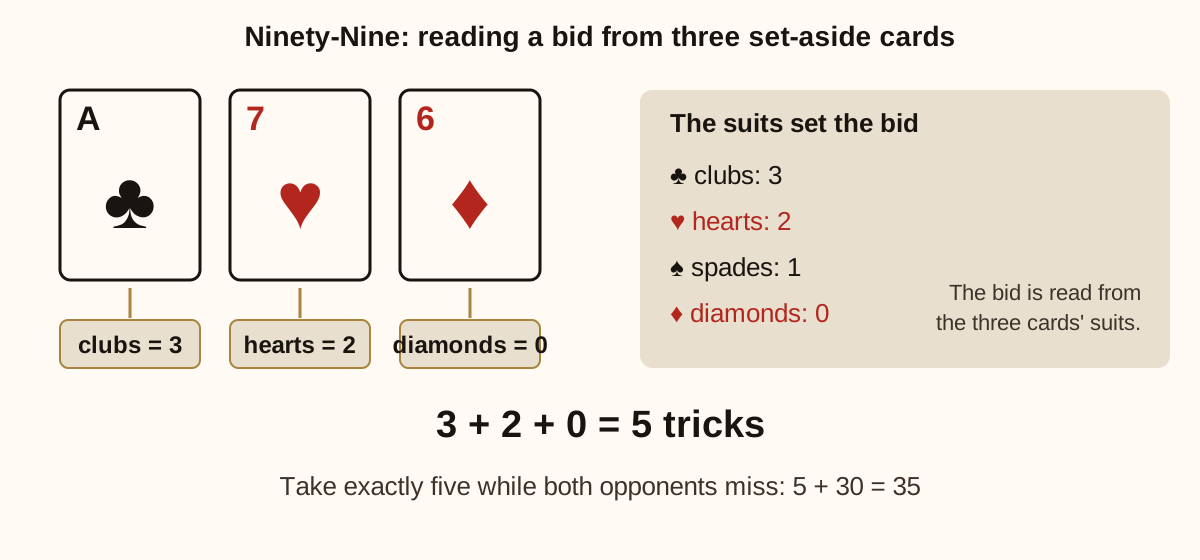
Table feel (our read): many trick-taking games need special rules for three (see Pagat's Spades and Hearts pages); this one was built for it. Bidding with cards also costs you three cards you'd rather play.
Rummy 500: rummy-style, scorepad yes
Pagat's 500 Rummy works for 2 to about 8 players, using one pack plus two jokers, and two packs once five or more play (Pagat). With three or more, deal seven cards each (Pagat). Discards are overlapped so all stay visible, and you may take a card from deep in the pile if you meld it right away, taking every card above it too (Pagat). Melded cards score for you and cards left in hand count against you, with aces and jokers 15 (an ace in A-2-3 counts 1), picture cards 10 and the rest face value; the first to 500 or more wins (Pagat).
Meld 7-8-9 of hearts and you bank 7 + 8 + 9 = 24; get caught holding an ace when someone goes out and the hand nets 24 − 15 = 9.
Table feel (our read): at three on a single deck, seven-card hands leave a deep stock, and the dig-deep rule turns the discard pile into a second source of cards for everyone. A race to 500 needs a running total.
Golf: rummy-style, scorepad yes
In Pagat's six-card Golf, two to four players share one pack, a second pack comes in past four players and a third past eight (Pagat). Each player lays out six cards face down in two rows of three and turns up two; on a turn you draw from the stock or the discard pile and swap the card into your layout, though a card drawn from the stock can simply be thrown away (Pagat). Aces count 1, twos minus 2, kings 0, jacks and queens 10, a matching pair in a column scores 0, and the lowest total after nine deals wins (Pagat).
A column holding a king over a 2 scores 0 + (−2) = −2; a column with two 7s scores 0.
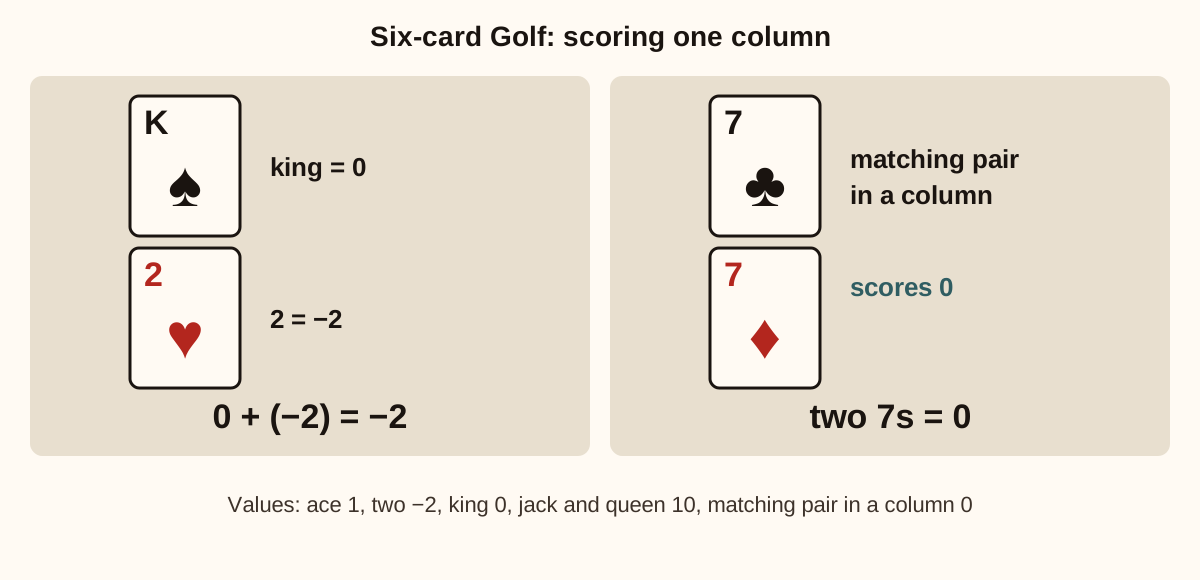
Table feel (our read): three is comfortable on one deck, and nine holes means a scorecard. Rules differ between families; our golf card game rules guide compares the four-, six- and nine-card versions.
Four at the table
Spades: trick-taking, scorepad yes
Spades is usually played by four in fixed partnerships, partners sitting opposite, with 13 cards each and spades always trump (Pagat). Each player bids a number of tricks and a team's target is its two bids added together; a bid of zero is nil (Pagat). A team that makes its contract scores 10 per trick bid plus 1 per extra trick, called a bag; ten bags cost 100 points, a failed contract loses 10 per trick bid, and 500 wins (Pagat). Nobody may lead spades until one has been played on another suit, unless they hold nothing else (Pagat).
Bid 4 + 3 = 7 as a team and take 9 tricks: 10 × 7 + 2 = 72 points, plus two bags toward the next penalty.
Table feel (our read): a team's target is the sum of two separate bids, so each partner's bid is also a message to the other, and bags make overtricks a slow leak. Pagat also gives a three-player version with 17 cards each and one card removed (Pagat).
Hearts: trick-taking, scorepad yes
Hearts is most often a four-player game, and Pagat adds ways to play with three or five (Pagat). Deal 13 each and pass three cards: left on the first hand, right on the second, across on the third, no pass on the fourth, then repeat (Pagat). The holder of the 2 of clubs leads it; you can't lead hearts until one has been played, each heart you take costs 1 point and the queen of spades 13, and when someone reaches 100 the lowest score wins (Pagat). Take every penalty card and you've shot the moon: knock 26 off your own score or add 26 to everyone else's (Pagat).
Swallow the queen of spades and four hearts in one hand and you've added 13 + 4 = 17 points against yourself. The 26 for shooting the moon is all 13 hearts plus the queen: 13 + 13 = 26.
Table feel (our read): no trump and no bidding make this the gentlest trick game here to teach, but the passing rule means your hand is never quite yours.
Oh Hell: trick-taking, scorepad yes
Oh Hell takes three to seven players and is best with four to six (Pagat). The first hand deals 10 cards each with three to five players, 8 with six and 7 with seven; each later hand deals one card fewer down to one, then climbs back up, and a card turned up after the deal sets trump (Pagat). Everyone bids an exact number of tricks, and the dealer, bidding last, may not make the bids add up to the number of tricks in the hand (Pagat). In the simplest scoring, an exact bid scores 10 plus the tricks bid and a miss scores nothing (Pagat).
Bid 2 and take exactly 2 for 10 + 2 = 12; take 3 and you score 0. With seven players the deals run 7, 6, 5, 4, 3, 2, 1, 2, 3, 4, 5, 6, 7, thirteen hands in all.
Table feel (our read): the dealer's rule guarantees that at least one player misses every hand, so nobody coasts. It stretches from three to seven, which covers the awkward headcounts.
Euchre is the other classic four-handed game: Pagat describes it as a game for four in fixed partnerships, played in North America with a 24-card deck (Pagat). It gets its own walkthrough in our step-by-step euchre rules.
Five to eight players
President: shedding, scorepad no
Pagat puts President at about four to seven players, sometimes with a double deck for big groups (Pagat). Deal out the whole pack; 2s are high, then aces down to 3s, and suits don't matter (Pagat). The leader plays a single card or a set of equal cards, and each player in turn passes or beats it with a higher single or a higher set of the same size, until everyone passes (Pagat). The first player out becomes President and the last is the Scum; next deal, seats shift and the Scum hands their best card to the President, who gives back any card they like (Pagat).
Table feel (our read): the titles are the scoreboard, so no pencil needed; Pagat treats points as optional (Pagat). The card swap is a built-in handicap that keeps the top player on top, which is half the fun with five to seven players.
Crazy Eights: shedding, scorepad optional
Crazy Eights takes two to eight players, with two packs shuffled together for a big group (Pagat). Deal five cards each (seven if only two play); on your turn, match the last card's rank or suit, or play an eight, which goes on anything and lets you name the next suit (Pagat). If you can't play you draw, and a player down to one card must say so or draw two as a penalty (Pagat). The first to empty their hand wins, and everyone else counts penalty points: 50 per eight, 10 per picture card, face value for the rest (Pagat).
Get stuck holding an eight and a king and you take 50 + 10 = 60 penalty points.
Table feel (our read): with matching as the core rule, this is the easiest game here for young players. Pagat names Uno as the best known of the commercial versions (Pagat), so an Uno family will feel at home; our Uno rules guide covers that game's differences. Keep score only if you want a winner across several hands.
31 (Scat): chaotic, scorepad no
Pagat's 31 takes from 2 to 9 or more players, each with three cards (Pagat). On a turn you draw from the stock or the discard pile and discard one; a hand is worth the total of its cards in one suit, aces 11 and pictures 10 (Pagat). Instead of drawing you can knock, giving everyone else one last turn: the lowest hand loses a life, and a knocker who ends up alone at the bottom loses two (Pagat). Hit exactly 31 and you win the hand at once while everyone else loses a life; everyone starts with three pennies as lives, and the last player still in wins (Pagat).
Ace, king and 9 of hearts make 11 + 10 + 9 = 30, one short of the instant win.
Table feel (our read): chaotic because a knock can come at any moment, and players drop out as their pennies run out. Coins or tokens replace the scorepad.
Spoons: chaotic, scorepad no
Up to 13 players can play Spoons with one standard pack (Pagat). Deal four cards each and pass one card at a time to your left while picking up from your right, hunting for four of a kind (Pagat). Put one spoon fewer than the number of players in the middle; whoever completes four of a kind takes a spoon, everyone else may then grab one, and the player left empty-handed loses the deal (Pagat). In the lives version each loss earns a letter, and in Spoons each elimination also takes a spoon away (Pagat).
Table feel (our read): there's no score at all, just spoons and letters, and the grab rewards whoever notices first, so it's the loudest game on the list.
Cheat: chaotic, scorepad no
Cheat, also known as I Doubt It, takes two to ten players, and you deal out the whole pack (Pagat). On your turn you put one or more cards face down on the pile and announce their rank, with ranks running in order from aces upward, and you're free to lie (Pagat). Anyone can challenge: if the cards were what you said, the challenger picks up the whole pile, and if not, you do; the first player to empty their hand and survive any challenge to that last play wins (Pagat).
Table feel (our read): more players means more possible challengers, so it gets sharper as the group grows, and the only thing to keep track of is your own nerve.
Common questions about card games with a deck of cards
What card games can three people play with one deck? Ninety-Nine was designed for three (Pagat), Rummy 500 deals seven cards each at that count (Pagat), and Spades has a three-handed version with 17 cards each (Pagat).
Which deck-of-cards games work for kids? By our read, the ones without a scorepad: Crazy Eights for matching, Spoons for grabbing and Cheat, under its gentler name I Doubt It, for bluffing.
Which games suit an adult card night? The scorepad games: Spades and Oh Hell for bidding, Hearts for dodging points, Rummy 500 for a long race.
What if it's just two of you? Most of these need three or more to work well; our one-deck games for two players ranks eight built for a pair.
Sources
- Pagat.com: Ninety-Nine: designer and 1975 publication, players, deck, bidding, trumps, scoring, 100
- Pagat.com: 500 Rummy: players, decks and jokers, deal, discard pile, values, 500
- Pagat.com: Golf: six-card layout, turn, values, column pairs, nine deals, extra packs
- Pagat.com: Spades: partnerships, bidding, nil, bags, scoring, 500, three-player version
- Pagat.com: Hearts: players, passing, first lead, penalty points, shooting the moon, 100
- Pagat.com: Oh Hell: players, deal sequence, trump, bidding rule, scoring
- Pagat.com: Euchre: four players in partnerships, 24-card North American deck
- Pagat.com: President: players, ranking, plays, titles, card exchange, optional scoring
- Pagat.com: Crazy Eights: players, deal, matching, eights, last-card penalty, scoring, Uno
- Pagat.com: 31 (Scat): players, hand value, knocking, 31, lives
- Pagat.com: Pig and Spoons: players, passing, spoons, letters
- Pagat.com: Cheat / I Doubt It: players, deal, calling ranks, challenges, winning