
Cribbage pays out twice every deal: once while you lay cards toward a count of 31, and again when you count your hand. The short version of how to play cribbage: each player is dealt six cards and throws two into the crib, a bonus hand for the dealer; you peg points during the play, then count your four cards plus a shared starter card, and the first player to reach 121 wins, even in the middle of a hand (ACC rules; Pagat).
Counting is where most beginners stall, so this guide starts with a hand and builds the rules around it. The first three hands come from one sample deal, which you can follow from the cut to the final tally.
Count this hand first
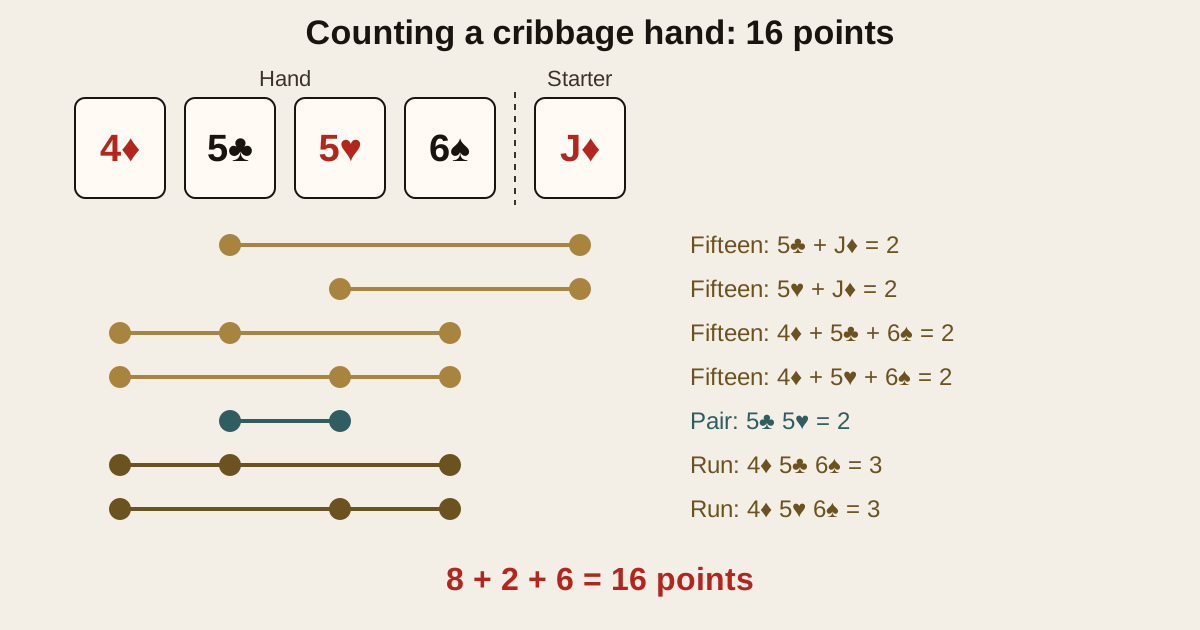
You're the dealer. After discarding, you hold 4♦ 5♣ 5♥ 6♠, and the starter cut from the deck is J♦. In the count, the starter works as a fifth card for every hand (Pagat). Kings, queens and jacks are worth 10, aces 1, everything else its number (ACC). Count in this order:
- Fifteens. Every different combination of cards that totals 15 scores 2 (ACC). Each 5 pairs with the J♦ (two fifteens), and 4 + 5 + 6 works twice, once with each 5. Four fifteens: 8 points.
- Pairs. Each pair of the same rank scores 2 (ACC). The two 5s: 2 points.
- Runs. Three or more consecutive ranks score 1 per card. Because you hold two 5s, the run 4-5-6 exists twice: 3 + 3 = 6 points. The ACC calls this a double run (ACC).
- Flush and nobs. Four hand cards of one suit would add a flush, and a jack in your hand matching the starter's suit would add 1 for nobs (ACC). Neither applies.
Hand 1, the dealer's hand: 4♦ 5♣ 5♥ 6♠, starter J♦
| Combination | Cards | Points |
|---|---|---|
| Fifteen | 5♣ + J♦ | 2 |
| Fifteen | 5♥ + J♦ | 2 |
| Fifteen | 4♦ + 5♣ + 6♠ | 2 |
| Fifteen | 4♦ + 5♥ + 6♠ | 2 |
| Pair | 5♣ 5♥ | 2 |
| Run of three | 4♦ 5♣ 6♠ | 3 |
| Run of three | 4♦ 5♥ 6♠ | 3 |
| Total | 16 |
That J♦ earned you, the dealer, 2 more points, but not in this count. A jack turned up as the starter scores 2 for the dealer immediately, a bonus called his heels, and it isn't counted again in the hand (ACC).
How to play cribbage: deal, discard, cut
- Use a standard 52-card deck with the jokers taken out (ACC).
- Cut for the first deal. Lower card deals, and aces are low (ACC).
- The dealer deals six cards to each player, one at a time, starting with the opponent, who is called the pone (ACC).
- Each player lays two cards face down to form the crib, which belongs to the dealer (ACC).
- The pone cuts the rest of the deck, and the dealer turns up the top card of the lower half as the starter (ACC; Bicycle). A jack here means 2 for his heels.
- After each hand, the deal passes to the other player (Pagat).
In the sample deal, the dealer was dealt 4♦ 5♣ 5♥ 6♠ 10♥ K♥ and threw the 10♥ and K♥ into the crib. The pone was dealt 7♣ 8♣ 9♣ Q♣ 2♥ 3♥ and threw the 2♥ and 3♥.
Pegging: the race to 31
The pone plays first. Take turns laying one card face up in front of you and announcing the running total of every card played so far (ACC). The total can never pass 31. If you can't play without going over, say "go," and your opponent keeps playing as long as they can stay at 31 or under. The count then starts again from zero, and the player who said go leads (ACC). The starter plays no part in pegging (Pagat).
| You play a card that… | You peg |
|---|---|
| brings the count to exactly 15 | 2 |
| brings the count to exactly 31 | 2 |
| is the last card played, with the count under 31 | 1 |
| matches the card just played (pair) | 2 |
| makes three of a kind in a row | 6 |
| makes four of a kind in a row | 12 |
| completes a run of three or more among the latest cards, in any order | 1 per card |
Pegging values from the ACC scoring chart, which also notes that 31 and last card can't both score on the same card.
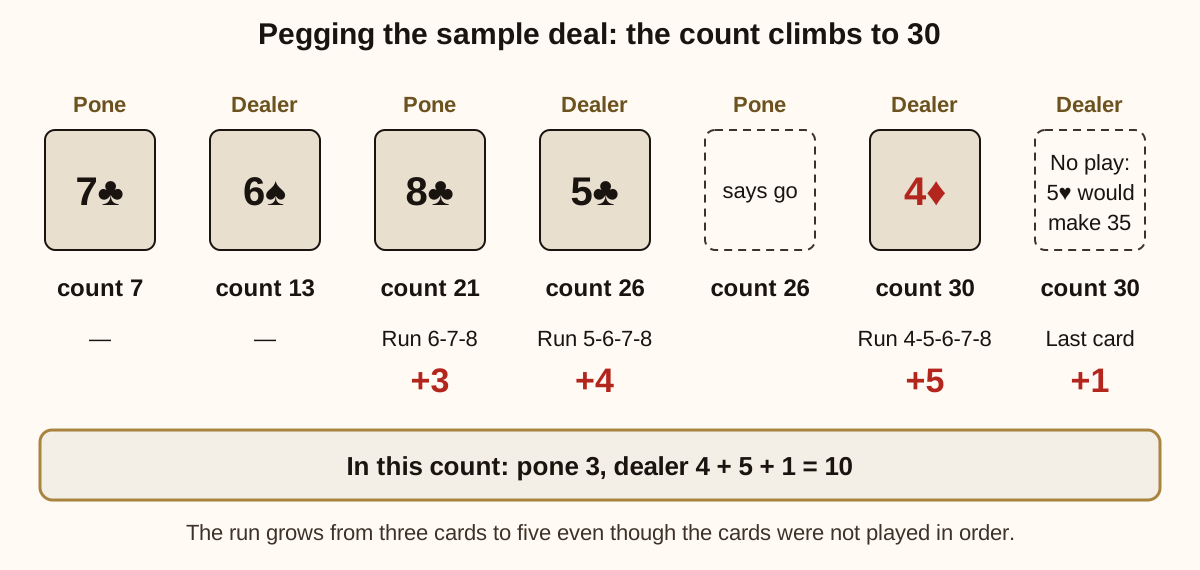
Here's the sample deal pegged out, pone holding 7♣ 8♣ 9♣ Q♣ and dealer holding 4♦ 5♣ 5♥ 6♠:
| Who | Card | Count | What scores |
|---|---|---|---|
| Pone | 7♣ | 7 | — |
| Dealer | 6♠ | 13 | — |
| Pone | 8♣ | 21 | Run 6-7-8: pone pegs 3 |
| Dealer | 5♣ | 26 | Run 5-6-7-8: dealer pegs 4 |
| Pone | none (9 or Q would pass 31) | 26 | Pone says go |
| Dealer | 4♦ | 30 | Run 4-5-6-7-8: dealer pegs 5 |
| Dealer | none (5♥ would make 35) | 30 | Dealer played last: 1 |
| Pone | 9♣ (new count) | 9 | — |
| Dealer | 5♥ | 14 | — |
| Pone | Q♣ | 24 | Last card: pone pegs 1 |
Pegging totals: pone 3 + 1 = 4; dealer 4 + 5 + 1 = 10. Notice that the run grew from three cards to five even though nobody played the cards in order.
The show: who counts first
Once the play is over, everyone picks up their own four cards and counts them with the starter: the pone's hand first, then the dealer's hand, then the dealer's crib (ACC). Near the finish that order decides games, because the first player to 121 wins on the spot (Pagat).
Hand 2, the pone's hand: 7♣ 8♣ 9♣ Q♣, starter J♦
| Combination | Cards | Points |
|---|---|---|
| Fifteen | 7♣ + 8♣ | 2 |
| Run of three | 7♣ 8♣ 9♣ | 3 |
| Flush (four hand cards) | 7♣ 8♣ 9♣ Q♣ | 4 |
| Total | 9 |
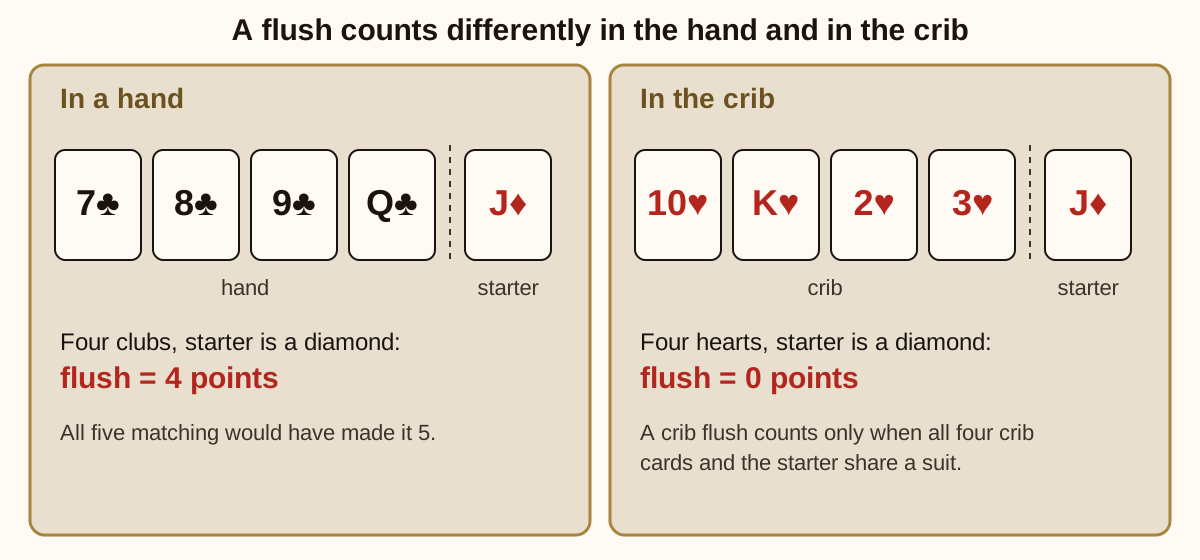
The queen and the jack don't join the run, because no 10 bridges the gap from 9. And the four clubs score a flush even though the starter is a diamond; all five matching would have made it 5 (ACC).
The dealer's hand is Hand 1 above: 16.
Hand 3, the crib: 10♥ K♥ 2♥ 3♥, starter J♦
| Combination | Cards | Points |
|---|---|---|
| Fifteen | 2♥ + 3♥ + 10♥ | 2 |
| Fifteen | 2♥ + 3♥ + K♥ | 2 |
| Fifteen | 2♥ + 3♥ + J♦ | 2 |
| Flush | Four hearts, but the starter is a diamond | 0 |
| Total | 6 |
Those four hearts would have been a flush in a hand. In the crib, a flush counts only when all four crib cards and the starter share a suit (Pagat; ACC).
Two more hands to practice on
Hand 4: 6♣ 7♦ 7♠ 8♥, starter 8♣
| Combination | Cards | Points |
|---|---|---|
| Fifteens (4) | 7♦+8♥, 7♦+8♣, 7♠+8♥, 7♠+8♣ | 8 |
| Pair | 7♦ 7♠ | 2 |
| Pair | 8♥ 8♣ | 2 |
| Runs of three (4) | 6-7-8, once for each 7-and-8 pairing | 12 |
| Total | 24 |
Two pairs inside one run give four separate runs of three, which the ACC calls a double-double run (ACC). Check the fifteens: the 6 can't reach 15 with anything here, so only the four 7-and-8 combinations count.
Hand 5: 5♣ 5♦ 5♥ J♠, starter 5♠
| Combination | Cards | Points |
|---|---|---|
| Fifteens (4) | J♠ with each of the four 5s | 8 |
| Fifteens (4) | Every set of three 5s | 8 |
| Pairs (6) | Four 5s make six different pairs | 12 |
| Nobs | J♠ matches the starter's suit | 1 |
| Total | 29 |
Four of a kind is 12 in a hand, the same as in pegging (ACC). Big hands get noticed, too: the ACC's member programs include lapel pins for 28- and 29-point hands (ACC).
Keeping score without a board
A board is just a scorekeeper. ACC tournament boards run sixty holes up and sixty down, and each player moves two pegs, front and rear, so the gap between them shows the latest score (ACC). Paper does the same job. Give each player a column and write every score as "+points = new total," so a slip is easy to trace. Here's the sample deal on paper:
| Score | Pone | Dealer |
|---|---|---|
| His heels (J♦ starter) | +2 = 2 | |
| Pegging | +4 = 4 | +10 = 12 |
| Pone's hand | +9 = 13 | |
| Dealer's hand | +16 = 28 | |
| Crib | +6 = 34 |
Mark two lines on the sheet. The game hole is 121 (ACC). And because the ACC defines a skunk as winning by 31 or more points, a player still on 90 or below when the winner reaches 121 has been skunked (ACC). Short on time? Bicycle suggests playing to 61 instead (Bicycle).
Three or four players
The ACC treats two players as the basic game and says three- and four-handed versions use essentially the same rules (ACC). Pagat gives the deals (Pagat):
- Three players: the dealer deals five cards to each player and one card straight into the crib. Each player discards one card to the crib, leaving four cards in every hand and four in the crib. The player on the dealer's left cuts for the starter and plays first.
- Four players: partners sit opposite each other. Deal five cards to each player, one at a time, and each player puts one card into the crib.
With just two of you and a taste for card counting, gin rummy's knock-and-score system is the natural next game; there are more ideas among these two-player games that need only one deck, and for boxed games, see the best two-player board games.
Muggins, if you want it
Muggins is optional. If a player overlooks points in their own count, the opponent can call "muggins" and peg those points instead (Pagat). In ACC tournaments it applies only when the tournament director chooses it (ACC). Decide before the first deal, because muggins turns every miscount into a gift for the other side.
A miscount checklist
- Starter: in the count, out of the pegging. It counts with both hands and the crib but is never played (Pagat).
- Each distinct combination is its own fifteen. Any combination totaling 15 scores 2 (ACC), so a pair of 5s with one ten-card makes two fifteens, not one.
- A run of four scores 4. The runs of three inside it don't count separately (Pagat). Duplicates are different: one extra card of a rank doubles the run.
- No four-card flush in the crib. The crib needs all five cards in one suit (Pagat).
- Heels versus nobs. A starter jack is 2 for the dealer at the cut; a jack in hand matching the starter's suit is 1 in the count (ACC).
- Aces only go low. Queen-king-ace is not a run (Pagat).
- 31 and last card never stack. One card earns one or the other (ACC).
- Counted 19? Count again. Pagat notes that 19 is impossible in a hand or crib (Pagat).
Sources
- Cribbage Tournament Rules, 2020 edition (PDF), American Cribbage Congress: object and 121, cards and values, deal and crib, starter and his heels, play and go, counting order, scoring chart, multiple runs, flush, nobs, skunk, muggins, board
- Cribbage, Pagat.com (John McLeod): starter use, runs, flushes, 19, winning mid-hand, three- and four-player deals, muggins
- Cribbage, Bicycle Cards: starter turn-up, 61-point short game