
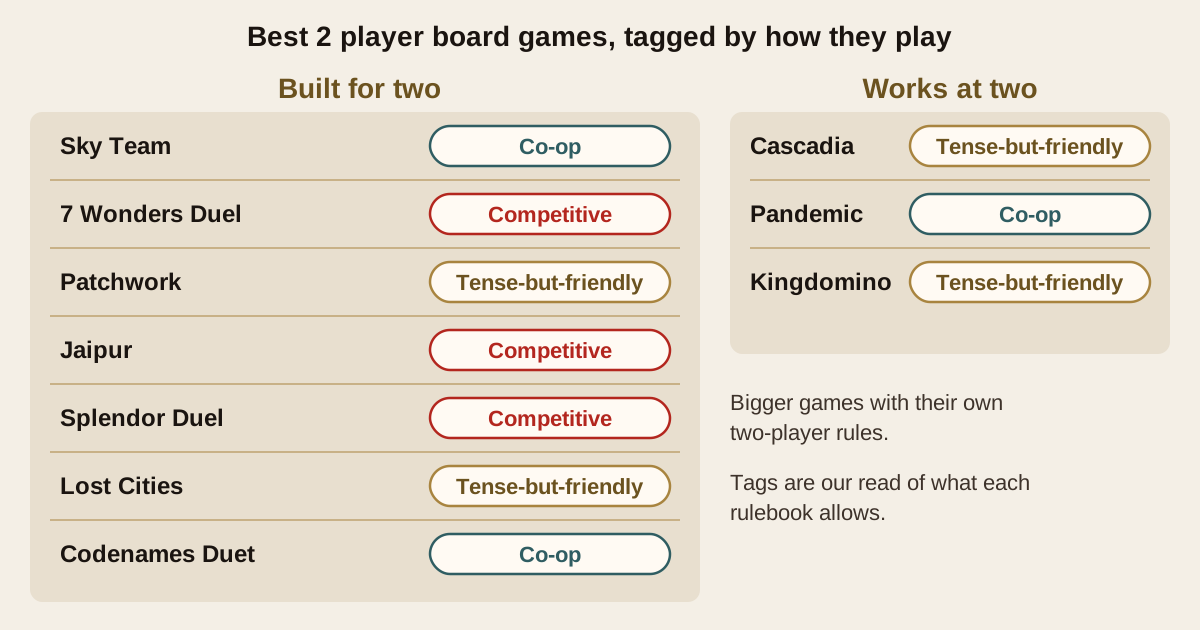
Should a two-player game be built for exactly two, or can a bigger game scale down? The best 2 player board games here include both: seven designed for two (Sky Team, 7 Wonders Duel, Patchwork, Jaipur, Splendor Duel, Lost Cities and Codenames Duet) and three bigger games with their own two-player rules (Cascadia, Pandemic and Kingdomino). Each pick carries a tag for couples, co-op, competitive or tense-but-friendly, based on our read of how far each rulebook lets you get in each other's way.
| Game | Built for | Tag (our read) | Players | Age | Time | Designer |
|---|---|---|---|---|---|---|
| Sky Team | Exactly two | Co-op | 2 | 14+ (rulebook) | 20 min | Luc Rémond |
| 7 Wonders Duel | Exactly two | Competitive | 2 | 10+ | 30 min | Antoine Bauza, Bruno Cathala |
| Patchwork | Exactly two | Tense-but-friendly | 2 | 8+ | About 30 min | Uwe Rosenberg |
| Jaipur | Exactly two | Competitive | 2 | 10+ | 30 min | Sébastien Pauchon |
| Splendor Duel | Exactly two | Competitive | 2 | 10+ | 30 min | Marc André, Bruno Cathala |
| Lost Cities | Exactly two | Tense-but-friendly | 2 | 10+ | Not stated | Reiner Knizia |
| Codenames Duet | Two, or teams | Co-op | 2+ | 11+ | 15 min | Vlaada Chvátil, Scot Eaton |
| Cascadia | Up to four | Tense-but-friendly | 1–4 | 10+ | 45 min | Randy Flynn |
| Pandemic | Up to four | Co-op | 2–4 | 8+ | 45 min | Matt Leacock |
| Kingdomino | Up to four | Tense-but-friendly | 2–4 | 8+ | 15 min | Bruno Cathala |
Box facts for each row: Sky Team rulebook, 7 Wonders Duel, Patchwork, Jaipur, Splendor Duel, Lost Cities rulebook, Codenames Duet, Cascadia, Pandemic, Kingdomino rulebook with its designer from Spiel des Jahres.
What the three tags mean
The tags describe what each rulebook allows, not how any particular couple plays:
- Co-op: you win or lose together.
- Competitive: the rules let you take from, block or race each other head-on, so one player's good turn is often the other's bad one.
- Tense-but-friendly: you compete for the same cards or tiles, but nothing in the rules lets you damage what the other player has already built.
Best 2 player board games built for exactly two
Sky Team (co-op)
Le Scorpion Masqué describes Sky Team as a cooperative game exclusively for two (Le Scorpion Masqué). The English rulebook credits Luc Rémond and gives 20 minutes and ages 14 and up (rules), while the Spiel des Jahres jury rates it from 10 (Spiel des Jahres); it won the Spiel des Jahres in 2024 (Spiel des Jahres). As pilot and co-pilot you each roll four dice behind a screen; you may discuss strategy, never the dice, and once they're rolled the round is played in silence (rules). In each of the seven rounds you must each put a die on the axis, where any difference tilts the plane, and one on the engines, where the sum sets the speed; spin, collide or overshoot the airport and you both lose (rules).
For couples (our read): the silence rule means nobody can give orders once the dice are down, so the game becomes reading each other's placements instead of out-arguing each other. That's a different tension from anything else here, and it suits a pair who'd rather not compete.
7 Wonders Duel (competitive)
Repos Production says Antoine Bauza and Bruno Cathala made 7 Wonders Duel specifically for two players, ages 10 and up, in about 30 minutes (Repos Production). A game runs over three rounds called Ages, and there are three ways to win: military supremacy, scientific supremacy or a civilian victory (Repos Production).
Why it's competitive (our read): with three routes to a win, building your own civilization isn't enough. You have to keep an eye on which route your opponent is closest to and decide when spending a turn to slow them down beats improving your own position. That constant look across the table is the head-on pressure the tag means.
Patchwork (tense-but-friendly)
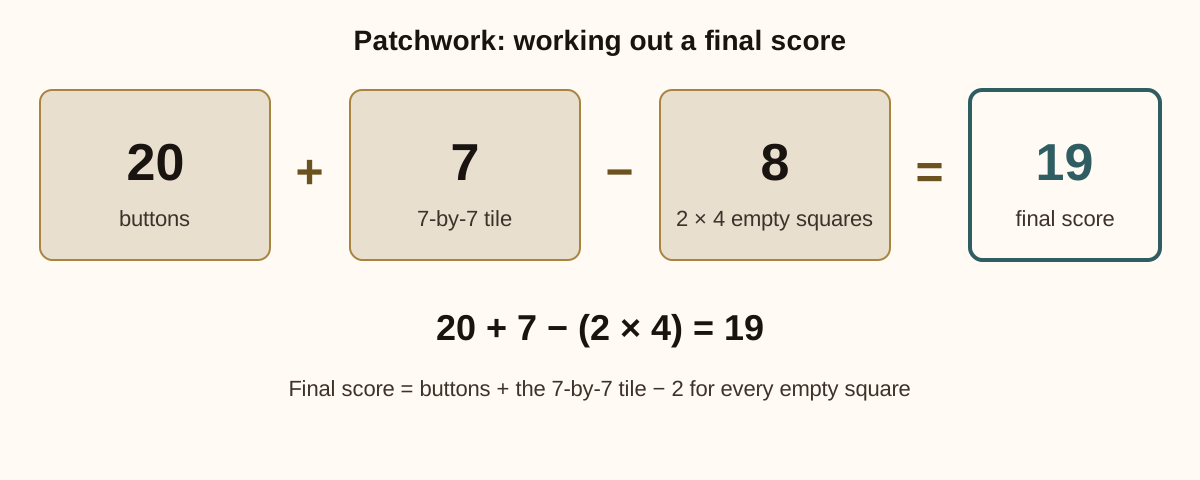
Lookout lists Uwe Rosenberg's Patchwork for two players aged 8 and up, about 30 minutes (Lookout). Turns don't alternate: whoever is further behind on the time board goes next, sometimes several times running. On a turn you either jump to just past your opponent and collect a button per space moved, or buy one of the next three patches in the circle with buttons and move ahead by its time cost (rules). The first to fill a 7-by-7 square on their quilt takes a tile worth 7, and the final score is your buttons plus that tile, minus 2 for every empty square (rules).
Finish with 20 buttons, the 7-by-7 tile and 4 empty squares, and you score 20 + 7 − (2 × 4) = 19.
For couples (our read): nothing in the rules lets you touch your partner's quilt. The friction is taking the patch they were saving buttons for, or beating them to the 7-by-7 tile. Tense, never mean.
Jaipur (competitive)
Space Cowboys lists Sébastien Pauchon's Jaipur for two players, ages 10 and up, 30 minutes (Space Cowboys). You collect and swap goods cards at a shared market and sell them for rupee tokens. Camels are mainly a trading tool for taking several goods at once, a sale of three or more cards earns a bonus token, the richer merchant takes each round's Seal of Excellence, and two Seals win (Space Cowboys).
Why it's competitive (our read): every card you lift from the market decides what your opponent can take next, and each round has exactly one winner. There's no private board to retreat to; the whole game happens in that shared row of cards.
Splendor Duel (competitive)
Space Cowboys lists Splendor Duel, by Marc André and Bruno Cathala, for two players, age 10, about 30 minutes (Space Cowboys); Cathala's note in the rulebook dates its publication to 2022 (rules). On your turn you take up to three adjacent tokens in a line from the board, reserve a card with a gold token, or buy a card, and you win at the end of any turn on which you have 20 prestige points, 10 crowns, or 10 points on cards of one color (rules).
Why it's competitive (our read): it's the most direct of the built-for-two games. Some cards let you take a token from your opponent, and taking three tokens of one color or two pearls hands your opponent a privilege (rules). With three ways to win, you're forever checking how close they are to each one.
Lost Cities (tense-but-friendly)
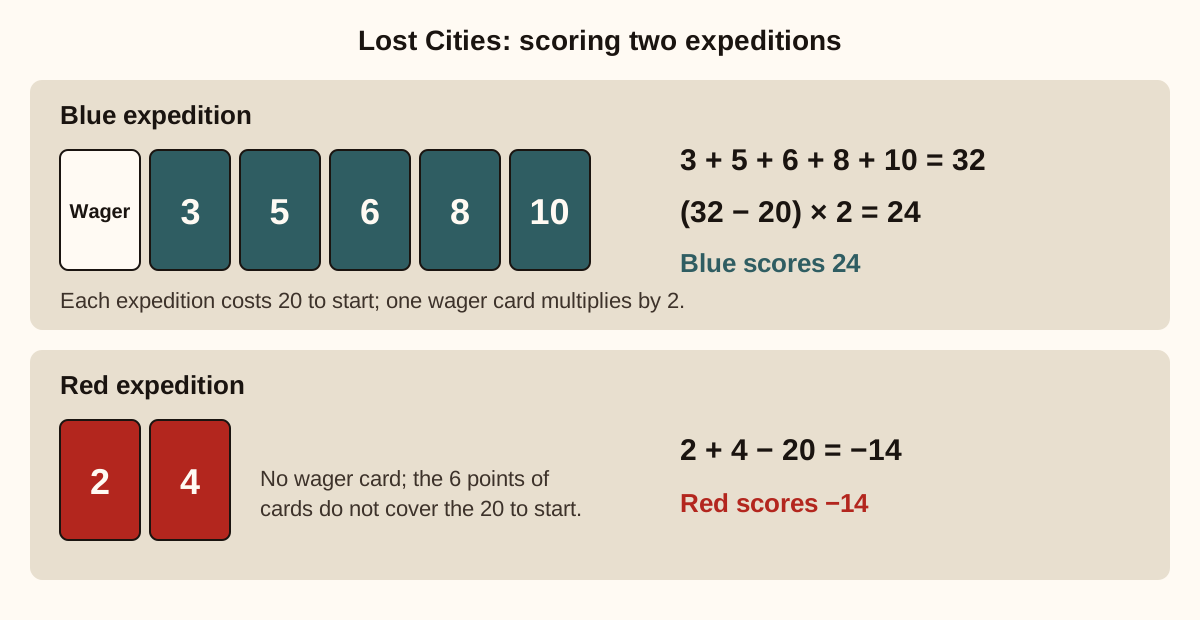
Kosmos's rulebook, distributed in North America by Thames & Kosmos, lists Reiner Knizia's Lost Cities card game for two players aged 10 and up (rules). From a hand of eight, each turn you play a card onto your own expedition of that color, always higher than the last, or onto that color's shared discard pile, then draw from the deck or a discard pile (rules). Each expedition you start costs 20 points, one, two or three wager cards at its start multiply the result by 2, 3 or 4, and eight or more cards earn an unmultiplied 20-point bonus; three games make a match (rules).
Blue with one wager and the 3, 5, 6, 8 and 10 sums to 32 and scores (32 − 20) × 2 = 24; red with just the 2 and 4 scores 2 + 4 − 20 = −14.
For couples (our read): you only play on your own side of the board (rules), but every discard is a card your partner can take: a quiet duel. The rulebook prints no playing time.
Codenames Duet (co-op)
Czech Games Edition lists Codenames Duet, by Vlaada Chvátil and Scot Eaton, for 2 or more players, ages 11 and up, about 15 minutes (CGE). Twenty-five word cards form a 5-by-5 grid, and a shared key shows each of you, from your own side, nine agents and three assassins; together you need to find all 15 agents (CGE). A clue is one word and a number, a bystander ends the turn, an assassin ends the game, and a standard game gives you nine turns (CGE).
For couples (our read): because each side of the key shows its own agents, each of you holds information the other needs, and the shared turn limit turns it into one puzzle solved together. The team game for bigger groups lives in our party games for adults.
Bigger games that keep their shape at two
Cascadia (tense-but-friendly)
AEG lists Randy Flynn's Cascadia for 1 to 4 players, ages 10 and up, about 45 minutes (AEG), and it won the Spiel des Jahres in 2022 (Spiel des Jahres). With two players you shuffle in 43 habitat tiles, 20 per player plus 3, and each of you takes exactly 20 turns, picking one of four tile-and-wildlife-token pairs from a shared display (rules). The two-player rules also shrink the habitat bonus: the larger corridor of each habitat type earns 2 points, a tie earns 1 each, and second place earns nothing (rules).
Why it works at two (our read): the shared display is the only point of contact, so at two it plays as side-by-side puzzles where the pair you take is the pair your partner doesn't get. The rescaled bonus keeps the habitat race worth watching.
Pandemic (co-op)
Z-Man lists Matt Leacock's Pandemic as a cooperative game for 2 to 4 players, ages 8 and up, about 45 minutes (Z-Man). In a two-player game each of you starts with four player cards, where a four-player game deals two (rules). A turn is four actions, two player cards and an infection step (rules). You lose at eight outbreaks, when a disease runs out of cubes or when the player deck runs dry, and the rulebook suggests four epidemic cards for a first game, with five or six for harder ones (rules).
For couples (our read): at two, each of you carries a bigger share of the plan. The rulebook also settles arguments by design: anyone may offer advice, but the player whose turn it is makes the call (rules).
Kingdomino (tense-but-friendly)
Bruno Cathala's Kingdomino (Spiel des Jahres) is listed for 2 to 4 players, ages 8 and up, about 15 minutes (rules). At two you use 24 of the 48 dominoes and each control two kings, so you claim two dominoes a round; the Mighty Duel variant keeps all 48 and has you build 7-by-7 kingdoms (rules).
Why it works at two (our read): two kings each means every pick is half for you and half a block against your partner, and the trade-off between a better domino now and a later pick next round gets sharper when only one other person is choosing. It's also on our family board games list for mixed ages.
Matching the game to the evening
Our read, by mood:
- Same side, little talking: Sky Team.
- Same side, plenty of talking: Codenames Duet or Pandemic.
- A fair fight: 7 Wonders Duel, Splendor Duel or Jaipur.
- Competitive but calm: Patchwork, Lost Cities, Cascadia or Kingdomino.
If you'd rather skip the box entirely, our card games for two people need only one standard deck.
Sources
- Le Scorpion Masqué's Sky Team page: cooperative, two players only
- Le Scorpion Masqué's English Sky Team rulebook: designer, time, age, dice and silence rules, losing
- The Spiel des Jahres listing for Sky Team: jury age recommendation
- The 2024 award winners on spiel-des-jahres.de: Sky Team's award
- Repos Production's 7 Wonders Duel page: designers, box facts, Ages, ways to win
- Lookout's Patchwork page: designer, box facts
- Lookout's English Patchwork rules: time board, buttons, 7-by-7 tile, scoring
- Space Cowboys' Jaipur page: designer, box facts, market, camels, Seals
- Space Cowboys' Splendor Duel page: designers, box facts
- Space Cowboys' Splendor Duel rulebook: actions, win conditions, privileges, 2022 date
- Kosmos's Lost Cities card game rulebook, via Thames & Kosmos: designer, players, age, turn, scoring
- Czech Games Edition's Codenames Duet page: designers, box facts, key card, turns
- AEG's Cascadia page: designer, box facts
- AEG and Flatout Games' Cascadia rulebook: two-player setup, turns, corridor bonus
- The 2022 award winners on spiel-des-jahres.de: Cascadia's award
- Z-Man Games' Pandemic page: designer, box facts, cooperative
- Z-Man Games' Pandemic rulebook: starting hands, turn, losing, epidemics, advice
- Blue Orange's US Kingdomino rulebook: box facts, two-player rules, Mighty Duel
- The Spiel des Jahres listing for Kingdomino: designer