
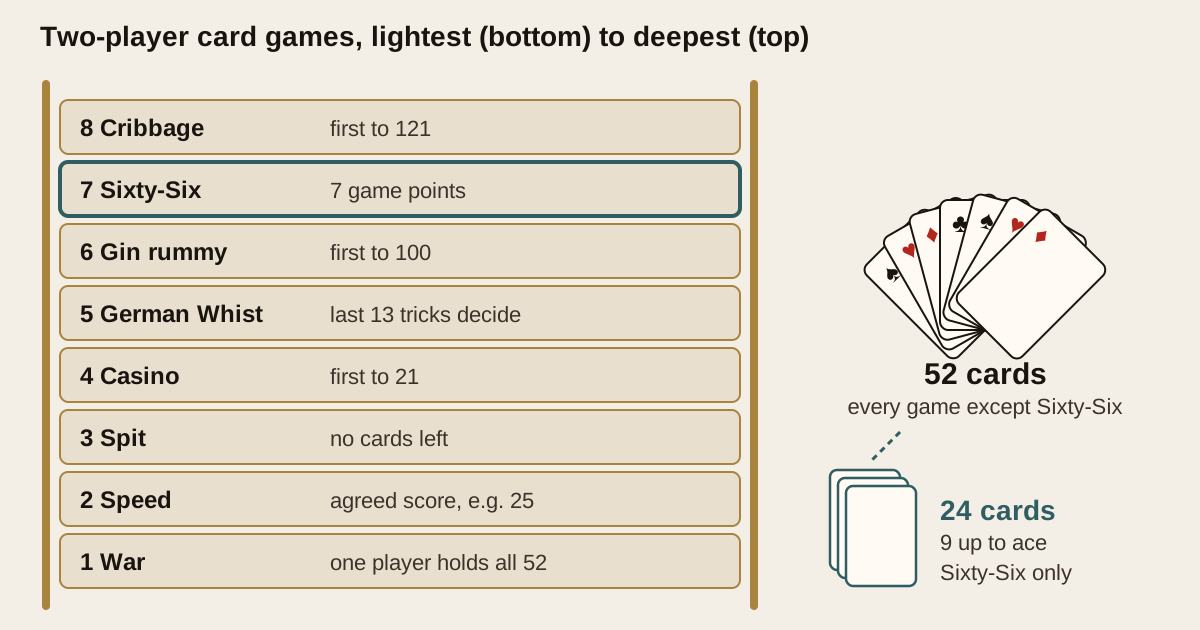
One shuffled 52-card deck covers every card game for two people on this list, from War, which asks for no decisions at all, to cribbage, a race to 121 points with a choice on almost every card. Ranked from lightest to deepest by our reading of each game's rules on Pagat, they are War, Speed, Spit, Casino, German Whist, gin rummy, Sixty-Six (which uses only 24 of the cards) and cribbage.
| Rank | Game | Cards used | A game ends when | Choices per turn (our read) |
|---|---|---|---|---|
| 1 | War | 52 | One player holds every card | None |
| 2 | Speed | 52 | Someone reaches an agreed score, such as 25 | Which card, which pile, how fast |
| 3 | Spit | 52 | One player has no cards left | Speed's choices, plus five piles to manage |
| 4 | Casino | 52 | Someone reaches 21 | Capture, build or trail |
| 5 | German Whist | 52 | A hand ends after 26 tricks; the last 13 decide it | Win the face-up card or let it go |
| 6 | Gin rummy | 52 | Someone reaches 100 | Which pile, which discard, when to knock |
| 7 | Sixty-Six | 24 (9 up to ace) | Someone reaches 7 game points | Lead, meld, or close the stock |
| 8 | Cribbage | 52 | Someone reaches 121 | Crib discards, pegging, counting |
How we ranked these card games for two people
Two things set the order, both read from the rules rather than timed at a table. Length is how far away the finish line sits: one hand, a race to 21, or a race to 121. Depth is how many real choices a turn gives you and how much known information you can use when you make them. The two mostly rise together. The exception is War, which has the least depth of all but which Pagat warns can take a long time (Pagat), so it's the lightest game here, not the shortest.
1. War
How it plays. Deal the whole deck face down, 26 cards each, and both players flip their top card at once; the higher card takes both, and suits don't matter (Pagat). Equal cards start a war: each of you adds one card face down and one face up, and the higher new card wins everything on the table (Pagat). The game ends when one player has all 52 (Pagat).
Why it's first. Pagat says outright that no strategy is involved (Pagat), so its real job is teaching a young player which card beats which. Pagat also offers two ways to handle a player who runs out of cards mid-war, losing on the spot or playing on with their last card face up (Pagat); pick one before the first flip. If a game drags, stopping at a set time and counting cards is a reasonable house rule, though it isn't Pagat's.
2. Speed
How it plays. Each of you holds a hidden five-card hand with a face-down stock of 15 in front of you, and two single cards flipped together start two piles in the middle (Pagat). There are no turns: both of you play at once onto either pile with any card one rank higher or lower, refilling your hand to five from your stock as you go (Pagat). Empty your hand first and you score a point for every card your opponent still holds in hand and stock, and the first to an agreed total, such as 25, wins (Pagat).
If your opponent is left with 3 cards in hand and 7 in their stock pile when you go out, you score 3 + 7 = 10.
Why it's second. You do choose which card goes on which pile, but Speed rewards hands and eyes more than planning, and a deal lasts only as long as it takes someone to play out. Some players use a 20-card stock instead of 15 (Pagat).
3. Spit
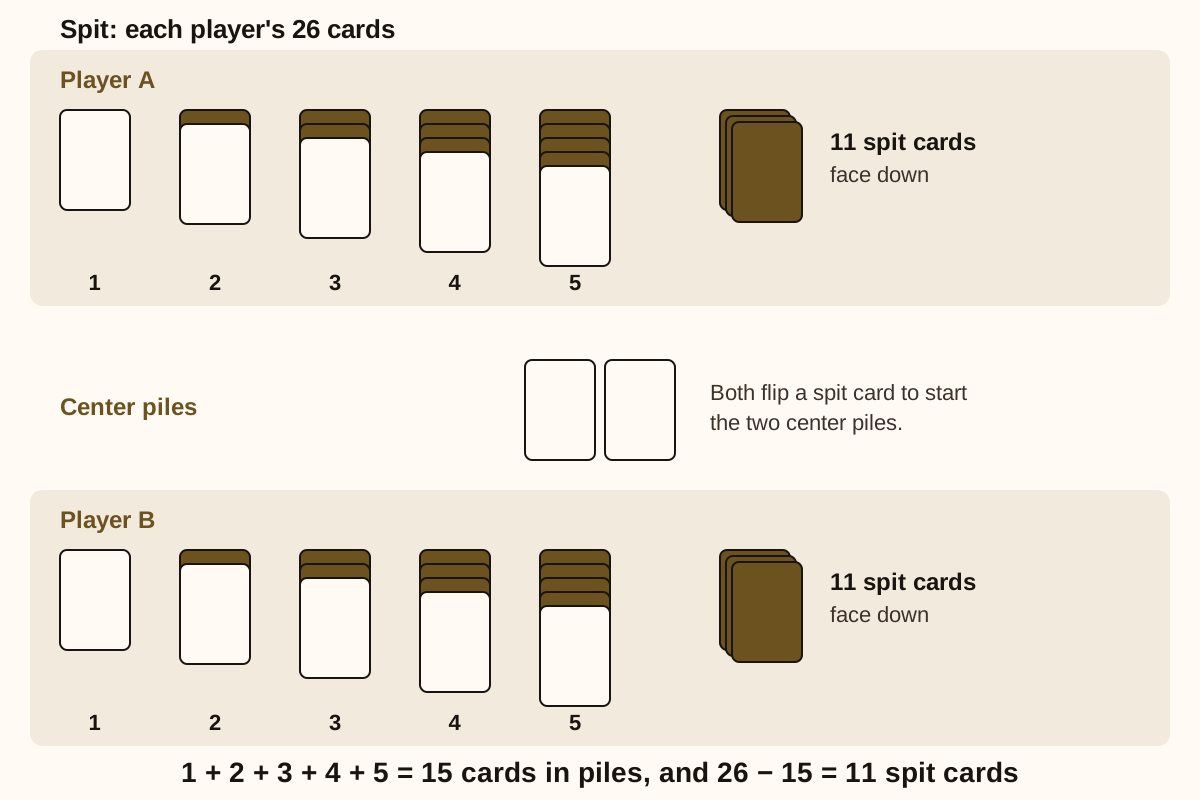
How it plays. Split the deck 26 apiece; each of you deals five stock piles of one, two, three, four and five cards with the top cards face up, and keeps the other 11 face down as spit cards (Pagat). Both shout "spit," flip a spit card each to start two center piles, then play at the same time onto either pile, one rank up or down, with suits ignored and aces and kings wrapping around (Pagat). When someone clears their layout, both slap a center pile to take, and over several deals whoever sheds every card wins (Pagat).
Layout math: 1 + 2 + 3 + 4 + 5 = 15 cards in piles, and 26 − 15 = 11 spit cards.
Why it's third. It has Speed's reflex core with more to manage: turning up stock cards, moving cards into empty spaces, and picking which center pile to slap, since the smaller one leaves you fewer cards to shed. A game spans several deals, so its length swings more than Speed's.
4. Casino
How it plays. Deal four cards each and four face up to the table, then four more each whenever hands run out, six deals in all for two players (Pagat). Each turn you play one card to capture table cards of its rank or groups that add up to it, to build a combination you'll capture later, or to trail it onto the table; picture cards capture only their own rank (Pagat). Most cards scores 3, most spades 1, each ace 1, the 10 of diamonds 2 and the 2 of spades 1; first to 21 wins (Pagat).
Why it's fourth. It's the first game here where you plan ahead, because a build is a promise: you must hold a card that can capture it (Pagat). A hand is worth 3 + 1 + 4 + 2 + 1 = 11 points, so a game takes at least two hands unless you add the sweep variant, and Pagat notes that building rules vary by group (Pagat).
5. German Whist
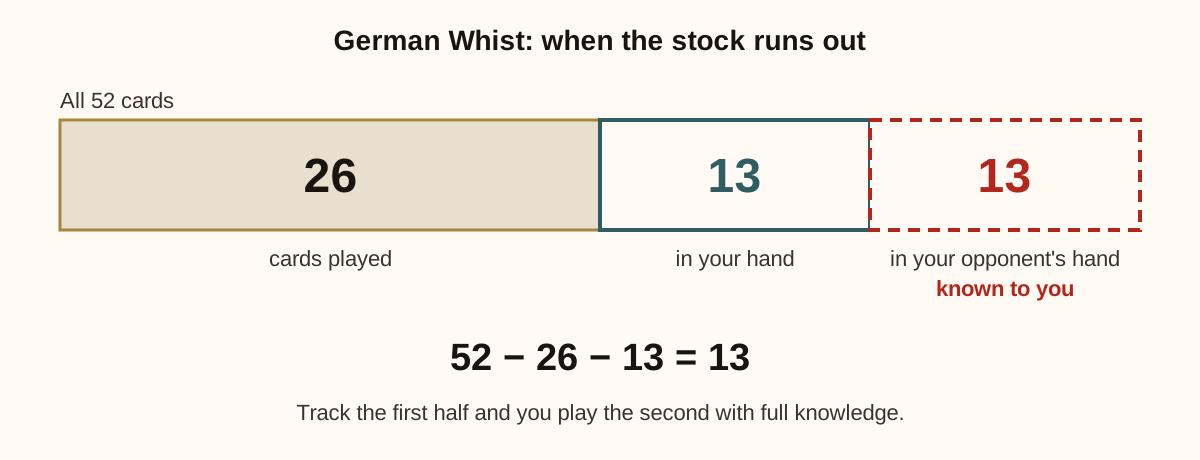
How it plays. Deal 13 cards each and turn up the top card of the stock; its suit is trump for the hand (Pagat). For the first 13 tricks, the winner of each trick takes that face-up card and the loser takes the unseen card beneath it, and these tricks don't count; once the stock is gone, you play out your hands, and whoever wins most of those last 13 tricks wins the hand (Pagat). You must follow suit if you can (Pagat).
Why it's fifth. The first half is a running decision: win the face-up card, or lose with a low card and take the mystery one? The second half is arithmetic. When the stock runs out, 26 cards have been played and 13 are in your hand, so your opponent holds exactly the rest: 52 − 26 − 13 = 13. Track the first half and you play the second with full knowledge. Pagat scores single hands, so agree how many make a match (Pagat).
6. Gin rummy
How it plays. Deal ten cards each; on your turn you take the top card of the stock or the discard pile, then discard one, building sets of one rank and runs in one suit (Pagat). You may knock when your unmatched cards, your deadwood, total 10 or less; going gin with no deadwood earns a 20-point bonus, and if your opponent finishes a knocked hand with no more deadwood than you, they score the difference plus 10 (Pagat). The first player to 100 wins (Pagat).
Why it's sixth. Each turn holds two decisions that leak information: the pile you draw from tells your opponent what you're collecting, and every discard might be the card they need. Then comes the timing call, knock now with a little deadwood or hold out for gin. Our gin rummy guide scores a knock, a gin and an undercut hand by hand.
7. Sixty-Six
How it plays. Strip the deck to the 24 cards from 9 up to ace, deal six each and turn up a trump card under the stock (Pagat). While the stock lasts, nobody must follow suit and both draw after each trick; once it's gone or closed, you must follow suit and win the trick if you can (Pagat). The first to declare 66 card points (aces 11, tens 10, kings 4, queens 3, jacks 2) takes the deal for 1 to 3 game points; 7 game points win (Pagat).
Why it's seventh. The pack holds 4 × (11 + 10 + 4 + 3 + 2) = 4 × 30 = 120 card points and the last trick adds 10, so 66 is one more than half of 130 (Pagat). Showing a king and queen of one suit when you lead scores a marriage, 20 or 40 in trumps, and closing the stock bets you'll reach 66 without another draw (Pagat). The 24 cards are the same ones a North American euchre game uses (Pagat).
8. Cribbage
How it plays. Deal six cards each; you each discard two to the crib, which scores for the dealer, and a starter card is cut and turned up (Pagat). In the play you lay cards in turn, keeping a running total that can't pass 31 and pegging points for fifteens, pairs, runs and hitting 31 exactly (Pagat). Then each hand and the crib are counted with the starter, 2 per fifteen and per pair plus runs, flushes and one for the jack of the starter's suit, and the first to 121 wins (Pagat).
Why it's last. No other game here asks for as many decisions per card. Your two crib discards shape two hands at once, and because the crib belongs to the dealer, a non-dealer is discarding into the opponent's score. The play is tactical card by card, the counting is real arithmetic, and the finish line is the farthest on the list; Pagat keeps the score on a cribbage board with two pegs each (Pagat). Our cribbage guide counts five hands step by step.
Quick answers for two-player card nights
What's the easiest card game for two people? War, because it has no decisions to make (Pagat). For a first game where choices matter, Casino teaches capturing and simple adding over a couple of hands.
Which two-player card game has the most strategy? By our read, cribbage and Sixty-Six, with German Whist close behind for anyone willing to track every card played.
Can you play euchre with two people? Not by Pagat's rules. Its euchre page covers the four-player partnership game and points to an outside site for a two-player version (Pagat). Pagat's two-player index explains the snag: when each player can work out that the other holds exactly the cards they don't, trick play can go flat, and the simplest fix is leaving some cards out of play (Pagat). Sixty-Six and German Whist both keep a stock in reserve during the early tricks. For the four-handed game, see our euchre guide.
What's a good card game for a couple? For conversation, a turn-based game such as Casino or gin rummy; for noise, Speed or Spit. If you'd rather open a box than shuffle, the games in our 2-player board game rundown carry co-op, competitive and tense-but-friendly tags, and when a third or fourth player turns up, switch to our standard-deck games for bigger groups.
Sources
- War, Pagat.com: deal, battles, wars, ending, no strategy, running out mid-war
- Spit and Speed, Pagat.com: both layouts, simultaneous play, scoring, 20-card stock variant
- Casino, Pagat.com: deal, capturing, building, trailing, scoring, 21, variants
- German Whist, Pagat.com: deal, trump, two stages, following suit, single-hand scoring
- Gin Rummy, Pagat.com: deal, melds, knocking, gin and undercut bonuses, 100
- Sixty-Six, Pagat.com: 24-card pack, card values, phases, marriages, closing, game points, last-trick bonus
- Cribbage, Pagat.com: deal, crib, starter, play, counting, 121, board
- Euchre, Pagat.com: pack, North American 24-card deck, four players, off-site two-player page
- Card games for two players, Pagat.com: the problem with trick-taking for two and its fixes