
Euchre is a four-player partnership game played with just the 9s through aces, 24 cards in all: one team names a trump suit and must win at least three of the five tricks, and the first team to 10 points wins (Pagat; Bicycle). Learning how to play euchre mostly means learning one odd fact: once trump is named, the jack of trump and the other jack of the same color jump to the top of the ranking.
Everything else in the game is ordinary trick-taking. So start with the ladder.
The trump ladder: how every card's rank changes
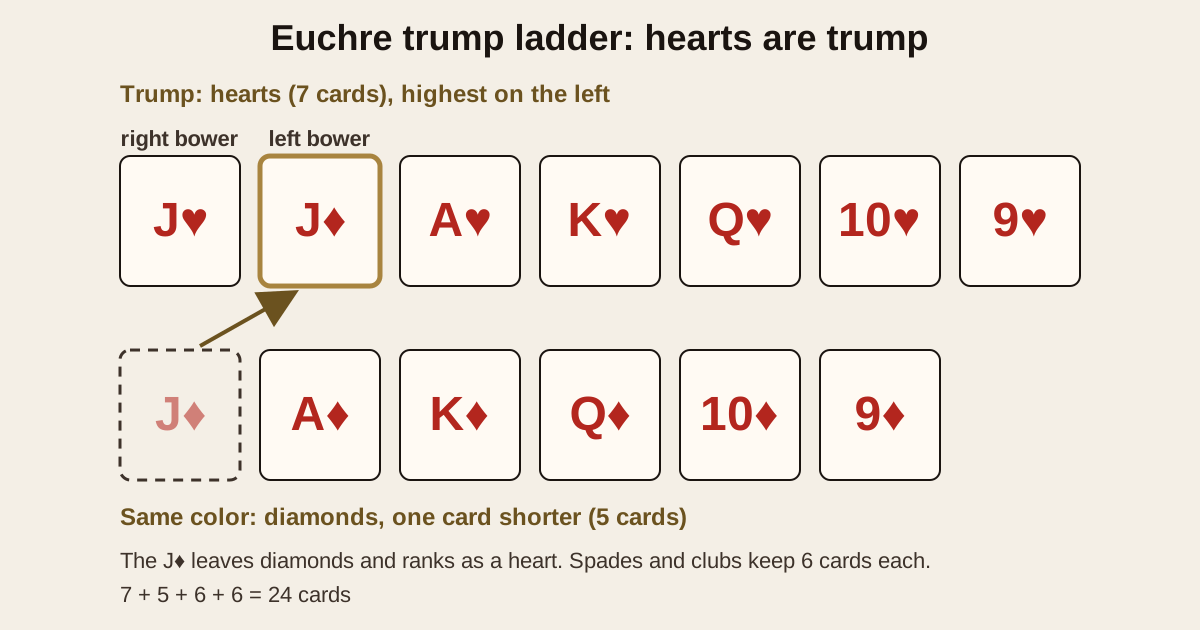
The highest trump is the jack of the trump suit, the right bower. Second is the jack of the other suit of the same color, the left bower (Bicycle). The left bower stops belonging to its printed suit: with hearts as trump, Pagat's own example is that the jack of diamonds is a heart, not a diamond (Pagat). Below the bowers, trumps run ace, king, queen, 10, 9, and the other suits rank in the normal order (Pagat; Bicycle).
Here's where all 24 cards land when hearts are trump:
| Rank | Trump: hearts (7 cards) | Same color: diamonds (5 cards) | Spades and clubs (6 cards each) |
|---|---|---|---|
| 1 (highest) | J♥, right bower | A♦ | A |
| 2 | J♦, left bower | K♦ | K |
| 3 | A♥ | Q♦ | Q |
| 4 | K♥ | 10♦ | J |
| 5 | Q♥ | 9♦ | 10 |
| 6 | 10♥ | 9 | |
| 7 | 9♥ |
Check the total: 7 + 5 + 6 + 6 = 24. Any trump beats any card from another suit, so the 9♥ beats the A♠. A plain suit's ranking only matters when that suit is led.
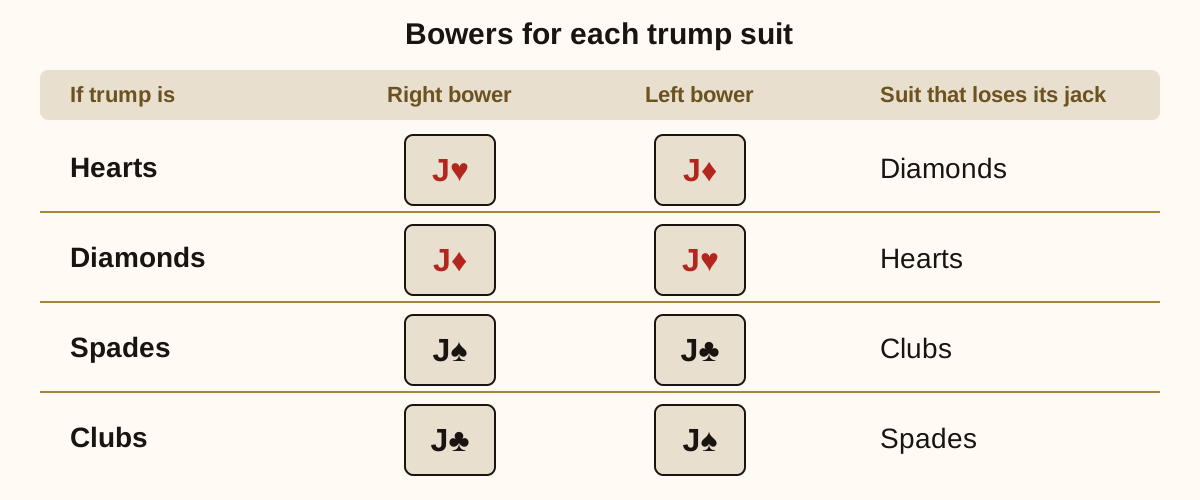
The same pattern works for every trump suit:
| If trump is | Right bower | Left bower | Suit that loses its jack |
|---|---|---|---|
| Hearts | J♥ | J♦ | Diamonds |
| Diamonds | J♦ | J♥ | Hearts |
| Spades | J♠ | J♣ | Clubs |
| Clubs | J♣ | J♠ | Spades |
How to play euchre: seats, deck and the deal
- Strip a standard deck down to the 9, 10, J, Q, K and A of each suit. North American euchre uses no joker, which leaves 24 cards (Pagat).
- Seat four players in two teams, partners opposite each other (Pagat).
- Choose a first dealer. A common North American method is dealing cards around until a black jack shows up (Pagat).
- Deal five cards to each player: a round of three at a time and then a round of two, or two then three, as long as the dealer keeps the same pattern (Bicycle).
- Set the leftover cards in the middle and turn the top one face up (Bicycle). That's 24 − 20 = 4 cards, one face up and three face down that stay out of play.
- The deal rotates one seat to the left after every hand (Bicycle).
Calling trump: two chances around the table
Round one. Starting on the dealer's left, each player either passes or accepts the turned-up card's suit as trump (Bicycle). An opponent of the dealer accepts by saying "I order it up," the dealer's partner says "I assist," and the dealer, who speaks last, can take it up (Bicycle; Pagat). Once anyone accepts, the dealer adds that card to their hand and discards one face down under the pack (Bicycle). The team that chose trump are the makers; the others are the defenders.
Round two. If all four pass, the dealer turns the card down. Going around again from the dealer's left, each player may now name any other suit as trump; the turned-down suit can't be named (Bicycle; Pagat). If everyone passes a second time, the cards are thrown in and the next player deals (Pagat).
Going alone
When you make trump, you can declare "alone" right then. Your partner lays their cards face down and sits out the hand (Bicycle; Pagat). Three tricks still win; all five earn 4 points instead of 2 (Bicycle).
Playing the five tricks
- The player on the dealer's left leads the first trick. If that player is sitting out because their partner went alone, the player across from the dealer leads instead (Bicycle).
- Follow the suit that was led if you can (Bicycle). The left bower counts as trump for this, never as its printed suit (Pagat).
- The highest trump wins the trick. With no trump in it, the highest card of the suit led wins (Bicycle).
- Whoever wins a trick leads the next one (Pagat).
Scoring: first team to 10
| What happens | Who scores | Points |
|---|---|---|
| Makers take 3 or 4 tricks | Makers | 1 |
| Makers take all 5 | Makers | 2 |
| Lone hand takes 3 or 4 | Makers | 1 |
| Lone hand takes all 5 | Makers | 4 |
| Makers take 2 or fewer ("euchred") | Defenders | 2 |
Points: Bicycle and Pagat. North American games run to 10 (Pagat); Bicycle lets the table agree on 5, 7 or 10 (Bicycle). For keeping score, Pagat describes two low cards laid over each other, cards the 24-card game doesn't use anyway: a 6 and a 4, two 5s, or a 2 and a 3, depending on the group (Pagat).
One hand, played trick by trick
North and South are partners against East and West. South deals, and the up-card is the K♥.
| Seat | Five cards dealt |
|---|---|
| West (dealer's left) | J♦ A♦ K♦ 9♠ 10♣ |
| North (dealer's partner) | A♠ K♠ 9♥ Q♣ 10♦ |
| East | A♥ 10♥ Q♠ J♠ K♣ |
| South (dealer) | J♥ Q♥ A♣ 10♠ 9♦ |
The bidding. West passes; the only card that would be trump in that hand is the J♦, as left bower. North and East pass too. South takes it up: the J♥, Q♥ and the K♥ make three trumps. South discards the 9♦, which leaves no diamonds in that hand. Hearts are trump, and North-South are the makers.
| Trick | Leads | West | North | East | South | Won by |
|---|---|---|---|---|---|---|
| 1 | West | A♦ | 10♦ | J♠ | Q♥ | South |
| 2 | South | J♦ | 9♥ | 10♥ | J♥ | South |
| 3 | South | 10♣ | Q♣ | K♣ | A♣ | South |
| 4 | South | 9♠ | A♠ | Q♠ | 10♠ | North |
| 5 | North | K♦ | K♠ | A♥ | K♥ | East |
- West leads the A♦. North holds a diamond and has to follow with the 10♦. East has no diamonds and throws the J♠ (just a spade this hand) rather than trump a trick partner seems to be winning. South has no diamonds either and trumps with the Q♥, the only trump played, so South wins.
- South leads the J♥, the right bower. West's only "heart" is the J♦, so West must play it, and the left bower loses to the right. North follows with the 9♥, East with the 10♥.
- South leads the A♣. Every other player still has a club and must follow, so the ace wins.
- South leads the 10♠. West follows with the 9♠, East with the Q♠, and North wins with the A♠.
- North leads the K♠. East is out of spades and trumps with the A♥. South's last card is the K♥, a lower trump, and West's is the K♦. East wins.
North-South took four tricks, three or four for the makers, so they score 1 point. A fifth trick would have made it 2.
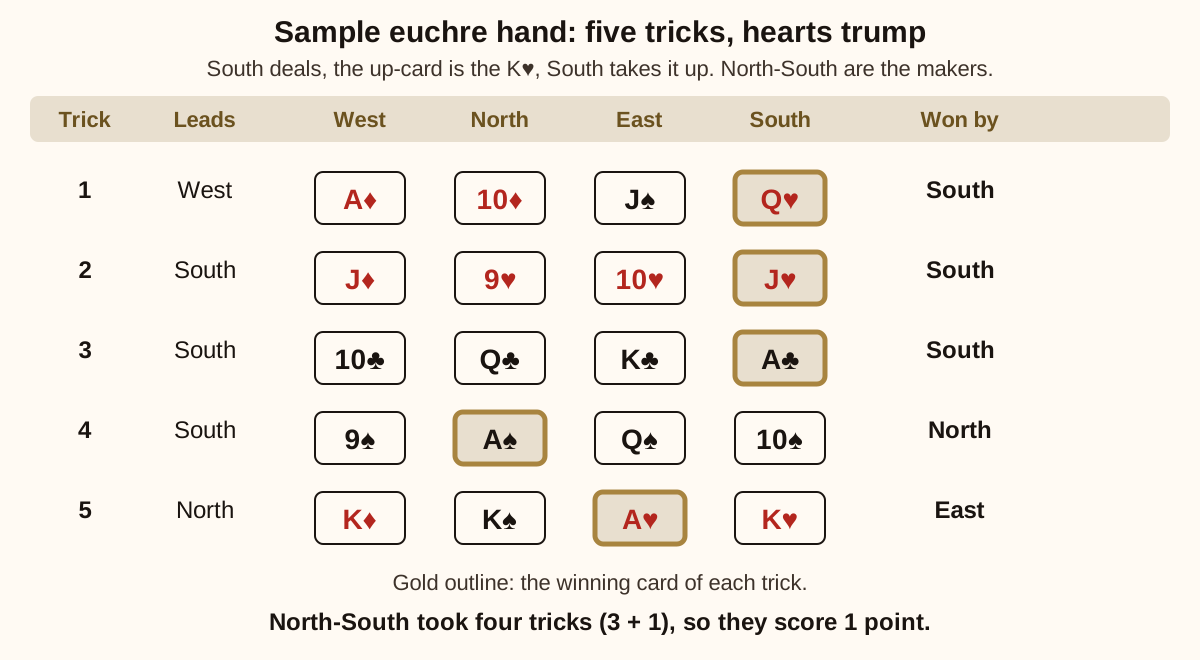
Table rules worth agreeing on
- Stick the dealer. The dealer may not pass in round two; if the first three players pass, the dealer must name a suit. Pagat notes it's often played when time is short (Pagat).
- The dealer's partner ordering up. In the USA, any player, the dealer's partner included, may order up and still play with a partner. In Australia, England and Canada, a dealer's partner who orders up must play alone (Pagat).
- Dealing style. Pagat's North American notes mention many groups dealing one card at a time rather than in twos and threes (Pagat).
- A shorter game. Play to 5 or 7 instead of 10 (Bicycle).
- The joker. Some games add one as the highest trump; it's standard in the British game Pagat describes (Bicycle; Pagat).
If your four would rather mix in something without trumps, here are more games for one standard deck.
Euchre with two or three players
Two players. Neither of the rule sources used here publishes a standard two-player game. Bicycle lists two players for euchre but gives only the four-player rules, and Pagat sends two-player readers to an outside page (Bicycle; Pagat). Rather than print rules we can't source, we'd point a pair to games designed for two: cribbage and its pegging race, gin rummy, or another pick from this roundup of two-player card games.
Three players. Pagat describes Buck Euchre, also called Cut-throat Euchre, in which everyone plays for themselves (Pagat). Each player starts at 25 and subtracts a point for every trick they win; a player who makes trump and fails adds 5, and the first to reach zero wins. For three players, Pagat gives a version that deals four hands anyway, the fourth being a face-down spare called the widow, and everyone starts at 15 instead (Pagat).
Where new players trip up
- Following suit with the left bower. With hearts trump, the J♦ can't follow a diamond lead, and it must be played to a heart lead if it's your only heart (Pagat).
- Naming the rejected suit. In round two, the turned-down suit is off the table (Bicycle).
- Forgetting the dealer's discard. Taking up the card gives the dealer six; one goes face down so the dealer plays with five (Bicycle).
- Scoring a euchre as 1. Stopping the makers is worth 2 to the defenders (Bicycle).
- Leading into an empty seat. When someone goes alone, check who actually leads before the first card hits the table (Bicycle).
Sources
- Euchre, Pagat.com (John McLeod): partnerships, card ranking and the left bower, deal, two rounds of trump-making, going alone, scoring, North American rules (24 cards, game to 10), stick the dealer, dealer's-partner rule, score-keeping with low cards
- Euchre, Bicycle Cards: bowers, deal pattern, order up and assist, dealer's discard, rejected suit, first lead, follow suit, scoring table, game length, joker variation
- Buck Euchre, Pagat.com: Cut-throat Euchre for individuals, scoring from 25, three-player widow version