
Flip 7 asks one question, over and over: flip another card, or stop? Here is how to play Flip 7: you build a face-up row of number cards and may stay at any point to bank its total; draw a number you already hold and you bust, scoring nothing for the round, but seven different numbers end the round on the spot with a 15-point bonus (Flip 7 rulebook). When a round ends with anyone at 200 or more, the highest total wins (rulebook).
The deck lets arithmetic answer it, so the math comes first.
The bust check: one subtraction, one division
Flip 7's deck holds twelve 12s, eleven 11s, ten 10s and so on down to a single 1, plus a single 0 (rulebook). Each card's value is also its number of copies, which gives you a shortcut:
Matching cards still in the deck = (sum of your number cards) − (how many non-zero number cards you hold)
Divide by the cards left in the deck to get your bust chance on the next flip.
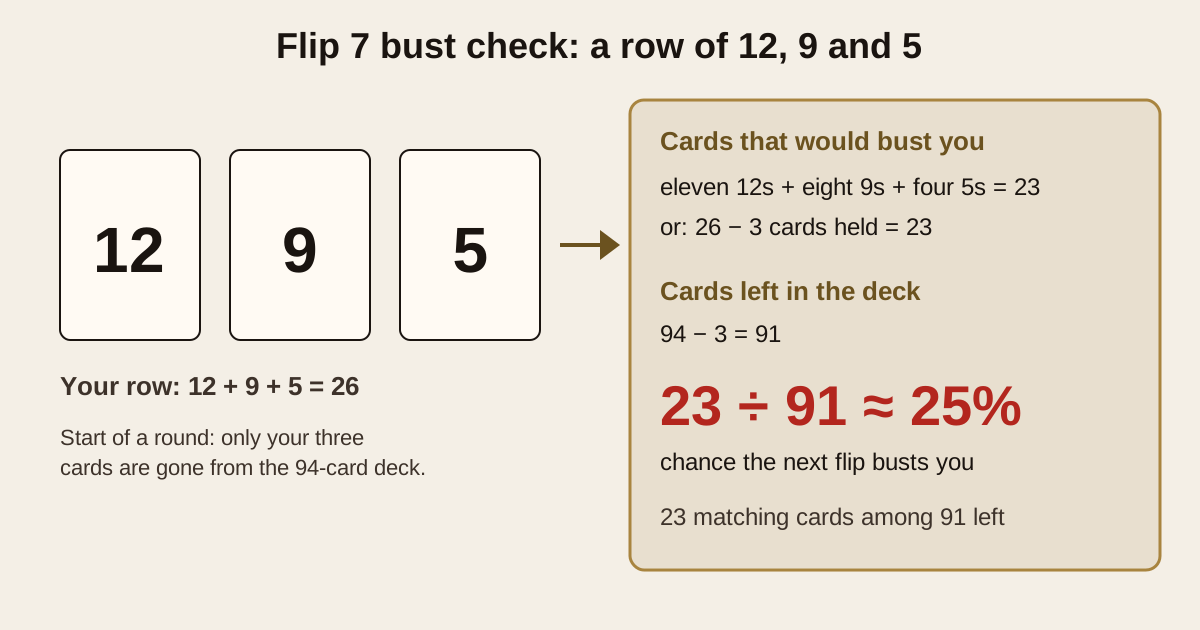
Say your row is 12, 9 and 5. That's 26 − 3 = 23 cards that would bust you (eleven 12s, eight 9s and four 5s). At the start of a round, with only your three cards gone from the 94-card deck, 91 cards remain: 23 ÷ 91 ≈ 25%.
To sharpen it, subtract copies showing in other players' rows and remember earlier rounds. The rulebook tells players to keep the card count in mind, and finished rounds' cards are set aside, not shuffled back, until the deck runs out (rulebook).
Bust odds at every row length
This is the chance your next flip busts you, for the safest and riskiest rows of each length, plus the average across a computer simulation of 1,000,000 shuffled solo deals. Assumptions: a fresh deck at the start of the round, only your own cards known to be gone, and Second Chance ignored; the simulation treated action and modifier cards as harmless blanks.
| Number cards in your row | Safest row | Bust chance | Riskiest row | Bust chance | Simulated average |
|---|---|---|---|---|---|
| 1 | 0 | 0.0% | 12 | 11.8% | 7.8% |
| 2 | 0, 1 | 0.0% | 11, 12 | 22.8% | 15.6% |
| 3 | 0, 1, 2 | 1.1% | 10, 11, 12 | 33.0% | 23.2% |
| 4 | 0 to 3 | 3.3% | 9 to 12 | 42.2% | 30.7% |
| 5 | 0 to 4 | 6.7% | 8 to 12 | 50.6% | 38.0% |
| 6 | 0 to 5 | 11.4% | 7 to 12 | 58.0% | 45.2% |
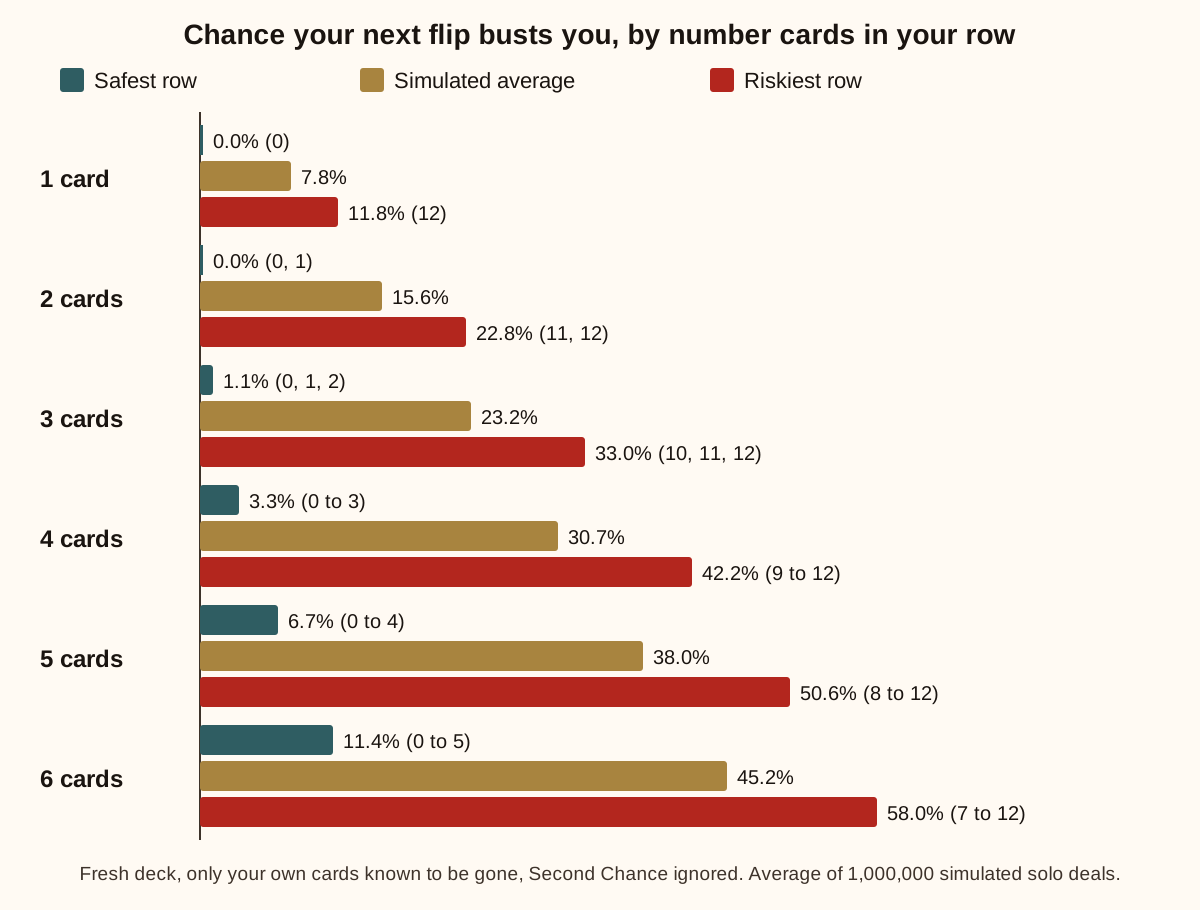
A six-card row of 0 through 5 (11.4%) is slightly safer than a lone 12 (11.8%): what you hold matters more than how many. Average risk climbs about seven to eight percentage points per card, and a player who never stays reaches the Flip 7 bonus in about 8.7% of simulated deals.
When to stop flipping: a one-flip check
A bust wipes out your whole row, while a safe card adds only its own value, so weigh both sides. The test: flip only if the total value of the safe number cards left beats (bust cards × your current score). Divide each side by the cards left and you get expected gain and expected loss.
For the 12-9-5 row (26 points) at the start of a round:
- All the number cards together are worth 650, because each value appears that many times: 1×1 + 2×2 + … + 12×12 = 650. Take out your 26 and 76 number cards worth 624 remain.
- The 23 bust cards are worth 11×12 + 8×9 + 4×5 = 132 + 72 + 20 = 224.
- That leaves 76 − 23 = 53 safe number cards worth 624 − 224 = 400.
- Compare 400 with 23 × 26 = 598, and stay. On average the flip would gain 400 ÷ 91 ≈ 4.4 points and lose 598 ÷ 91 ≈ 6.6.
A row of 3 and 7 (10 points, 92 cards left) comes out the other way: its 8 bust cards are worth 2×3 + 6×7 = 48, so the safe cards are worth (650 − 10) − 48 = 592, far above 8 × 10 = 80. Flip.
It's a gauge, not a strategy: it ignores modifiers, action cards (a Flip Three can force you past your stopping point), the bonus and the score race.
How to play Flip 7: the deck, the deal and a turn
Flip 7 is a game by Eric Olsen from The Op (USAopoly), for 3+ players, ages 8+, in about 20 minutes (rulebook). These steps follow the current rulebook, Ruleset Edition 3.1.
| Card type | What's in the 94-card deck | Count |
|---|---|---|
| Number cards | Twelve 12s, eleven 11s and so on down to one 1, plus one 0 | 79 |
| Action cards | Freeze, Flip Three, Second Chance (three of each) | 9 |
| Modifier cards | +2, +4, +6, +8, +10 and x2 (one of each) | 6 |
That's 1 + 2 + … + 12 = 78 number cards plus the 0, and 79 + 9 + 6 = 94. With more than 18 players, the rulebook recommends a second deck (rulebook).
- Keep a pen and paper handy, shuffle well and pick a dealer for the round (rulebook).
- The dealer gives one face-up card to each player in turn order, themselves included. If an action card appears, pause and resolve it right away, then keep dealing until everyone has been dealt a card. Some players may start the round with no cards, others with several (rulebook).
- Going around, the dealer asks each active player to hit (take another face-up card) or stay (leave the round and bank your points). You may stay only if at least one card is in front of you (rulebook).
- Keep number cards in one row, with modifiers and action cards above it (rulebook).
- A duplicate number busts you: you're out of the round and score nothing from it. Once you've busted or stayed, turn your cards face down so everyone can see you're out (rulebook).
An active player is anyone who hasn't busted or stayed (rulebook).
The three action cards
Whoever is dealt an action card picks its target: any active player, themselves included (Flip 7 FAQ). If you're the only active player left, it has to be you (rulebook).
- Freeze: the target banks their points and is out of the round.
- Flip Three: the target takes the next three cards one at a time, stopping early on a bust or a seventh different number. Every card type counts toward the three. A Second Chance that turns up can be set aside and used; a Freeze or another Flip Three waits until all three cards are out, and applies only if the player hasn't busted (rulebook).
- Second Chance: keep it; a later duplicate gets discarded along with the Second Chance instead of busting you. You can hold only one (pass an extra to another active player, or discard it if nobody can take it), and unused ones are discarded at round's end (rulebook). It won't stop a Freeze, and using it doesn't earn another card that turn (FAQ).
Modifiers and the x2
A +2 through +10 card adds its value to your number total. The x2 doubles your number cards' sum, before any plus cards are added (rulebook). Modifiers can't bust you and don't count toward seven; a plus card alone still scores if you stay, but an x2 alone scores nothing (rulebook).
Ending and scoring a round
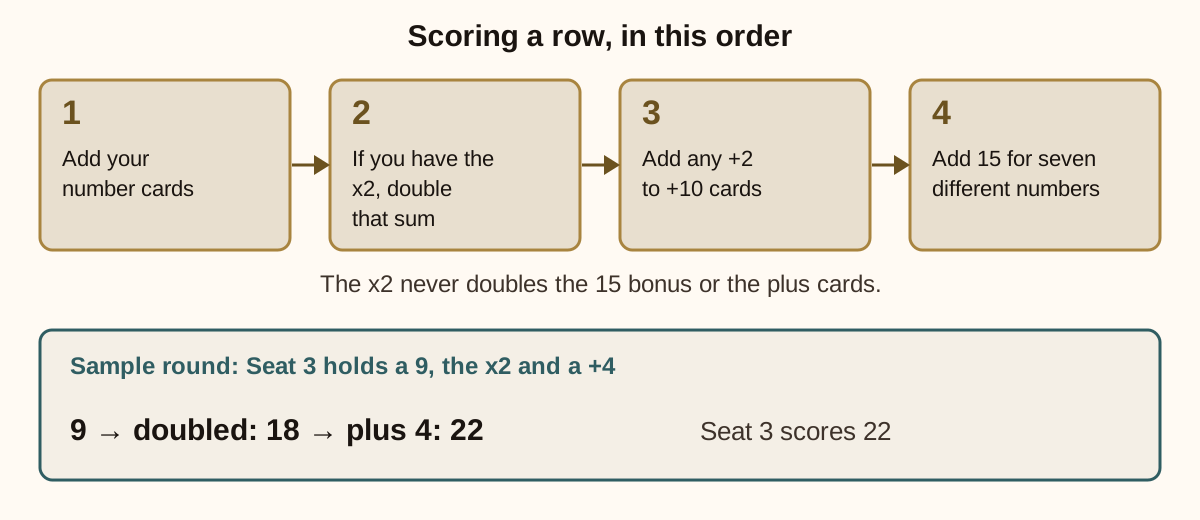
A round ends when nobody is active, or the instant someone has seven different number cards (rulebook). Score each row in this order (rulebook; FAQ):
- Add up your number cards.
- If you have the x2, double that sum.
- Add any +2 to +10 cards.
- Add 15 for seven different numbers. The x2 never doubles this bonus or the plus cards.
Then set the round's cards aside without shuffling them in and pass the rest of the deck to the left; that player deals next. When the deck runs out, shuffle the set-aside cards into a new deck, leaving everyone's cards in place if it happens mid-round (rulebook).
A sample round, flip by flip
Three players; Seat 3 deals.
- Opening deal. Seat 1 gets an 11, Seat 2 a 4, and Seat 3 the +4, which counts as a card, so Seat 3 could stay at once for 4 points.
- First pass. Seat 1 hits: a 6 (row worth 17). Seat 2 hits, draws Flip Three and aims it at Seat 1, who flips a 2, a 12, then a second 6: bust, zero for the round. Seat 3 hits: a 9.
- Second pass. Seat 2 hits: a 10. Seat 3 hits: the x2.
- Third pass. Seat 2 hits: a 7 (row 4, 10, 7, worth 21). Seat 3 stays: 9 doubled is 18, plus 4 makes 22.
- Fourth pass. Seat 2 is the only active player. Matching cards: 21 − 3 = 18, none visible elsewhere, among the 94 − 12 = 82 cards left, so about 22%. The one-flip check narrowly says go: the 67 points of number cards already dealt leave 650 − 67 = 583 in the deck, 144 of them in bust cards (three 4s, six 7s, nine 10s), and 583 − 144 = 439 beats 18 × 21 = 378. Seat 2 flips an 8 (row worth 29).
- Fifth pass. Now 29 − 4 = 25 matching cards sit among 81, about 31%. The deck's number cards are worth 583 − 8 = 575, with 200 of that in bust cards (three 4s, six 7s, seven 8s, nine 10s), and 575 − 200 = 375 falls well short of 25 × 29 = 725. Seat 2 stays, nobody is active, and the round ends.
Round scores: Seat 1, 0; Seat 2, 29; Seat 3, 22.
Score sheet: a grid you can copy
The publisher has a printable Flip 7 score sheet (PDF) with a row for player initials, and its Flip 7 resources page links a scoring web app. Or copy this grid and write each player's running total after every round (first row: the sample round).
| Round | Player 1 | Player 2 | Player 3 | Player 4 | Player 5 | Player 6 |
|---|---|---|---|---|---|---|
| Example | 0 | 29 | 22 | |||
| 1 | ||||||
| 2 | ||||||
| 3 | ||||||
| 4 | ||||||
| 5 | ||||||
| 6 | ||||||
| 7 | ||||||
| 8 | ||||||
| 9 | ||||||
| 10 |
Add rows as needed; there's no fixed number of rounds. Since a second deck stretches Flip 7 past 18 players, it can handle a crowd; for more big-group options, see these games for a full Thanksgiving table.
Flip 7: With a Vengeance, briefly
With a Vengeance is a separate 108-card deck from the same publisher: still 3+ players, ages 8+ and 20 minutes, still a race to 200 with the same bust rule and 15-point bonus (With a Vengeance rules). What changes (rules):
- 13s join the ladder, plus three special number cards: The Zero, Unlucky 7 and Lucky 13.
- Modifiers subtract (−2 to −10), a ÷2 halves your number total (rounded down), and a round score can't fall below zero.
- Actions become take-that cards: Just One More, Swap, Steal, Discard and Flip Four.
- Staying doesn't make you safe: you turn a card sideways, and actions can still reach you until the round ends. One Swap can even bust two players (With a Vengeance FAQ).
- An optional Brutal Mode allows negative scores and lets a Flip 7 player subtract 15 from someone else instead of taking 15.
Three easy misreads
- Counting non-numbers toward seven. Only seven different number cards earn the 15 (rulebook).
- Shuffling used cards back in. They stay set aside until the deck runs out (rulebook), which is what makes counting pay off.
- Staying with an empty spot. Gave away the action card from your opening deal? With no card in front of you, you can't stay yet (rulebook).
Rulings people look up mid-game
Can you stay right after the opening deal? Yes, as long as a card is in front of you, even a lone modifier (rulebook).
What if players tie at the top after someone passes 200? Everyone keeps playing extra rounds until there's a single winner (FAQ).
Can two people play Flip 7? The rulebook lists 3+ players. For a party of two or fewer, it offers a challenge instead: count how many rounds it takes to reach 200 (rulebook). For a real head-to-head game, try these card games built for two players. And if Uno is your family's other go-to deck, our guide to Uno's official rules versus house rules covers the stacking question.
Sources
- Flip 7 rulebook, Ruleset Edition 3.1 (PDF), The Op: all core rules, deck, box details, designer
- Flip 7 FAQs, The Op: official rulings
- Flip 7 resources page, The Op: score sheet and app links
- Flip 7 score sheet (PDF), The Op
- Flip 7: With a Vengeance rulebook (PDF), The Op
- Flip 7: With a Vengeance FAQs, The Op