
Thanksgiving 2026 falls on Thursday, November 26 (OPM federal holidays), and the best games to play at Thanksgiving seat a big, mixed-age crowd and survive a pie break. Wits & Wagers in teams, Herd Mentality, Flip 7 and Hues and Cues all handle a crowd, while Twenty Questions and charades need nothing but the people already at the table.
What Thanksgiving asks of a game
This list is planned around a typical holiday house, not an ideal game night:
- A big group. Somewhere between 8 and 15 people, often split between the main table and a kids' table.
- A wide age range. Guests from about 6 to 80, so reading speed, eyesight and patience all vary.
- A late, full-stomach start. After dinner, attention is short and nobody wants a long rules lecture.
- Interruptions. Pie, coffee, a game on TV, someone leaving early. A good pick has clean places to stop.
- Uncertain equipment. Maybe someone brought a deck of cards. Maybe there's nothing but a pen.
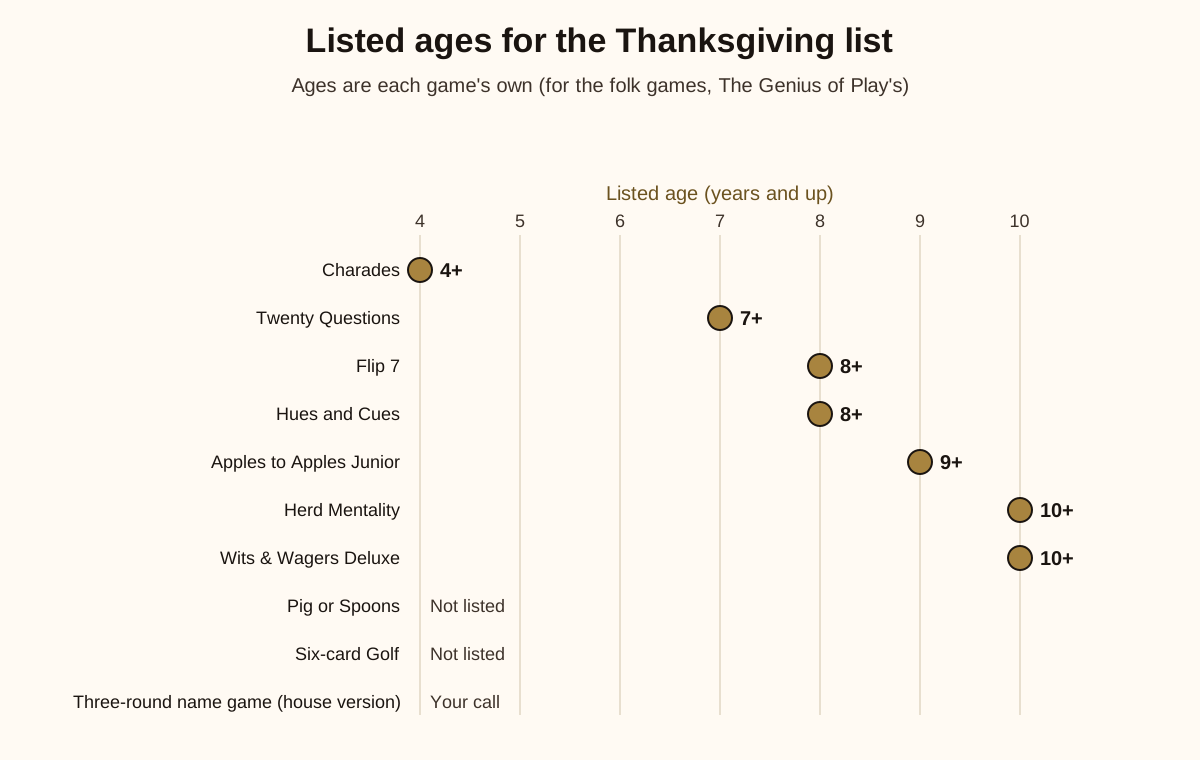
The ages and counts in the table are each game's own (for the folk games, The Genius of Play's); the advice about fitting them into the day is ours, reasoned from the rules.
Games to play at Thanksgiving: the short list
| Game | Players | Age | Time | What you need | Clean stopping point |
|---|---|---|---|---|---|
| Twenty Questions | 2-10 | 7+ | Open-ended | Nothing | After any round |
| Charades | Two teams | 4+ | 30-60 second turns for older kids | Slips, pencils, a bowl | After any turn |
| Three-round name game (house version) | Two teams | Your call | Open-ended | Slips, pens, a timer | After any round |
| Pig or Spoons | Up to 13 per deck | Not listed | Short deals | One standard deck (plus spoons) | Between deals |
| Six-card Golf | 2-4 per deck; 2nd deck past 4, 3rd past 8 | Not listed | Nine holes | Standard decks | Between holes |
| Flip 7 | 3+; 2nd deck past 18 | 8+ | 20 min | The Flip 7 deck, pen and paper | Between rounds |
| Herd Mentality | 4-20 | 10+ | 20 min | The box | Between questions |
| Wits & Wagers Deluxe | 3-7, or up to 7 teams of 1-3 | 10+ | 25 min | The box | Between questions |
| Hues and Cues | 3-10 | 8+ | 30 min | The box | After each clue-giver's turn |
| Apples to Apples Junior | 4-10 | 9+ | Not listed | The box | Between rounds |
No equipment: games for the table as it is
Twenty Questions
Twenty Questions is the one game you can start before the plates are cleared. As The Genius of Play lays it out, one player is "it" and secretly picks a person, place or thing. Everyone else asks questions that can be answered yes or no, rephrasing any that can't, and one person keeps count. The round ends at 20 questions or a correct guess, and whoever guesses right becomes the next "it."
The guide lists it for 2 to 10 players, ages 7 and up. With more people than that, split the table and run two games, one at each end. It also flips nicely for young kids: let the youngest guest hold the secret while the grown-ups ask, since the person who knows the answer only has to say yes or no.
Charades
Charades needs a little more than nothing: slips of paper, pencils and a bowl, in The Genius of Play's version. Write simple words or short phrases on the slips, fold them into the bowl and split into teams. The actor draws a slip and acts it out with gestures and facial expressions, never a word, while their team calls out guesses until someone gets it or time runs out.
The guide suggests 30 to 60 seconds a turn for older kids, with more slack for little ones, and a point per correct guess. Its listed age of 4 and up makes it the most forgiving game here for the youngest guests, and anyone who doesn't want to perform can sit on a team as a full-time guesser.
Pen and paper: the three-round name game
Monikers, a boxed party game rated 17 and up, uses one stack of cards for three rounds that get stricter as you go: talk freely, then say just one word, then act it out without speaking (CMYK). Paper slips can stand in for the cards. Here is the simple house version we suggest; it's our adaptation, not an official ruleset.
- Everyone writes three names on separate slips: people, characters or things the whole family would recognize. Fold them into a bowl.
- Split into two teams.
- On your turn, you have one minute to get your team to guess as many slips as you can. Guessed slips come out; skipped ones go back in.
- Round one: say anything but the name. Round two: one word only. Round three: act it out, no words.
- Each round ends when the bowl is empty. Teams count their slips, everything goes back in, and the next round starts.
Because the same names come back every round, the last round is easier than it sounds: by then everyone knows the answers and only has to recognize them. Late arrivals can join a team at the start of any round.
One deck of cards
Pig, or Spoons if you have the cutlery
Pig is built for a crowd: per Pagat, up to 13 people can play with one standard deck. You use four cards of one rank for each player, so 10 players need 4 × 10 = 40 cards, ten ranks. Everyone passes one card at a time to the left while picking up from the right, hunting for four of a kind. Whoever gets there quietly touches their nose, everyone else copies as soon as they notice, and the last nose loses the deal.
The Spoons version puts one fewer spoon than there are players in the middle, and whoever comes up empty-handed loses. Each loss earns a letter of the game's name, and spelling it out knocks you out. Our house suggestion for a family table: skip the knockouts and just tally letters, so nobody spends dessert sitting out. For more standard-deck games that seat a crowd, see card games for three or more players.
Six-card Golf
Golf suits the relatives who want a real card game while the kids run charades in the next room. In six-card Golf as Pagat describes it, each player lays out six face-down cards in two rows of three, turns two face up, and spends the hand swapping in better cards from the stock or the discard pile. Kings count 0, aces 1, and a matching pair in a column scores 0; the hole ends as soon as one player's last card is face up.
The lowest total after nine holes wins, which gives you nine natural places to stop for pie. One deck covers two to four players, a second goes in with more than four, and a third with more than eight. If nobody remembers the finer points, our golf card game rules cover the four-, six- and nine-card versions.
Boxed games that seat a crowd
Flip 7
Flip 7 might be the easiest boxed game to teach a room of relatives. On your turn you take another card or stop, and a second copy of any number you already hold busts you for the round, unless you're holding a Second Chance card. The rules list 3 or more players, ages 8 and up and about 20 minutes, and only suggest a second deck once you pass 18 people, so one box can cover the whole house.
Collect seven different numbers and you score a 15-point bonus and end the round; the game ends after the round in which someone reaches 200 points. Scores live on pen and paper between rounds, so a pie break costs nothing. Eric Olsen designed it, and our Flip 7 guide has the full rules plus the odds of busting at each hand size.
Herd Mentality
Herd Mentality flips the usual party-game goal: you want the most ordinary answer, not the cleverest. Per Big Potato, one player reads a question, everyone secretly writes an answer, and everyone whose answer matches the majority wins a cow token. If you're the odd one out, you get the Pink Cow, and you can't win while you hold it. First to eight cows wins.
The publisher lists 4 to 20 players, ages 10 and up, about 20 minutes, which makes it one of the few boxed games that can take nearly the whole crowd at once. Grandparents and teenagers start on equal footing, because the only skill is guessing what everyone else will say.
Wits & Wagers Deluxe
Wits & Wagers is a trivia game for people who don't know the answers, and its own rulebook recommends it for holiday parties and family reunions. Someone reads a question with a numerical answer, every player or team writes a guess within 30 seconds, and the guesses go on the mat in order. Then you place your two wager chips on the guess you think is closest without going over, which may well be someone else's.
That's the charm for a family: knowing which cousin actually follows baseball is a real strategy. For a large group, the rules suggest up to seven teams of one to three players, so a child can team up with a grandparent and both have a job. A game is seven questions. North Star's game page lists 3 to 7 players, ages 10 and up, about 25 minutes, and Dominic Crapuchettes designed it.
Hues and Cues
Hues and Cues needs almost no reading and no general knowledge. Per its rules, the cue giver secretly picks a color from a card and gives a one-word clue, though not a common color name, not a spot on the board and not anything in the room. Everyone places a marker on the shade they think it is, then a two-word clue allows a second marker.
A scoring frame awards 3 points for the exact square, 2 inside the frame and 1 just outside it, and the cue giver earns a point for every marker inside the frame. The rules list 3 to 10 players, ages 8 and up, about 30 minutes, and offer a variant for younger players, who may describe any color on the board instead of one from a card. With seven or more players, each person gives clues once, so a full table finishes in a single loop. Scott Brady designed it.
Apples to Apples Junior
Apples to Apples Junior bridges the kids' table and the grown-ups'. Mattel rates it 9 and up and fits 4 to 10 players on its instruction sheet, and everyone gets a turn as judge, so a 9-year-old gets to rule on Grandpa's card too.
Lobbying is allowed, but the judge's ruling stands, which settles arguments before the pie gets cold. Since every red card adds a fact or a joke beneath its title, seat a confident reader near the youngest players. For more games built on the judge idea, sorted from kid-safe to adults-only, see our Apples to Apples alternatives.
The pie break: where each game stops
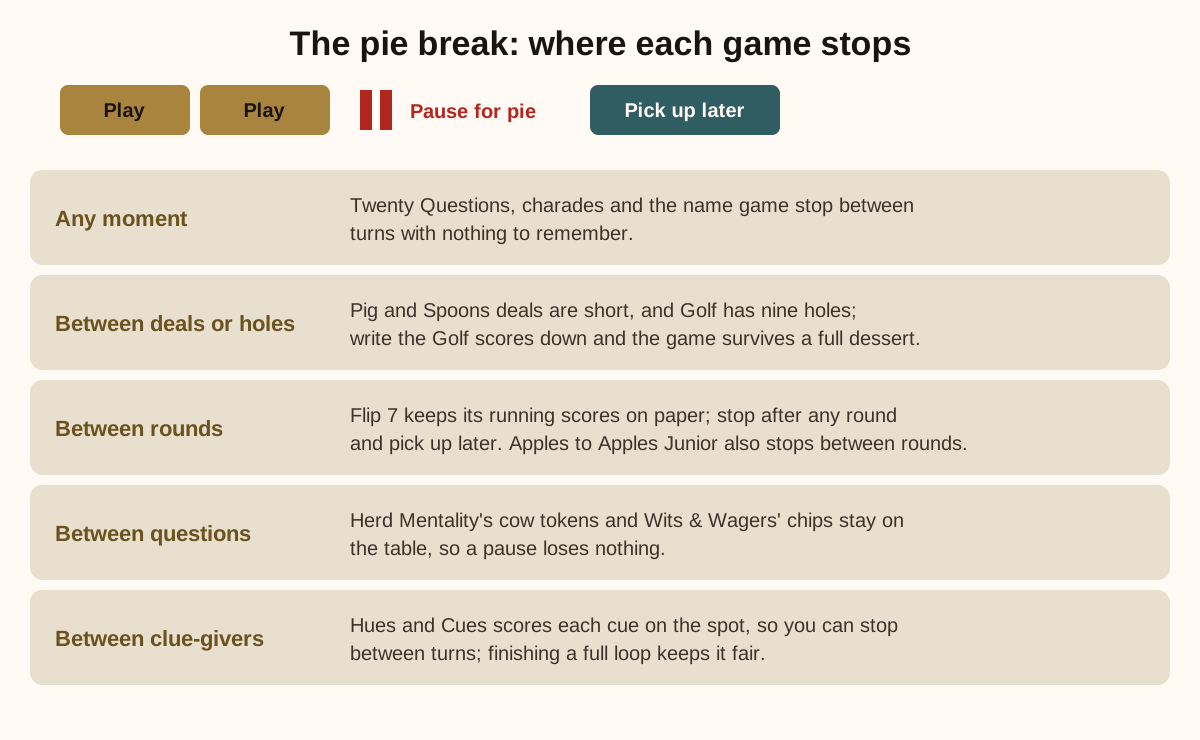
Plan your evening around these stopping points, all taken from the rules above:
- Any moment: Twenty Questions, charades and the name game stop between turns with nothing to remember.
- Between deals or holes: Pig and Spoons deals are short, and Golf has nine holes; write the Golf scores down and the game survives a full dessert.
- Between rounds: Flip 7 keeps its running scores on paper, so you can stop after any round and pick up later.
- Between questions: Herd Mentality's cow tokens and Wits & Wagers' chips stay on the table, so a pause loses nothing.
- Between clue-givers: Hues and Cues scores each cue on the spot, so you can stop between turns; finishing a full loop keeps it fair, since the rules count the game in loops (one with seven or more players, two with four to six).
Thanksgiving game questions
When is Thanksgiving in 2026? Thursday, November 26, per the Office of Personnel Management's federal holiday list.
What can you play at the dinner table without clearing it? Twenty Questions needs nothing at all. Pig needs one deck and a little elbow room for passing cards.
What works for kids and grandparents together? Charades (4 and up) and Twenty Questions (7 and up) have the lowest listed ages. Among boxed games, Hues and Cues (8+) has a variant for younger players, and Wits & Wagers lets you mix ages within a team.
Sources
- Federal holidays, including Thanksgiving 2026 (U.S. Office of Personnel Management)
- 20 Questions play guide (The Genius of Play)
- Charades play guide (The Genius of Play)
- Monikers game page, three-round format (CMYK)
- Pig and Spoons (Pagat)
- Golf card game (Pagat)
- Flip 7 rules (The Op)
- Herd Mentality game page (Big Potato)
- Wits & Wagers Deluxe rulebook (North Star Games)
- Wits & Wagers Deluxe game page (North Star Games)
- Hues and Cues rules (The Op)
- Mattel's instruction sheet for Apples to Apples Junior