
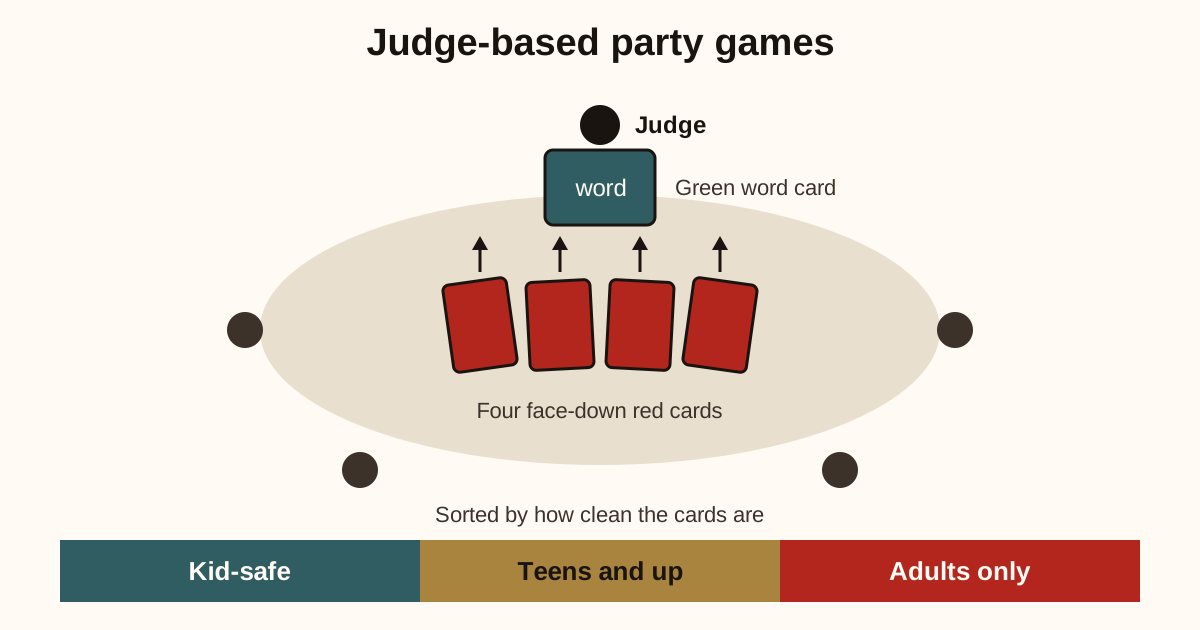
The closest games like Apples to Apples keep its rotating judge and change what's on the cards: Apples to Apples Junior and What Do You Meme? Family Edition for kids, Snake Oil for teens who like to perform, and Funemployed or the original What Do You Meme? for adults only. Eight picks are sorted below by how clean their cards are, after a quick look at why the judge round works so well.
Ages, player counts and rules come from each publisher's instruction sheet or game page, linked as we go. Where we say a game suits a certain crowd, that's our reasoning from what the rules ask of players, not a play report.
How a judge round works (and why it keeps working)
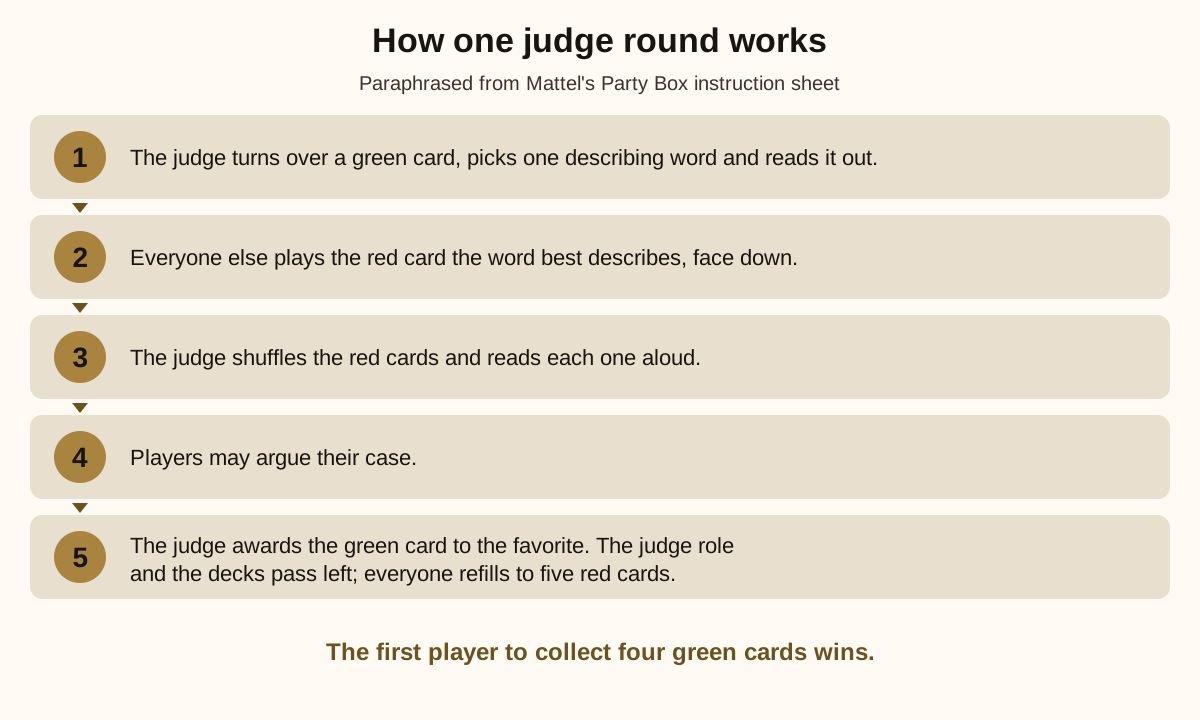
Here's one round of the standard game, paraphrased from Mattel's Party Box instruction sheet:
- The judge turns over a green card, which holds describing words, picks one word and reads it out.
- Everyone else chooses the red card from their hand that the word best describes. Red cards name a person, place, thing or event. Cards go face down.
- The judge shuffles the red cards and reads each one aloud.
- Players may argue their case. The sheet treats this table talk as one of the best parts of the game.
- The judge awards the green card to whoever played the favorite. The judge role and the decks pass left, and everyone refills to five red cards.
The first player to collect four green cards wins. One small rule matters more than it looks: red cards that start with "My" are read from the judge's point of view, so they always describe the judge's life, not the player's.
Why does such a simple loop last? Four reasons, all visible in the rules:
- There's no right answer, only an audience. You're playing to one person's taste, and that person changes every round, so you spend the game learning how your friends think.
- The shuffle hides who played what. Nobody has to own a dud unless they choose to argue for it.
- Everyone gets the spotlight. Rotation means even the quietest player spends a round in charge.
- The deck sets the tone. Players can only play what they hold, so the cards decide how clean or wild the night gets. That's why the list below is sorted by content.
Games like Apples to Apples, compared
| Game | Players | Time | Age | Content | Why it's here |
|---|---|---|---|---|---|
| Apples to Apples Junior | 4-10 | Not listed | 9+ | Kid-safe | The same loop with kid-sized words |
| What Do You Meme? Family Edition | 3-20+ | 30-90 min | 8+ | Kid-safe | Photo plus caption, rotating judge |
| Cards Against Humanity: Family Edition | Not listed | Not listed | 8+ | Kid-safe | The CAH idea rewritten for families |
| Dixit | 3-8 | 30 min | 8+ | Kid-safe | A storyteller instead of a judge |
| Apples to Apples Party Box | 4-8 (support page: 4-10) | Not listed | 12+ | Teens and up | The original |
| Snake Oil | 3-10* | 20-30 min* | 8+* | Clean, but you perform | Pitch a product to a rotating customer |
| Funemployed | 3+ | Not listed | 18+ | Adults only | Job interviews with absurd qualifications |
| What Do You Meme? (original) | Not listed | Not listed | 17+ | Adults only | Same loop, mature captions |
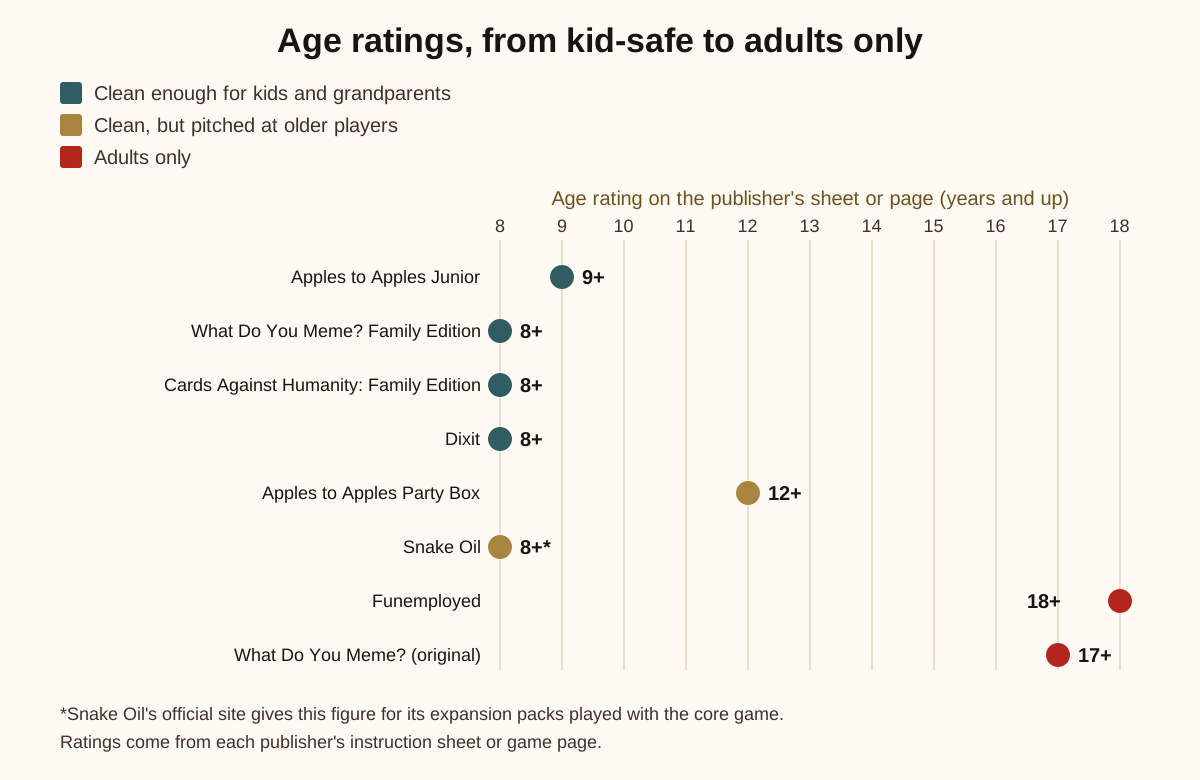
*Snake Oil's official site gives these figures for its expansion packs played with the core game; its core-game listing doesn't state them.
Clean enough for kids and grandparents
Apples to Apples Junior
Junior keeps the original's judge loop and tunes the cards for younger players. The Mattel instruction sheet lists ages 9 and up for 4 to 10 players, with 432 red cards and 144 green ones. Two small touches help children. Each red card carries an interesting fact or a bit of silliness under its title, and each green word comes with words of similar meaning underneath, so a player who doesn't know a word still has a way in.
Players hold five red cards. The sheet says it's fine to try to convince the judge, but once the judge picks, the decision is final. That last line is worth reading aloud before a family game, ideally before the first sulk.
What Do You Meme? Family Edition
This one swaps word cards for a photo and a caption. In the family instructions, the judge picks a photo card and stands it on an easel, everyone else passes one of their seven caption cards face down, and the judge reads them all aloud and keeps the funniest. The youngest player judges first, which is a kind rule for a mixed table.
Scoring scales with the crowd: three players race to seven photo cards, four or five players to five, and six to ten players to four. You may trade a photo card you've already won for a fresh hand of seven, which rescues anyone stuck with flat captions, and the rules encourage adding photos of your own. The sheet lists 3 to 20+ players, ages 8 and up, and 30 to 90 minutes.
Cards Against Humanity: Family Edition
Looking for a family-friendly Cards Against Humanity? This is the company's own answer. Its Family Edition page describes a whole new game written from scratch for kids and adults to play together, with 600 cards, appropriate for ages 8 and up. The company's home page describes its basic format as a close cousin of Apples to Apples: one player asks a question from a black card, and everyone else answers with their funniest white card.
Expect toilet humor rather than anything adult; the page's own description mentions toilets in its first breath. It doesn't list a player count, so treat it like any judge game, where more players means more answers for the judge to choose from.
Dixit
Dixit suits a family that loves Apples to Apples but winces when one person's taste decides everything. Per Libellud's rules, the rotating role is a storyteller, not a judge. The storyteller picks one of the dreamlike picture cards in their hand and gives a clue, which may be a word, a sentence, or even something sung or mimed. Everyone else slips in a card that fits the clue, and the whole table votes on which card was the storyteller's.
The scoring is the clever part. If everybody finds the storyteller's card, or nobody does, the storyteller scores nothing and everyone else scores 2, so the storyteller has to aim for a clue that only some players will get. The cards are illustrations, so there's very little to read. Libellud's game page lists 3 to 8 players, ages 8 and up, about 30 minutes.
Clean, but pitched at older players
Apples to Apples Party Box
Here's a detail that's easy to miss: the standard Apples to Apples is rated for ages 12 and up on its instruction sheet. That rating puts it above the little-kid crowd, which is why Junior is the better pick for a nine-year-old. The red cards name people, places, things and events, and Mattel's tip that judges often reward the most creative or humorous card, rather than the most accurate, is a good hint for new players.
The original also has two well-built variants. In Crab Apples you play the card least like the green word, and in 2 for 1 Apples your card has to fit both words on the green card, a nice stretch for older players. With five or more players, the optional Quick Pick rule leaves the last card played out of the judging, which keeps rounds brisk. The sheet lists 4 to 8 players; Mattel's support page says 4 to 10.
Snake Oil
Snake Oil turns the judge into a customer and everyone else into salespeople. Per the official site, one player draws a customer card, and the others each combine two word cards from a six-card hand into a product for that customer, then deliver a 30-second sales pitch. The customer picks the best pitch, and play continues until everyone has been the customer once.
The cards are clean; the pressure comes from performing. Because every turn asks for a 30-second pitch, it favors players who enjoy an audience, while quieter kids may be happier with Junior, where the card does the talking. The site's expansion pages rate its expansion packs, played with the core game, for 3 to 10 players aged 8 and up in 20 to 30 minutes, and flag one, Crude Oil, as an adult pack for ages 17 and up. Leave that pack in the box when kids play.
Adults only
Funemployed (adults only, 18+)
Funemployed is a judge game for people who like to ham it up. In Mattel's instruction sheet, one player is the employer and reveals a job. The applicants build a résumé from four qualification cards, swapping with ten face-up cards in the middle, then interview one at a time, revealing each qualification and explaining why it makes them the right hire.
After each pitch the employer plays a card from their own hand as a curveball question the applicant must explain, then hires the best candidate. Two variants change the feel: in one, applicants can't look at their cards before the interview, and in the other, everyone passes their résumé to the left before interviewing. The sheet lists 3 or more players and ages 18 and up, Mattel's support page gives the same age, and the game is licensed from Carrie and Anthony Conta of Urban Island Games.
What Do You Meme? original (adults only, 17+)
The original What Do You Meme? runs the same photo-and-caption loop as the Family Edition: seven caption cards each, a photo on the easel, and a judge who picks the winning pairing. The difference is the deck. The publisher's page says it's designed for ages 17 and up because of mature language and references.
Because the judge reads every caption aloud, the deck sets the tone for the whole table, not just for the person who played the card. If you own both boxes, keep the decks apart on family nights; mixing them is the fastest route to an awkward silence.
When the judge rewards an argument
Snake Oil and Funemployed show where this family of games goes once the card isn't enough on its own: the judge starts rewarding the pitch. At Golden Lab Games we're developing Mad Dogs Logic™, a party debate game in which a Judge crowns the winner of each argument.
For more table games without a judge, see party games for adults that work at a table, and for a mixed-age holiday crowd, try our Thanksgiving games for the whole family. Younger groups who want something calmer can look at family board games for all ages.
Quick answers about judge games
Is there a family-friendly version of Cards Against Humanity? Yes. Cards Against Humanity: Family Edition is rated for ages 8 and up on the company's page. What Do You Meme? Family Edition (8+) and Apples to Apples Junior (9+) are the other clean picks.
What age is Apples to Apples for? The Party Box instruction sheet says 12 and up. Apples to Apples Junior is the version for 9 and up.
Which Apples to Apples alternative suits adults? Funemployed (18+) if your group likes to perform, or the original What Do You Meme? (17+) if they'd rather let the captions do the work.
Sources
- Apples to Apples Party Box instruction sheet (Mattel)
- Apples to Apples Party Box support page (Mattel)
- Apples to Apples Junior instruction sheet (Mattel)
- What Do You Meme? Family Edition instructions (Relatable)
- Cards Against Humanity: Family Edition page
- Cards Against Humanity home page
- Dixit rulebook (Libellud)
- Dixit game page (Libellud)
- Snake Oil official site
- Snake Oil expansion pages (official site)
- Funemployed instruction sheet (Mattel)
- Funemployed support page (Mattel)
- What Do You Meme? original game page (Relatable)