
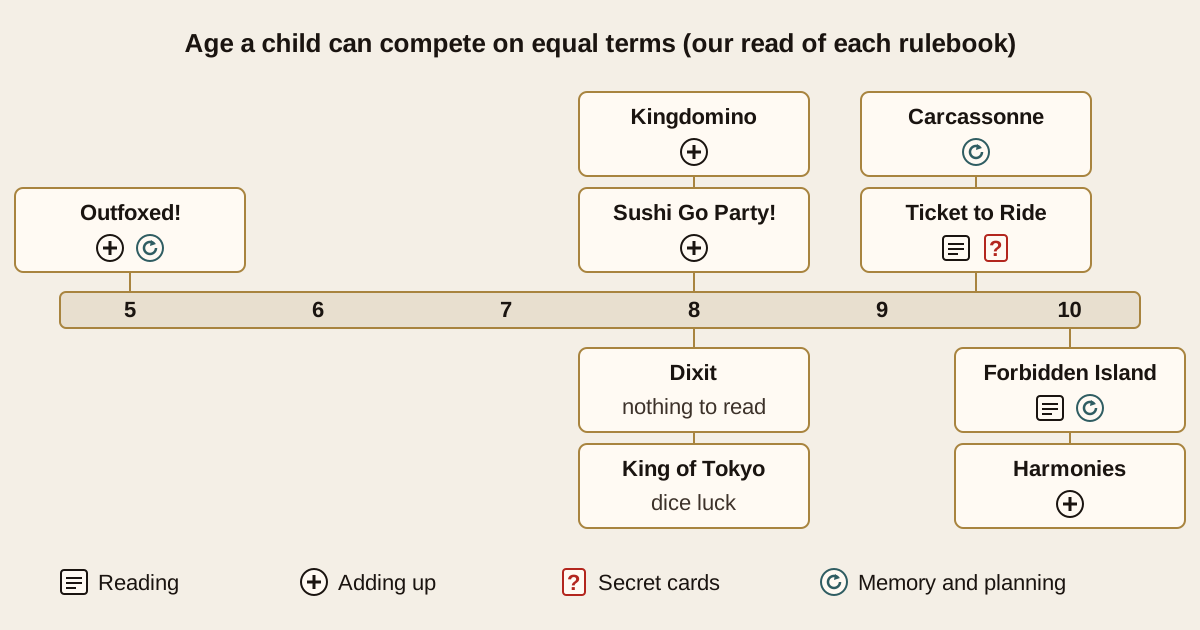
Box ages tell you when a child can follow the rules, not when they can beat you. Sorted by that second age, the best family board games for all ages here run from Outfoxed! for a 5-year-old, through Kingdomino, Sushi Go Party!, Dixit and King of Tokyo, to Carcassonne, Ticket to Ride and Forbidden Island, with Harmonies for tweens. Each "equal terms" age is our read of what the current rulebook asks a player to read, add up, keep secret or remember, not something measured in play.
| Game | Players | Box age | Time | What a young player has to handle (our read) | Grandparent-friendly? (our read) |
|---|---|---|---|---|---|
| Outfoxed! | 2–4 | 5+ | 20 min | Counting footprints, remembering clue results | Yes |
| Kingdomino | 2–4 | 8+ | 15 min | Matching terrain, one multiplication per area at the end | Yes |
| Sushi Go Party! | 2–8 | 8+ | 30 min | Collecting sets from a short list of card scores | Yes, on the starter menu |
| Dixit | 3–8 | 8+ | 30 min | Pitching a clue that's neither too easy nor too hard | Yes |
| King of Tokyo | 2–6 | 8+ | 30 min | Dice luck, and the chance of being knocked out | Yes |
| Carcassonne | 2–5 | 7+ | 30–45 min | Shared features, followers tied up until a feature is done | Yes, without farmers |
| Ticket to Ride | 2–5 | 8+ | 30–60 min | Reading city names, secret tickets that can cost points | Yes |
| Forbidden Island | 2–4 | 10+ | 30 min | Reading role powers, planning as a team | Yes, with open hands |
| Harmonies | 1–4 | 10+ | 30 min | Stacking rules, rotated patterns, several scoring rules | After a first game |
Players, box ages and times, from each publisher: Outfoxed!, Kingdomino, Sushi Go Party!, Dixit, King of Tokyo, Carcassonne, Ticket to Ride, Forbidden Island, Harmonies.
How we judged "equal terms" from the rulebooks
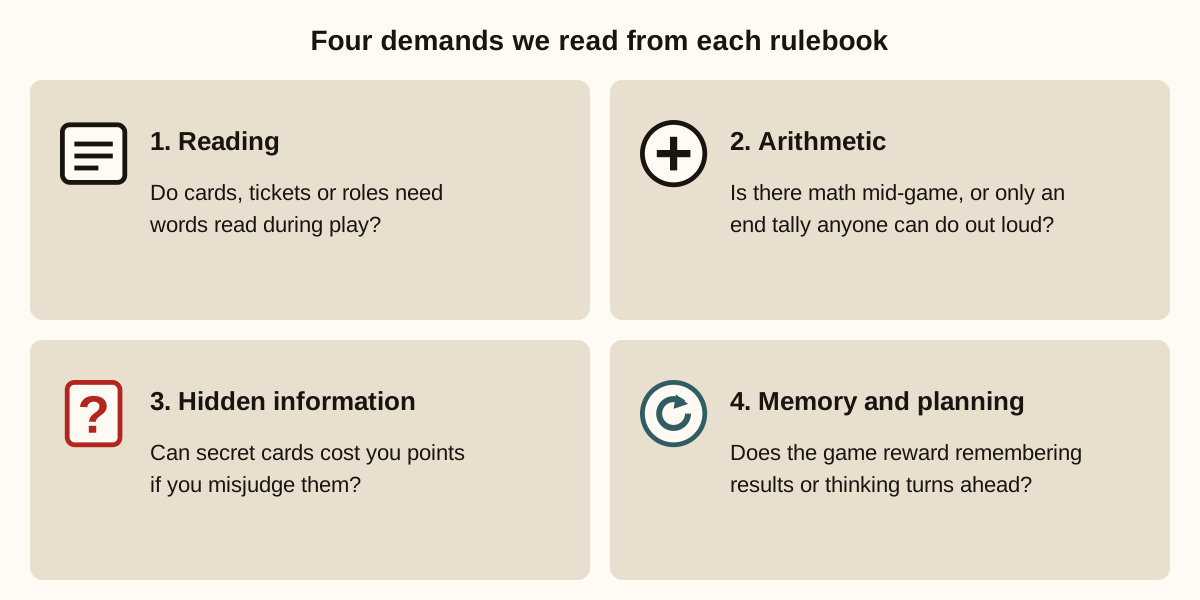
A child plays on equal terms when the rules don't hand the adult an edge the child can't see or can't use. We read each current rulebook for four demands:
- Reading. Do cards, tickets or roles need words read during play?
- Arithmetic. Is there math mid-game, or only an end tally anyone can do out loud?
- Hidden information. Can secret cards cost you points if you misjudge them?
- Memory and planning. Does the game reward remembering results or thinking turns ahead?
In a cooperative game nobody plays against the child, so equal terms means making real decisions instead of being steered by the strongest player. The grandparent-friendly flag comes from the same reading: how much you must explain before the first turn, whether a turn is one simple action, and whether the rules let others help. It's all judgment from the rules, so treat the ages as starting points. Choosing for another household? Our 2026 board game gift ideas are grouped by who's unwrapping them.
Around 5: a co-op where the youngest player counts
Outfoxed!
Gamewright bills Outfoxed! as a cooperative whodunit for 2 to 4 players aged 5 and up, about 20 minutes long (Gamewright). Before rolling, you announce your goal, clues or suspects, then roll three dice up to three times; miss, and the fox moves three spaces toward its hole (rules). A clue goes into a decoder that shows green if the thief wears that item, and the team wins by identifying the thief before the fox escapes (rules).
Our read: the cards are pictures, the counting tops out at the footprints on three dice, and everyone wins or loses together, so a 5-year-old's turn matters as much as yours. What grows with age is memory: you see a clue's color only while the decoder is open, and the rules expect players to remember the green ones (rules). The rulebook's harder variant moves the fox four or five spaces.
Grandparent note: the rules fit on one sheet. Older kids who like ruling out suspects will find more in our list of deduction board games.
Around 8: four games where kids keep up
Kingdomino
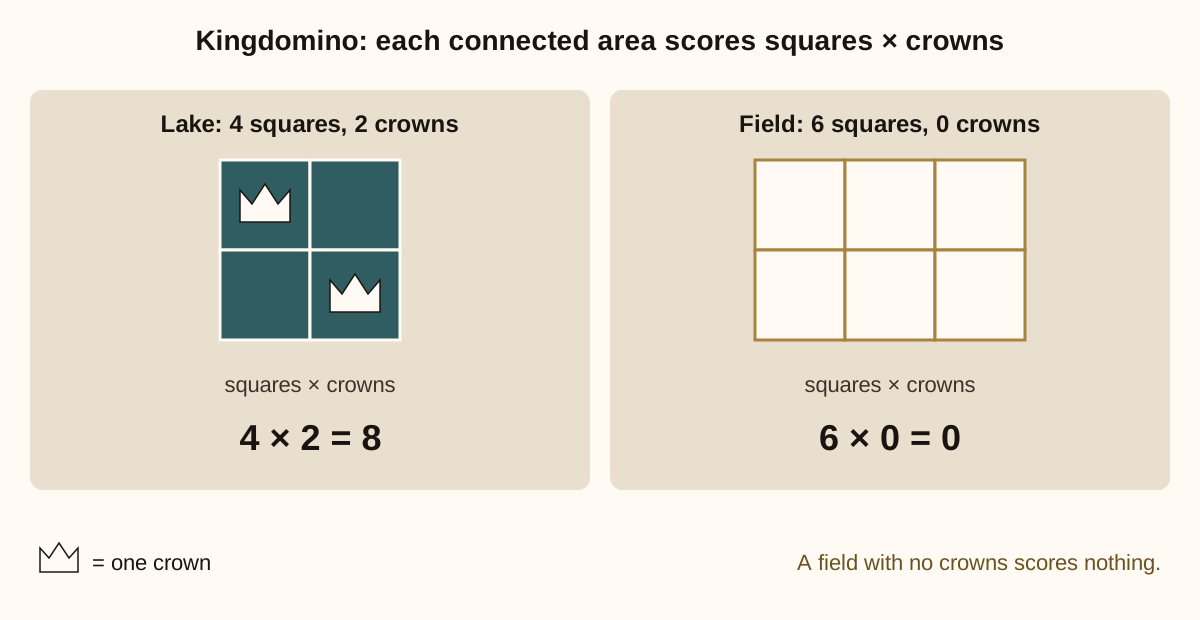
Blue Orange's rulebook lists Kingdomino for 2 to 4 players, ages 8 and up, about 15 minutes (Blue Orange); it's a Bruno Cathala design (Spiel des Jahres) that won the Spiel des Jahres in 2017 (Spiel des Jahres). Each turn you add last round's domino to a kingdom that must stay within 5 by 5 squares and connect through matching terrain, then claim a new one; better, higher-numbered dominoes put you later next round (rules). Each connected area scores its squares times its crowns (rules): a 4-square lake with 2 crowns is worth 4 × 2 = 8, a 6-square field with none 6 × 0 = 0.
Our read: everything on offer is face up, and the only math is one multiplication per area at the end. The real decision, a better domino now or an earlier pick later, sits in plain view: equal terms at the box age.
Grandparent note: four ideas to teach, two steps a turn. Its 7-by-7 Mighty Duel variant for two (rules) is one reason it's among our two-player board game picks.
Sushi Go Party!
Gamewright lists Sushi Go Party! for 2 to 8 players, ages 8 and up, about 30 minutes (Gamewright). A game runs three rounds; on each turn everyone picks one card from their hand in secret, all reveal together, and the hands pass left (rules). You pick the menu of dishes before you start, and My First Meal is the starter menu for first-time players (rules). Scores follow set patterns: two tempura are worth 5 and a lone tempura nothing, three sashimi are worth 10, and dumplings climb 1, 3, 6, 10, 15 (rules).
Our read: simultaneous turns mean nobody waits and nobody plays under a spotlight. The arithmetic is a handful of fixed values per dish, printed on menu tiles that sit on the board for everyone to check (rules). Watching the hand you're about to pass, and denying a neighbor their third sashimi, is a bonus skill rather than a gate. Equal terms at the box age, on My First Meal.
Grandparent note: it seats up to eight, and there's no turn order to keep track of.
Dixit
Jean-Louis Roubira's Dixit takes 3 to 8 players aged 8 and up, about 30 minutes (Libellud), and won the Spiel des Jahres in 2010 (Spiel des Jahres). The storyteller picks one of six picture cards and gives a clue; everyone else secretly adds a card that fits, then votes on which was the storyteller's (rules). If everyone or no one finds it, the storyteller scores 0 and the others 2; otherwise the storyteller and each correct guesser score 3, and every non-storyteller gets 1 per vote on their own card, with 30 to win (rules). With six players and two correct guessers, the storyteller and those two score 3 each, and a guesser who missed but drew two votes scores 0 + 2 = 2.
Our read: with nothing to read and no math beyond moving a rabbit, a guessing child stands level with adults from the box age. Storytelling is harder: the scoring punishes a clue everyone gets as much as one nobody gets.
Grandparent note: no text on any card.
King of Tokyo
IELLO lists Richard Garfield's King of Tokyo for 2 to 6 players, ages 8 and up, about 30 minutes (IELLO). You roll dice to heal, attack, buy cards or collect victory points, and the first monster to 20 points wins, or the last one left standing (IELLO).
Our read: dice squeeze the gap between a 9-year-old and a parent, which is exactly what equal terms needs. The catch is that second route to victory: if the last monster standing can win, players can be knocked out before the end and left to watch. Decide how to handle that before the first roll.
Grandparent note: roll, then act on what comes up; easy to join.
Around 9 to 10: games that reward planning ahead
Carcassonne
Z-Man Games lists Carcassonne for 2 to 5 players, ages 7 and up, 30 to 45 minutes (Z-Man). Klaus-Jürgen Wrede designed it (solo rules), and it won the Spiel des Jahres in 2001 (Spiel des Jahres). On a turn you draw a land tile, add it to the landscape and may place a follower on it (supplement; solo rules). A finished road scores 1 point per tile and a completed monastery 9 (Z-Man). When followers share a feature, whoever has the most scores it, and ties all score in full (supplement).
Our read: 7 suits learning, but we'd put equal terms nearer 9 or 10. Followers come back only when their feature is finished (Z-Man), so a player who parks them in sprawling cities runs out, and the majority rule lets an adult muscle into a child's city by connecting to it.
Grandparent note: leave out the farmers, which Z-Man saves for a supplemental sheet to add after a few games (supplement); without them a turn is draw, place, maybe add a follower, score.
Ticket to Ride
Days of Wonder lists Alan R. Moon's Ticket to Ride for 2 to 5 players, ages 8 and up, 30 to 60 minutes (Days of Wonder); under its German title, Zug um Zug, it won the Spiel des Jahres in 2004 (Spiel des Jahres). In the 2025 rulebook, everyone starts with four train cards and four tickets, keeping at least two tickets, and a turn is exactly one action: draw train cards, claim a route or draw tickets (rules). Routes of one to six spaces score 1, 2, 4, 7, 10 or 15 points; at the end, completed tickets add their value, unfinished ones subtract it, and the longest continuous path earns 10 more (rules).
Our read: two demands push equal terms past the box age: each ticket names two cities to find on a crowded map, and unfinished tickets secretly cost points, so a child who keeps too many can slide backward unnoticed. We'd say 9 or 10; an adult quietly checking a younger player's tickets is help, not equal terms.
Grandparent note: one action per turn.
Forbidden Island
Gamewright lists Matt Leacock's Forbidden Island as a cooperative game for 2 to 4 players, ages 10 and up, about 30 minutes (Gamewright). Hands are played face up, teammates are encouraged to advise each other, and each turn you take up to three actions, draw two treasure cards, then flood as many tiles as the water level shows (rules). Four matching treasure cards capture a treasure, and once the team holds all four, everyone must reach Fools' Landing and play a Helicopter Lift card (rules).
Our read: open hands and table talk let a team carry a younger player, which makes this a family game well before 10. Equal terms is a higher bar, because each adventurer's special power is written on its card and has to be understood to be used (rules). We'd hold to the box's 10 for that, and start at the Novice water level the rulebook suggests for a first cooperative game.
Grandparent note: with every card face up, nobody has to keep a secret or remember what they're holding.
10 and up: a puzzle for tweens and adults
Harmonies
Libellud lists Johan Benvenuto's Harmonies for 1 to 4 players, ages 10 and up, about 30 minutes (Libellud). Each turn you must take three tokens from one space on the central board and place them on your own board, following stacking rules; you may also take an animal card and settle its cubes once you've built its habitat pattern, turned any way you like (rules). Each landscape type scores its own way: trees and mountains by height, fields of two or more yellow tokens at 5 each, buildings at 5 when at least three colors surround them, and rivers by length, plus your animal cards (rules).
Our read: nothing is hidden or needs reading, but several scoring rules pull different ways and habitat patterns can be rotated, a spatial check you make every turn. The box's 10 matches our estimate, and the rulebook itself suggests side A of the player boards and no Nature's Spirit cards for early games (rules).
Grandparent note: game one is a learning game; the included scoresheet pad (rules) keeps the totals on paper.
What parents ask about the best family board games
What board game can young kids and adults play on equal terms? A cooperative one closes the gap fastest, because nobody is playing against the child. Outfoxed! is built for ages 5 and up (Gamewright). For a competitive option, Dixit puts a guessing child level with adults.
Which family board games still work for teens and adults? The ones that reward thinking ahead: Ticket to Ride's secret tickets, Carcassonne's fights over shared cities and Harmonies' scoring puzzle all keep a teenager and an adult honest.
Is there one board game that covers every age in the family? If you can only pick one, Kingdomino covers the widest span by our read: equal terms at its box age of 8, about 15 minutes a game, and a rulebook short enough to teach at the table. For a holiday crowd, our Thanksgiving games list is built around that day.
Sources
- Outfoxed!, Gamewright: box facts
- Outfoxed! rules, Gamewright: turn, decoder, variant
- Kingdomino US rulebook, Blue Orange: box facts, rules, scoring, Mighty Duel
- Kingdomino, Spiel des Jahres: designer
- Dragomino award news, Spiel des Jahres: Kingdomino's 2017 award
- Sushi Go Party!, Gamewright: box facts
- Sushi Go Party! rules, Gamewright: turns, menus, scores
- Dixit, Libellud: designer, box facts
- Dixit rulebook, Libellud: clues, voting, scoring
- 2010 archive, Spiel des Jahres: Dixit's award
- King of Tokyo, IELLO: designer, box facts, how to win
- Carcassonne, Z-Man Games: box facts, scoring, followers
- Carcassonne supplement, Z-Man Games: tiles, majorities, farmers
- Carcassonne solo variant, Z-Man Games: designer, followers
- 2001 archive, Spiel des Jahres: Carcassonne's award
- Ticket to Ride, Days of Wonder: designer, box facts
- Ticket to Ride 2025 rulebook, Days of Wonder: turns, tickets, scoring
- 2004 archive, Spiel des Jahres: Zug um Zug's award
- Forbidden Island, Gamewright: designer, box facts
- Forbidden Island rules, Gamewright: turns, winning, losing, roles
- Harmonies, Libellud: designer, box facts
- Harmonies rulebook, Libellud: turn, patterns, scoring, first-game advice