
For most groups, the best deduction board games beyond Clue are Cryptid and Turing Machine for pure logic, Mystery of the Abbey for Clue-style questioning, and Hanabi or MicroMacro: Crime City if you'd rather win or lose as a team. The ten picks below are sorted by how the deduction actually works, because that predicts who will enjoy a game far better than its theme does.
Every player count, age and play time here comes from the publisher's own rulebook or game page (for MicroMacro, the Spiel des Jahres jury's page), linked where it appears. The notes on each game are our read of those rules: what they ask you to track, hide or say out loud, and what one mistake costs. They are not play reports.
Three ways a deduction game can work
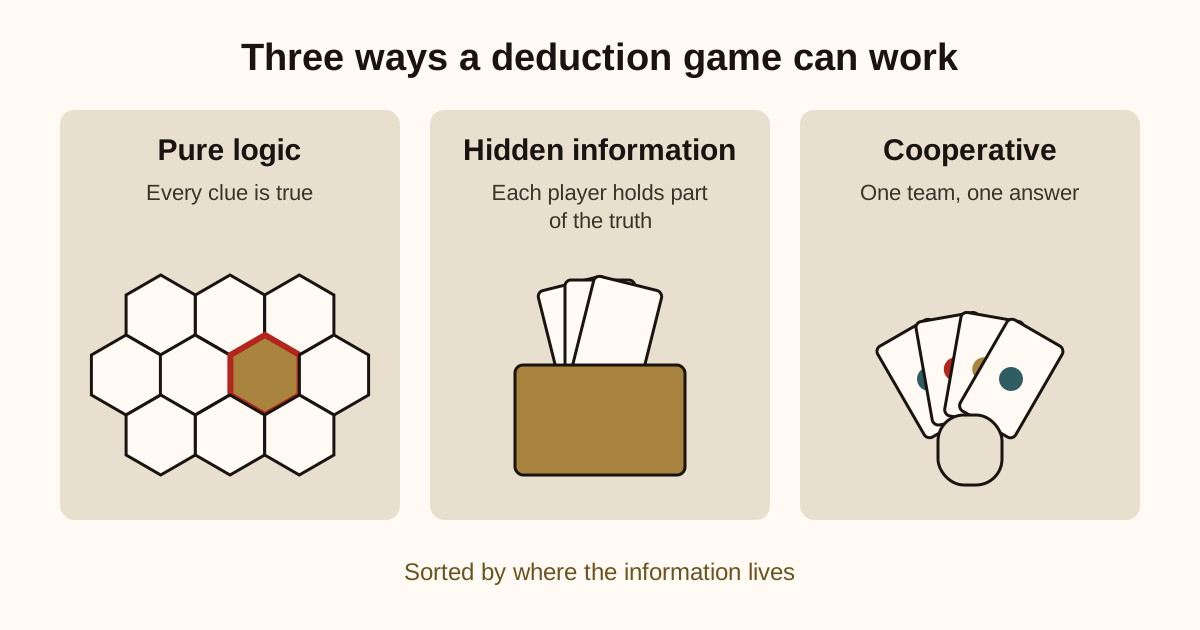
All of these games end with someone naming an answer. They differ in where the information lives.
- Pure logic. Every clue in the game is true, and the puzzle has exactly one solution. Your job is to ask efficient questions. It's a logic grid puzzle with opponents.
- Hidden information. Each player holds part of the truth, and the rules decide what they must reveal when asked. This is Clue's branch of the family.
- Cooperative deduction. The whole table shares one answer, and the rules restrict how you may communicate.
Games where players lie about who they are, such as Werewolf and Avalon, are a separate genre with their own list of social deduction games.
The best deduction board games compared
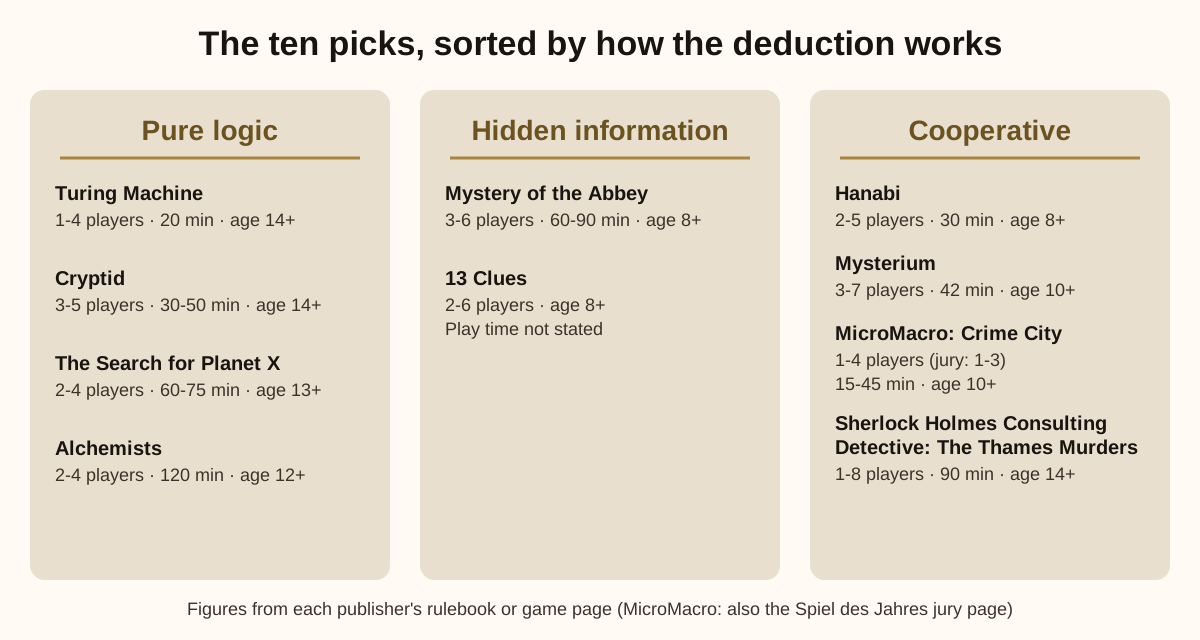
| Game | Style | Players | Time | Age | Why it's here | Numbers from |
|---|---|---|---|---|---|---|
| Turing Machine | Pure logic | 1-4 | 20 min | 14+ | You question a punch-card machine, not people | Rulebook |
| Cryptid | Pure logic | 3-5 | 30-50 min | 14+ | One true clue each; together they point to one hex | Osprey |
| The Search for Planet X | Pure logic | 2-4 | 60-75 min | 13+ | App-hidden solar system with fixed logic rules | Foxtrot |
| Alchemists | Pure logic | 2-4 | 120 min | 12+ | Deduction inside a full strategy game | CGE |
| Mystery of the Abbey | Hidden information | 3-6 | 60-90 min | 8+ | Clue-like, but you can ask almost anything | Rulebook |
| 13 Clues | Hidden information | 2-6 | Not stated | 8+ | Everyone sees your case except you | Rules |
| Hanabi | Cooperative | 2-5 | 30 min | 8+ | You hold your own cards backward | Rules, R&R |
| Mysterium | Cooperative | 3-7 | 42 min | 10+ | A ghost who can only send pictures | Libellud |
| MicroMacro: Crime City | Cooperative | 1-4 (jury: 1-3) | 15-45 min | 10+ | One huge map, searched together | Spiel des Jahres |
| Sherlock Holmes Consulting Detective: The Thames Murders | Cooperative | 1-8 | 90 min | 14+ | Ten long cases; you pick every lead | Space Cowboys |
Pure logic: every clue is true
Turing Machine
Turing Machine swaps the person across the table for a machine. Per the rulebook, the secret is a three-digit code, each digit from 1 to 5, guarded by four to six "verifiers" that each check one hidden criterion, such as whether a certain number is even. Each round you build a proposal from colored punch cards and question up to three verifiers; stacking the cards reveals a check or a cross.
Nobody answers you, so nobody can bluff or misread a clue. The only skill on show is choosing which question earns the most information, and the tiebreak makes that explicit: when several players crack the code in the same round, the one who asked the fewest questions wins. The note sheet tracks every answer and your question count, so tidy bookkeeping matters as much as insight. Yoann Levet and Fabien Gridel designed it, and the official site generates new problems beyond the 20 in the box.
Cryptid
Cryptid hands each player exactly one true clue about where a creature lives, based on the board's terrain and structures. The rulebook guarantees that all the clues together point to a single hex. On your turn you either ask one opponent whether the creature could be on a space, or you search a space yourself.
Answers are pieces, not words. A disc means "possible," a cube means "not here," and pieces stay on the board unless someone has made a mistake. The sharpest rule is what a "no" costs you: when your question draws a cube, you must also place a cube somewhere your own clue rules out, which leaks a little of your secret every time. The rulebook even includes a short note on honesty, because one wrong piece misleads everyone. Hal Duncan and Ruth Veevers designed it, and Osprey posts an official two-player rulesheet for couples.
The Search for Planet X
A companion app hides a solar system for each game, following fixed rules printed in the rulebook: comets only sit in certain numbered sectors, every asteroid is next to another asteroid, gas clouds touch a truly empty sector, and the dwarf planet is never beside Planet X. Planet X itself shows up as empty when you survey, so you can only find it by ruling things out.
Every action costs time on a shared track, and whoever is furthest behind takes the next turn. You also submit theories about objects; correct ones score at the end, while a wrong one costs you an extra sector of time on the track. That makes it forgiving for a logic game: a bad guess slows you down instead of ending your chances. Foxtrot's page lists 2 to 4 players, ages 13 and up. Note that the app is required.
Alchemists
Alchemists is deduction wrapped in a much heavier strategy game, and the CGE page is upfront about it: 2 to 4 players, ages 12 and up, about 120 minutes, designed by Matúš Kotry and released in the last quarter of 2014. You run experiments to learn what your ingredients do, with a companion app on a phone or tablet acting as the card reader.
The twist is where the points come from: you earn reputation by publishing theories, and rivals can endorse or challenge what you publish. So the game keeps asking whether to run one more experiment and be sure, or publish now and risk being wrong in public. Choose it for a group that already enjoys long strategy games. Skip it if you want deduction you can explain between dinner and dessert.
Hidden information: Clue's closest relatives
If you searched for games like Clue, start here. And if the original has gathered dust, here are Clue's rules and a note-taking method to get it back on the table.
Mystery of the Abbey
Mystery of the Abbey is the natural next step for Clue fans. In the Days of Wonder rulebook, twenty-four monks are suspects, each defined by five traits: order, title, hood, facial hair and girth. When your pawn ends in a room with another player, you must ask them a question, and almost any question is legal as long as the answer doesn't name a suspect.
The asked player has two choices. They answer truthfully and then get to ask you one back, or they take a vow of silence and say nothing. That single rule turns every encounter into a small trade of information. Scoring rewards partial knowledge too: a correct public revelation about one trait earns 2 points, a wrong one costs 1, and the rules point out that the highest scorer isn't always the monk who named the culprit. Bruno Faidutti and Serge Laget designed it.
13 Clues
13 Clues turns Clue's hidden cards inside out. In the rules, your mystery (a person, a location and a weapon) sits on the outside of your screen, where every opponent can see it and you can't. You act by spending magnifying-glass tokens: ask a player how many cards of one color or one category they can see, peek at a face-down informant card, or accuse.
Answers must be truthful; the rules say plainly that bluffing isn't allowed. The clever part is the economy. The token you spend on a question goes to the player you asked, which gives them extra actions next turn, so curiosity has a cost. A wrong accusation earns only a flat "wrong," but the rules warn that each miss still gives clues away. Andrés J. Voicu designed it, and the rules include special adjustments for two players.
Cooperative deduction: one team, one answer
Hanabi
Hanabi is cooperative deduction in its purest card form. Per R&R Games' rules, you hold your hand facing outward: you see every teammate's cards and never your own. On your turn you give one hint (every card of one color in a player's hand, or every card of one number, pointing to all of them), discard to win back a hint token, or play a card and hope it extends a firework in order from 1 to 5.
Eight clock tokens limit the hints, and every misplay burns a fuse. The third fuse ends the game for everyone. Teammates aren't allowed to comment during your turn, so the table drifts toward careful, deliberate signals. Antoine Bauza designed it, and R&R's game page puts a game at about 30 minutes.
Mysterium
Mysterium splits the table into one ghost and several psychics, and the refreshed rules take the ghost's voice away completely: no speaking, no gestures, no comments, only illustrated Vision cards. Each psychic must work out a personal trail of three cards (a character, a location and an object) before the clock passes its seventh hour. Then the group reads one final shared vision to pick the true culprit.
Answers arrive as knocks under the table, one for yes and two for no. The deduction is deliberately fuzzy, since a dreamlike picture can point several ways, but the psychics may talk as much as they like. That suits groups who enjoy arguing a case out loud. Libellud credits Oleg Sidorenko and Oleksandr Nevskiy, and with three players each psychic runs two colors.
MicroMacro: Crime City
MicroMacro: Crime City won the Spiel des Jahres in 2021, and it may be the easiest game here to set up: the whole investigation happens on one enormous city map. The publisher's series page describes the job as finding motives and evidence and convicting the culprits, on maps that join into one giant hidden-object picture.
Because the whole table works from the same drawing, the deduction is about noticing small moments and putting them in order, not prying information out of each other. The jury's game page credits Johannes Sich with Edition Spielwiese / Pegasus Spiele, and notes that the jury recommends 1 to 3 players while the publisher says up to 4. With a single map to share, the jury's smaller number is the safer guide.
Sherlock Holmes Consulting Detective: The Thames Murders & Other Cases
Sherlock Holmes Consulting Detective is the long-form pick. Space Cowboys' page describes ten Victorian London cases that a group solves together, using a map, a newspaper and a city directory to decide which leads to follow, including characters such as Inspector Lestrade.
Every decision is a choice of where to go next, so the table spends its time debating which address is worth a visit and what a newspaper item might mean. At about 90 minutes a game and ages 14 and up, it's built for an evening rather than a filler slot. Gary Grady, Raymond Edwards and Suzanne Goldberg are credited, and the cases reimplement the original Ystari edition. If a friend owned that older box, check before you start a case they may already know.
Table talk and the one-bad-clue problem
Two questions decide whether a deduction game lands with your group: how much the rules make people talk, and whether one wrong move can wreck the game. Here is our read of each rulebook. It's analysis of the rules, not a score from play, and we left out the two games whose rules we couldn't check in full.
| Game | What the rules make you say out loud | Can one wrong move sink you? |
|---|---|---|
| Turing Machine | Almost nothing; you question the machine | Partly: if nobody is right, players with wrong codes are knocked out and the rest play on |
| Cryptid | Very little; answers are cubes and discs | One mistaken cube misleads everyone, which is why the rules ask you to admit errors at once |
| The Search for Planet X | Little; theories are placed face down | No; a wrong theory costs time, not the game |
| Alchemists | Little; experiments run through the app | Publishing a wrong theory is the risk the whole game is built around |
| Mystery of the Abbey | A lot; every encounter forces a question | A false accusation costs 2 points and a trip to penance, but you keep playing |
| 13 Clues | Short, fixed-form questions | A wrong accusation ends your turn and leaks information |
| Hanabi | Only formal hints | Three misplays and the whole team loses |
| Mysterium | Psychics talk freely; the ghost never does | If any psychic misses the deadline, everyone loses |
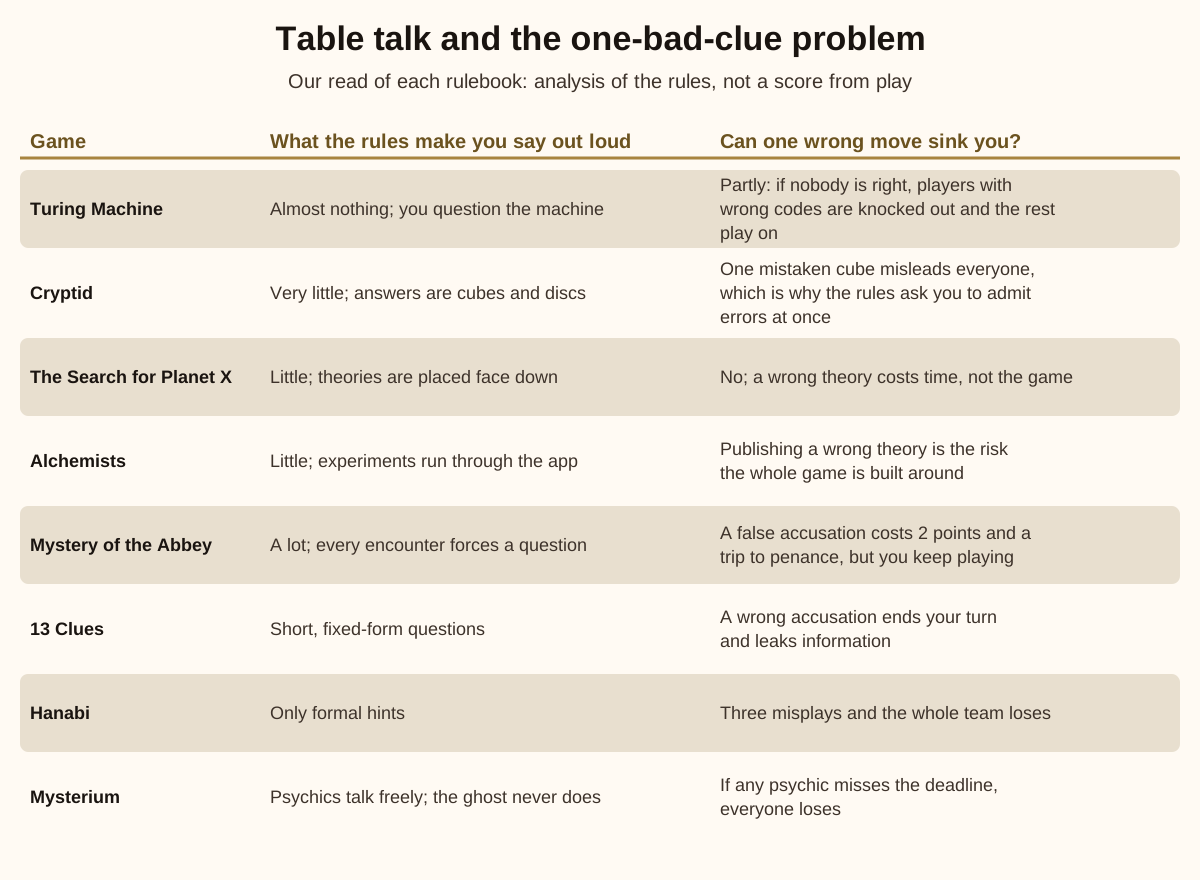
Read down the right-hand column and a pattern shows up. The co-op games punish mistakes collectively, so they need a group that can laugh about a shared loss. The competitive logic games mostly punish you alone, and Planet X punishes least of all, which makes it the gentlest place to start a logic-minded friend.
Questions people ask about deduction games
Which deduction games work with two players? Turing Machine (1-4), Hanabi (2-5) and The Search for Planet X (2-4) all include two in their normal range. 13 Clues has its own two-player rules, and Cryptid adds an official two-player variant on Osprey's download page. If your pair likes codebreaking, solving Mastermind by elimination scratches the same itch with a classic.
Are any of these good for kids? The youngest box ages here are 8 and up: Mystery of the Abbey, 13 Clues and Hanabi. MicroMacro and Mysterium start at 10. Hanabi needs no reading at all, only colors and numbers, while 13 Clues keeps its questions to a fixed pattern of colors and categories.
What's the closest game to Clue? Mystery of the Abbey keeps the "find the culprit by elimination" structure and adds open-ended questions. 13 Clues keeps the person, place and weapon, then hides your own case from you.
Sources
- Turing Machine rulebook (Le Scorpion Masqué)
- Turing Machine official problem site
- Cryptid rulebook (Osprey Games)
- Cryptid game page, players, age and time (Osprey)
- Osprey gaming resources, including the Cryptid two-player rulesheet
- The Search for Planet X game page (Foxtrot Games)
- The Search for Planet X rulebook (Foxtrot Games)
- Alchemists game page (Czech Games Edition)
- Mystery of the Abbey rulebook (Days of Wonder)
- 13 Clues rules (dV Games)
- Hanabi rules (R&R Games)
- Hanabi game page, play time (R&R Games)
- Mysterium game page (Libellud)
- Mysterium rulebook (Libellud)
- Spiel des Jahres 2021 announcement
- MicroMacro: Crime City on the Spiel des Jahres site
- MicroMacro: Crime City series page (Edition Spielwiese)
- The Thames Murders & Other Cases (Space Cowboys)