
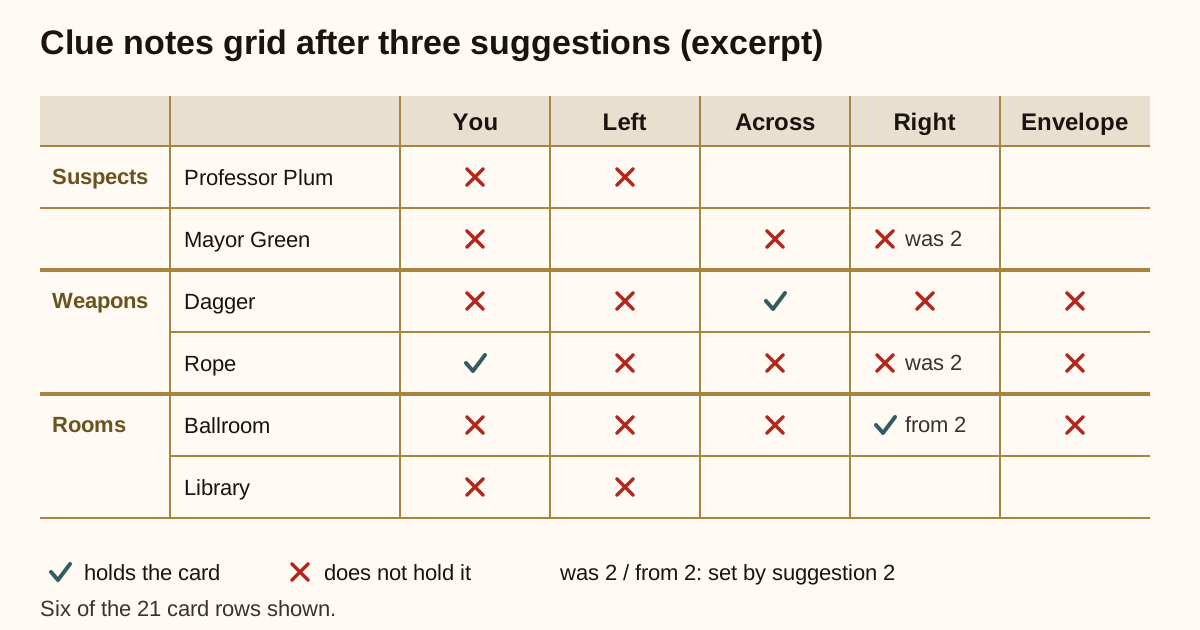
The short version of how to play Clue: one suspect card, one weapon card and one room card go into a secret envelope, the rest are dealt out, and on your turn you move into a room and make a suggestion that the other players, in order, must try to disprove by secretly showing you one matching card. Name all three envelope cards in an accusation and you win, but you get only one accusation per game (Hasbro rulebook).
Everything below follows Hasbro's current Clue rulebook (item F6420, © 2023), which is for 2 to 6 players aged 8 and up (Hasbro). Older boxes may use different names; copy yours onto the notes grid.
Set up the mystery
- Put all six character tokens on their colored start spaces, even if fewer than six people are playing, then choose your character.
- Place each weapon in a different room, chosen at random.
- Shuffle the 29 Clue cards into their own face-down pile.
- Sort the remaining cards into characters, weapons and rooms, and shuffle each pile face down.
- Without anyone looking, slide the top card of each pile into the solve envelope and put it in the middle of the board.
- Shuffle the other 18 cards together and deal them all out. Uneven hands are fine.
- Give everyone a sheet from the notepad and a pen (pens aren't in the box).
- Look at your cards and cross them off your sheet. None of them can be in the envelope.
All eight steps are from the rulebook's setup page, and the rulebook names the 21 suspect, weapon and room cards (Hasbro rulebook):
- Suspects (6): Miss Scarlett, Colonel Mustard, Solicitor Peacock, Professor Plum, Mayor Green, Chef White
- Weapons (6): Candlestick, Dagger, Lead Pipe, Revolver, Rope, Wrench
- Rooms (9): Ballroom, Billiard Room, Conservatory, Dining Room, Hall, Kitchen, Library, Lounge, Study
Hand sizes follow from the 18 dealt cards: 6 each with three players and 3 each with six. With four players, two people get 5 cards and two get 4; with five, three people get 4 and two get 3.
How to play Clue on your turn: roll, move, suggest
Roll one die to decide who goes first; after that, play passes to the left. Each step here is from the rulebook's "Let's Play" page (Hasbro rulebook).
- Roll both dice and move up to that many squares; the magnifying-glass face counts as 1. No diagonal moves, no square twice in one turn, and no landing on or passing through an occupied square, doorways included. You don't need an exact roll to enter a room, but you must use an unblocked doorway.
- Or stay where you are. If you start your turn in a room, you don't have to move before suggesting there, and if the room has a secret passage you can take it to the room it connects to.
- Rolled a magnifying glass? Draw a Clue card, read it aloud, do what it says and put it on the bottom of the pile. Two magnifying glasses still mean one card.
- Make a suggestion when you reach or stay in a room: any suspect, any weapon, and the room you're in. Move that suspect's token and that weapon into the room, where they stay.
- Let the table answer. The player on your left secretly shows you one of the named cards if they have one, choosing which if they have more than one. If they can't, the next player tries, and so on. The first card shown ends it. If nobody shows anything, every named card you don't hold is in the envelope or, in a two-player game, maybe in a room.
- Accuse when you're sure, even right after your suggestion.
Suggestion or accusation? The rules side by side
Every row comes from the rulebook's "Let's Play" and "How to Win" sections (Hasbro rulebook).
| Suggestion | Accusation | |
|---|---|---|
| When | On your turn, after you reach or stay in a room | On your turn, including straight after a suggestion |
| Where you must be | In the room you name | In any room; it needn't be the one you name |
| What you name | Any suspect, any weapon, the room you're in | Any suspect, any weapon, any room |
| Who answers | Players in order from your left, until one shows you a card | Nobody; you check the envelope privately |
| If you're wrong | You learn a card and play moves on | You take no more turns but must keep showing cards |
| How many | One per turn | One per game |
If nobody ever accuses correctly, the murderer gets away.
A notes grid that tracks who showed what
The notepad in the box already has a column for each player, and Hasbro's own advice is to mark a card you're shown twice: in the first column and under the initial of the player who showed it (Hasbro rulebook). This method also logs what happens between other players, using three marks:
- ✓ means this player holds the card.
- ✗ means this player doesn't hold it.
- A number means this player showed someone a card during suggestion number n, so they hold at least one of its three cards.
Four rules turn those marks into answers, and they're the same moves you'd make in a logic grid puzzle:
- A pass is proof. The rules make you show a card when you can, so a player who passes holds none of the three named cards. Write three ✗.
- An unseen card is one of three. When someone shows a card to another player, write the suggestion number in their three cells. Once two of those cells turn ✗, the third becomes ✓.
- One ✓ clears its row. Each card exists once. When one player holds it, every other player and the envelope get ✗.
- A row of ✗ is the answer. If no player can hold a card, it's in the envelope.
A worked round at a four-player table
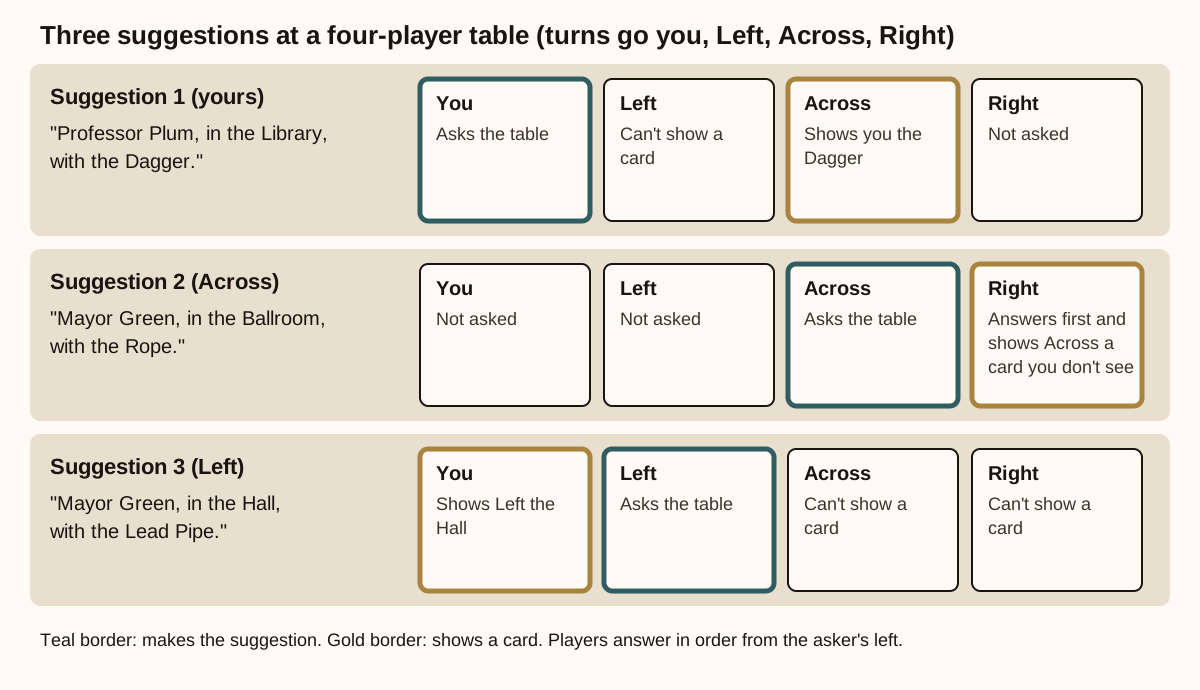
Call your three opponents Left, Across and Right by where they sit. Play passes to the left, so turns go you, Left, Across, Right. You hold five cards: Colonel Mustard, Rope, Wrench, Hall and Kitchen.
Suggestion 1, yours, in the Library: "Professor Plum, in the Library, with the Dagger." Left can't show anything. Across shows you the Dagger.
- Left: ✗ Plum, ✗ Library, ✗ Dagger.
- Across: ✓ Dagger, so the Dagger row is ✗ for everyone else and for the envelope.
- Across might also hold Plum or the Library; they only had to show one.
Suggestion 2, Across's, in the Ballroom: "Mayor Green, in the Ballroom, with the Rope." Right answers first, since Right sits on Across's left, and shows Across a card you don't see.
- Write "2" in Right's cells for Mayor Green, Ballroom and Rope.
- You hold the Rope, so Right can't. Cross out that 2: Right holds Mayor Green or the Ballroom.
Suggestion 3, Left's, in the Hall: "Mayor Green, in the Hall, with the Lead Pipe." Across can't show anything, Right can't show anything, and you show Left the Hall.
- Across and Right: ✗ Mayor Green, ✗ Hall, ✗ Lead Pipe.
- Right now has ✗ on Mayor Green, so the card Right showed for suggestion 2 must have been the Ballroom. Right: ✓ Ballroom.
The grid after three suggestions (blank means unknown):
| Card | You | Left | Across | Right | Envelope |
|---|---|---|---|---|---|
| Miss Scarlett | ✗ | ||||
| Colonel Mustard | ✓ | ✗ | ✗ | ✗ | ✗ |
| Solicitor Peacock | ✗ | ||||
| Professor Plum | ✗ | ✗ | |||
| Mayor Green | ✗ | ✗ | ✗ (was 2) | ||
| Chef White | ✗ | ||||
| Candlestick | ✗ | ||||
| Dagger | ✗ | ✗ | ✓ | ✗ | ✗ |
| Lead Pipe | ✗ | ✗ | ✗ | ||
| Revolver | ✗ | ||||
| Rope | ✓ | ✗ | ✗ | ✗ (was 2) | ✗ |
| Wrench | ✓ | ✗ | ✗ | ✗ | ✗ |
| Ballroom | ✗ | ✗ | ✗ | ✓ (from 2) | ✗ |
| Billiard Room | ✗ | ||||
| Conservatory | ✗ | ||||
| Dining Room | ✗ | ||||
| Hall | ✓ | ✗ | ✗ | ✗ | ✗ |
| Kitchen | ✓ | ✗ | ✗ | ✗ | ✗ |
| Library | ✗ | ✗ | |||
| Lounge | ✗ | ||||
| Study | ✗ |
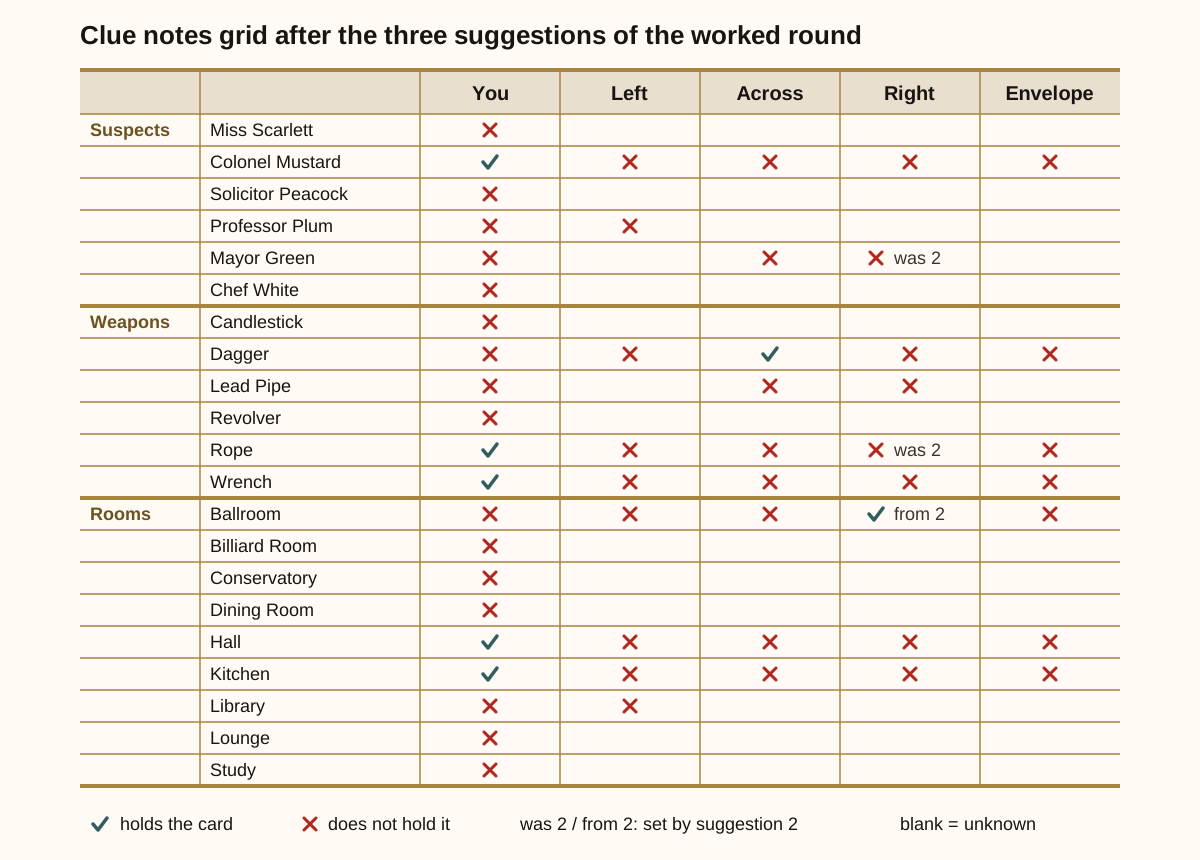
Now read the grid for your next move. Mayor Green and the Lead Pipe are each ✗ for you, Across and Right, so each is either in Left's hand or in the envelope. Next time you're in the Kitchen, suggest "Mayor Green, in the Kitchen, with the Lead Pipe." If Left shows you a card, you learn which of the two Left holds. If Left can't, Across and Right must pass too (they already passed on both, and you hold the Kitchen), so both cards are in the envelope. Naming one of your own cards to aim a question at one player is a move the rulebook itself recommends (Hasbro rulebook).
Clue with two players
Two-player Clue is official in Hasbro's current rules. It plays like the regular game with two changes (Hasbro rulebook):
- Setup: after the envelope is filled, shuffle the remaining cards and lay four of them face down in four different rooms, chosen at random, or in the corner rooms for a quicker game. Then deal the rest.
- Play: when you enter a room that holds one of those cards, secretly look at it and mark your sheet before you make your suggestion.
Each player ends up with 7 cards: 21, minus 3 in the envelope and 4 in rooms, leaves 14 to split two ways.
The room cards fix a real problem. With one opponent and every other card dealt out, a single pass would tell you that any named card you don't hold is in the envelope. With four cards parked in rooms, a pass only says the missing cards are in the envelope or face down on the board, so you still have to travel and look.
Hasbro lists Clue Game Classic (A5826) for 3 to 6 players (Hasbro), so with that edition two-player Clue is a house rule; borrow the four-cards-in-rooms setup. Hasbro's page for CLUE The Classic Mystery Game (38712) lists 2 to 6 players and a two-player mode (Hasbro). For a deduction duel built for two from the start, try Mastermind's code-breaking.
Habits that lose Clue games
- Accusing on a hunch. You get one accusation, and a wrong one ends your turns (Hasbro rulebook). Wait until each category has one candidate left.
- Logging only your own suggestions. Suggestion 3 above pinned down a card on someone else's turn.
- Assuming players lack what they name. Anyone can include their own cards in a suggestion to steer it, so a suggestion proves nothing about the suggester's hand.
- Showing a fresh card when an old one will do. When you hold two of the named cards, you choose which to show; if the asker has already seen one of them from you, show that one again.
Clue questions people ask
Can you play Clue with two people? Yes, with the official variant above.
How does Clue work with three players? Exactly as written, with 6 of the 18 dealt cards in each hand. Your grid needs only two opponent columns, and once you've found six cards for an opponent, you know their whole hand and can cross off the rest of their column.
Is Clue Junior the same game? No. Hasbro's Clue Junior (F6419) is for 2 to 6 players aged 4 and up, with a two-sided board for two levels of play, kid-friendly mysteries in a school setting, and the classic characters drawn as kids (Hasbro). For more, see deduction games that go beyond Clue.
From the Golden Lab Games team. Rules on this page are paraphrased from Hasbro's 2023 Clue rulebook, linked below.
Sources
- Hasbro: Clue rulebook, item F6420, © 2023 (PDF): cards, setup, turns, accusations, two-player game, notes tips
- Hasbro: Clue Board Game (F6420) instructions page: players, ages
- Hasbro: Clue Game Classic (A5826) instructions page: 3 to 6 players
- Hasbro: CLUE The Classic Mystery Game (38712) instructions page: two-player mode
- Hasbro: Clue Junior (F6419) instructions page: ages, levels, setting