
Should anyone have to sit out half of a party game? If your answer is no, the best social deduction games for you keep everyone playing: The Resistance: Avalon for 5 to 10 players, Spyfall and Insider for smaller tables, and Two Rooms and a Boom for crowds of up to 30.
If your group doesn't mind being "killed," Coup and Secret Hitler are sharper, and Blood on the Clocktower lets dead players keep talking. The nine picks below are grouped by the group size they handle best, with an elimination column and a section on how each one treats quieter players.
Each number comes from the publisher's own rules or product information, and gaps stay gaps rather than guesses. The commentary is reasoning from those rules (what they make you say, hide and vote on), not a record of games played.
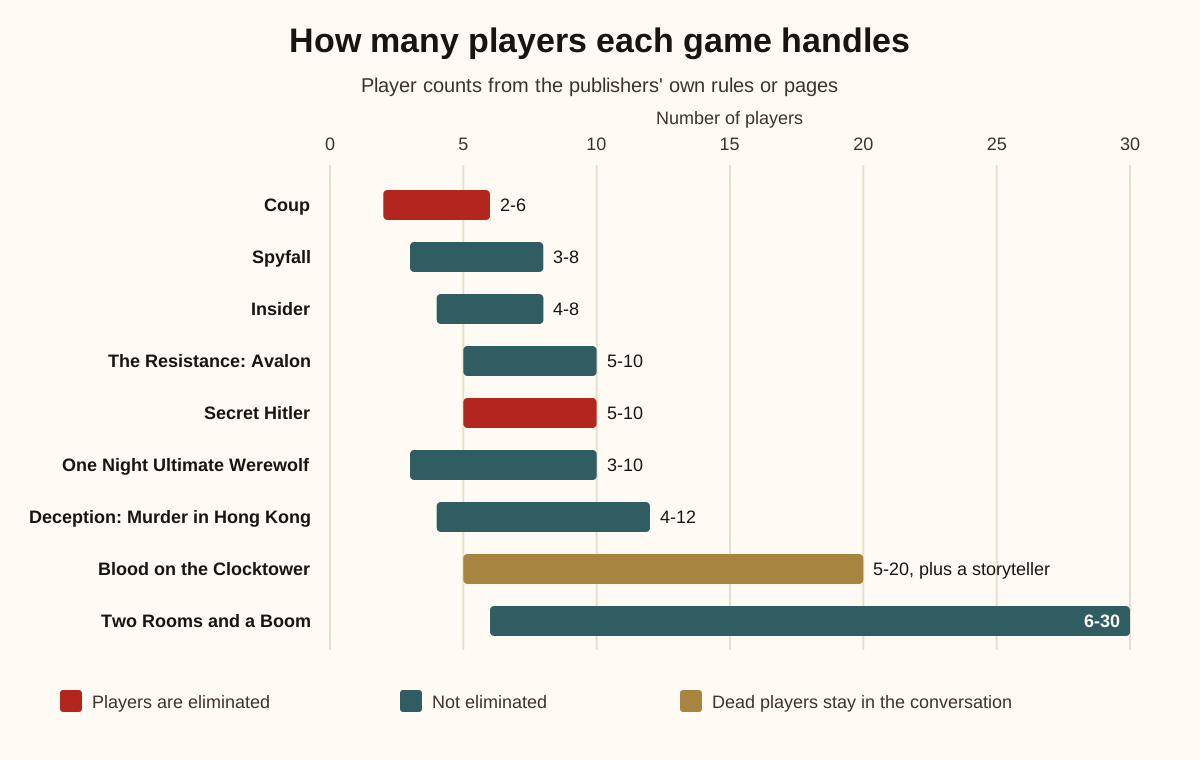
The best social deduction games at a glance
| Game | Players | Time | Age | Anyone eliminated? | Why it's here |
|---|---|---|---|---|---|
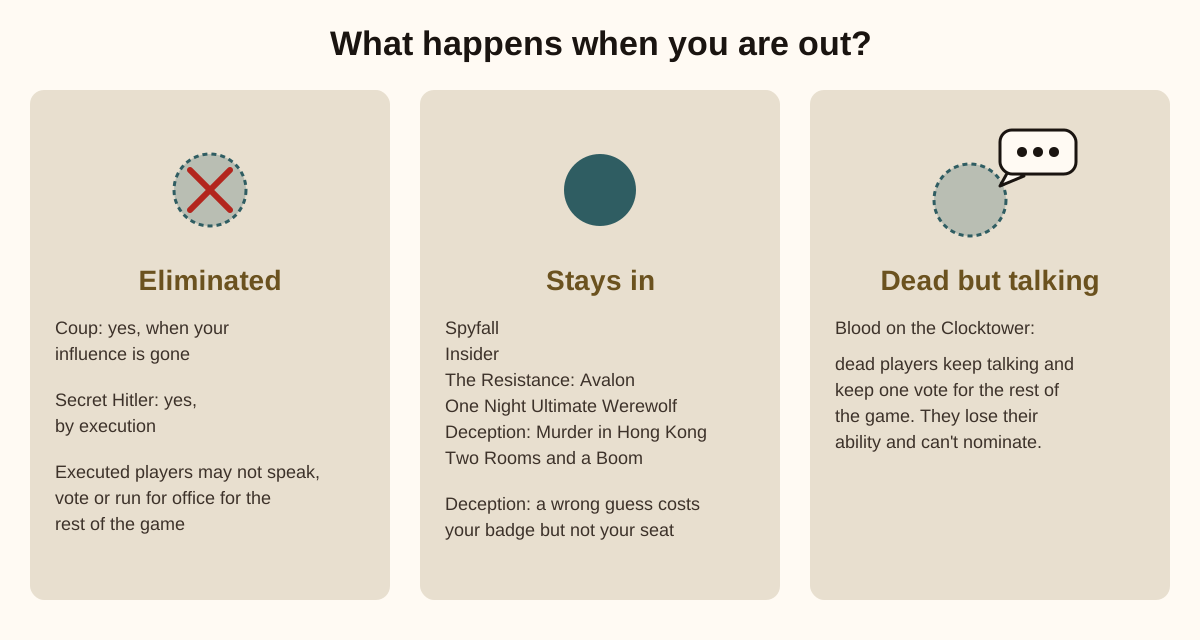
| Coup | 2-6 | 15 min | 13+ | Yes, when your influence is gone | Bluffing over in a quarter hour |
| Spyfall | 3-8 | 8-minute rounds | 13+ | No | One spy who doesn't know where you are |
| Insider | 4-8 | 15 min | 9+ | No | Yes/no questions with a hidden helper |
| The Resistance: Avalon | 5-10 | 30 min | 14+ | No | Hidden teams, everyone plays to the end |
| Secret Hitler | 5-10 | Not listed | Not listed | Yes, by execution | Elections and votes give it structure |
| One Night Ultimate Werewolf | 3-10 | About 10 min | Not listed | No | Werewolf squeezed into one night |
| Deception: Murder in Hong Kong | 4-12 | 20+ min | 14+ | No | A silent forensic scientist and a hidden murderer |
| Blood on the Clocktower | 5-20, plus a storyteller | Not listed | Not listed | Dead players stay in the conversation | Built for a big circle |
| Two Rooms and a Boom | 6-30 | 7-20 min | 8+ | No | Two rooms, hostage swaps, crowds welcome |
Five or six players
Coup
Coup is the shortest game here and the most cutthroat. The publisher's page casts you as a family in a corrupt city-state, with your influence shown as face-down character cards in front of you. The goal is to destroy everyone else's influence and force them into exile, so players are eliminated by design.
That stings less than it sounds, because the page lists a game at about 15 minutes for 2 to 6 players; whoever goes out first isn't waiting long. The page sells it on manipulation, bluffing and bribery, and those face-down cards are where the bluffing lives. Rikki Tahta designed it, and it was released in 2012. Pick it for five or six people who would rather have a fast, mean duel than a long debate.
Spyfall
Everyone in Spyfall is at the same location except one player, the spy, who has to work out where they are. Per the rules, players question each other by name in rounds of about eight minutes. Whoever answers asks the next question, and nobody may question the player who just questioned them.
The fun is the tightrope. Everyone else has to prove they know the place without naming it, while the spy fishes for hints. Any player can stop the clock once per round to accuse someone, but the vote must be unanimous apart from the suspect, and the spy can stop the game at any moment to guess the location. Nobody is knocked out; the round's spy simply deals the next one. Cryptozoic lists 3 to 8 players, ages 13 and up, and the rules suggest five rounds, about an hour, for a first session. Alexander Ushan created it.
Insider
Insider starts as a friendly guessing game and turns into an interrogation. Per Oink Games, one player is the master, who knows a secret word and answers only "yes," "no" or "I don't know." The group has five minutes to find the word or everyone loses. One player, the insider, also knows it and quietly steers the questions.
Once the word is out, the whole table, master included, tries to work out who was steering. That structure is kind to newcomers: the first half is cooperative, so a nervous player can learn by asking plain questions before any accusing starts. It runs about 15 minutes for 4 to 8 players aged 9 and up, and nobody sits out. At five or six players each person asks a bigger share of the questions, which leaves the insider less cover.
Seven to ten players
The Resistance: Avalon
If you only ever play one game from this list, make it this one. The publisher's page pits Arthur's loyal servants against a few evil players who know each other. One good player, Merlin, knows every villain, with a catch: Merlin may only speak in riddles, because if evil works out who Merlin is, good loses anyway. That single rule stops the best-informed player from simply announcing the answer.
Avalon is a standalone game that combines with The Resistance, whose page promises that players are never eliminated. At a party that's the whole point: nobody spends the second half watching. Both list 5 to 10 players and about 30 minutes; Avalon is rated 14+ and the original Resistance 13+. Don Eskridge designed both.
Secret Hitler
Secret Hitler gives a big group more structure than most hidden-role games. In the rules, every round is an election. A presidential candidate nominates a chancellor, everyone reveals a Ja or Nein ballot at once, and an elected government secretly enacts one policy from a draw of three.
Liberals hold the majority but don't know who's who. The fascists know each other, and with seven or more players Hitler doesn't know them. Liberals win with five liberal policies or by killing Hitler; fascists win with six fascist policies, or by electing Hitler chancellor once three fascist policies are down. Fascist policies can hand the president one-time powers, including execution, and executed players may not speak, vote or run for office for the rest of the game. The setting is Germany in 1932, so check that with your group before the box comes out. It was created by Mike Boxleiter, Tommy Maranges and Mac Schubert.
One Night Ultimate Werewolf
One Night Ultimate Werewolf fixes classic Werewolf's worst moment, the long wait after you're killed, by playing a single night and the morning after. Bezier's game page describes it as a moderator-free, condensed take on Ultimate Werewolf for 3 to 10 players, about 10 minutes a game, with nobody eliminated while it runs.
The rules give each role a fixed slot in the night's wake-up order. The Robber and the Troublemaker can swap cards, so you may not even be the role you were dealt. You always deal three more cards than there are players, and those extras in the middle keep every claim uncertain. Because a whole game takes minutes, it's the easiest way to try social deduction without committing an evening.
Deception: Murder in Hong Kong
Deception borrows a little from Werewolf and a little from cooperative clue games. In the rules, one player is the Forensic Scientist, who knows the answer but may only communicate by placing markers on scene tiles, never with words, gestures or even a look. One of the investigators is secretly the murderer, who picked the key evidence and the means from the cards in front of them.
Every player gets a single attempt to solve the crime. A wrong guess costs your badge but not your seat, and you keep presenting with everyone else. Presentations go around the table, about 30 seconds each, and nobody may interrupt except to try a solve. Tobey Ho designed it for 4 to 12 players, ages 14 and up, and from six players you can add an accomplice and a witness for a late twist.
Ten or more players
Blood on the Clocktower
Blood on the Clocktower is built for the big circle, and its take on elimination is the most generous here. The official site pitches it at five to twenty players plus one storyteller, who runs the game from outside both teams. Each player is secretly good or evil; the evil side includes a demon who kills at night, and by day the town nominates and votes on executions, which need votes from at least half of the living players.
The key rule, from the official wiki's rules explanation: dead players keep talking and keep one vote for the rest of the game. They lose their ability and can't nominate, but nobody is shut out of the conversation. Good wins when the demon dies; evil wins when only two players are left alive. Line up a confident storyteller, because that role carries the night.
Two Rooms and a Boom
This is the crowd answer. Tuesday Knight Games lists 6 to 30 players, ages 8 and up, and 7 to 20 minutes, and the game splits everyone between two separate rooms. Each person holds a hidden card on the blue team, which has the President, or the red team, which has the Bomber.
Each room picks a leader, the leaders choose hostages to send across, and the swaps happen at the end of three timed rounds that get shorter each time. After the last swap, everyone reveals: if the Bomber shares a room with the President, red wins; otherwise blue does. Hostages aren't out of the game, they just change rooms, and in a group of twenty a quiet player can hang back without being singled out. You do need two spaces to split into, so it suits a house party or a big family holiday more than a restaurant table.
Quiet players: which rules give them room
Some groups have two talkers and six listeners. Social deduction can flop there, so it helps to know which rules protect the listeners.
- Built-in speaking turns. Deception gives every player a protected turn of about 30 seconds per round; only an attempt to solve may interrupt it. Secret Hitler's ballots are revealed together, so a silent player's vote still counts and is on the record.
- Questions that find everyone. Spyfall's questions are addressed by name, so nobody can hide, and the rules note that vague answers are exactly what makes people suspect you. Great for outgoing groups, hard on shy ones.
- Cover in numbers. Two Rooms and a Boom and Blood on the Clocktower have enough people that a quiet player can watch, listen and still matter.
- A cooperative warm-up. Insider's first five minutes are a team effort, which eases people in before anyone is accused.
If your group would rather skip hidden roles entirely, look at party games for adults that work at a table, or at deduction games where every clue is true.
Questions about social deduction games
Is Secret Hitler a good party game? It handles 5 to 10 players and its simultaneous votes keep everyone involved, but two things are worth knowing first. Executed players stay out, silent, for the rest of the game, and the 1932 setting won't suit every table. If either is a problem, Avalon delivers the same hidden-team tension without elimination. Secret Hitler's creators publish it under a Creative Commons license, with print-and-play files on the official site.
What's the best social deduction game for a large group? Two Rooms and a Boom (6 to 30) and Blood on the Clocktower (5 to 20 plus a storyteller) are the two built for crowds. Deception stretches to 12.
Can you play social deduction without a board? Yes. Spyfall, One Night Ultimate Werewolf and Deception are played with cards, tiles and tokens rather than a board, and Tuesday Knight Games links a free print-and-play version of Two Rooms and a Boom on its page.
Sources
- Coup game page (Indie Boards & Cards)
- Spyfall rulebook (Hobby World / Cryptozoic)
- Spyfall game page, players and age (Cryptozoic)
- Insider game page (Oink Games)
- The Resistance: Avalon game page (Indie Boards & Cards)
- The Resistance game page (Indie Boards & Cards)
- Secret Hitler official site
- Secret Hitler rules
- One Night Ultimate Werewolf game page (Bezier Games)
- One Night Ultimate Werewolf rules (Bezier Games)
- Deception: Murder in Hong Kong rulebook (Grey Fox Games)
- Blood on the Clocktower official site (The Pandemonium Institute)
- Blood on the Clocktower wiki: rules explanation
- Two Rooms and a Boom game page (Tuesday Knight Games)