
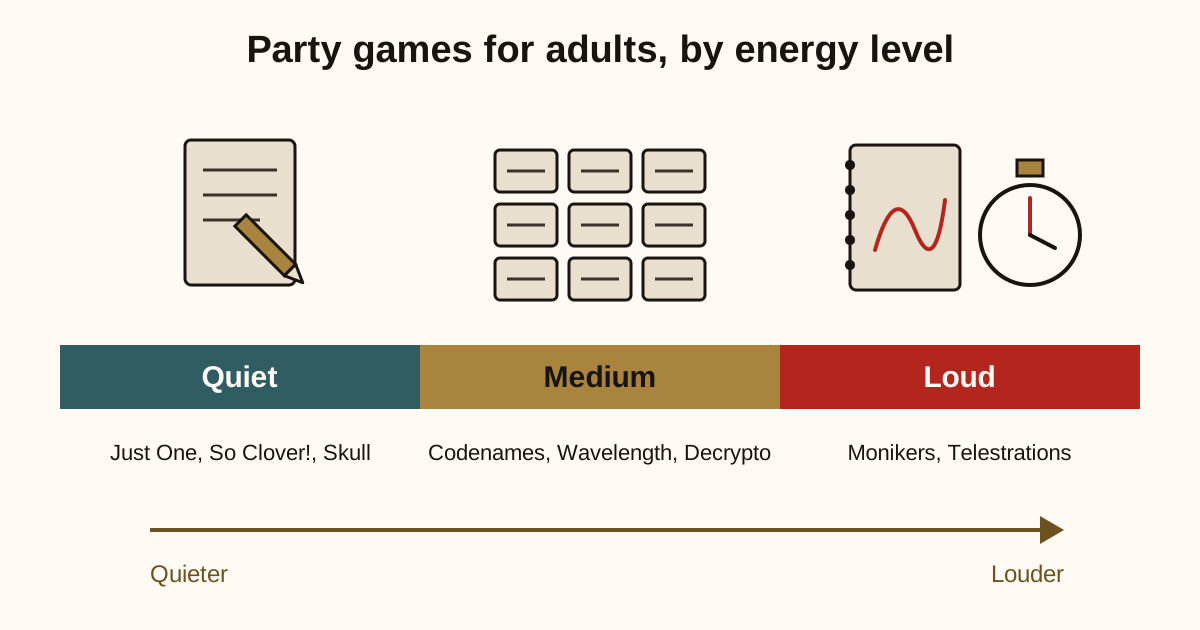
Clear the dishes, pull the chairs in, and you can run every game on this list without a single screen. Among party games for adults that suit four to eight players, Codenames is the safest first box to open, Telestrations and Monikers will make the room loudest, and Just One or So Clover! suit a calmer evening; the eight picks below are sorted by how much noise they're built to make.
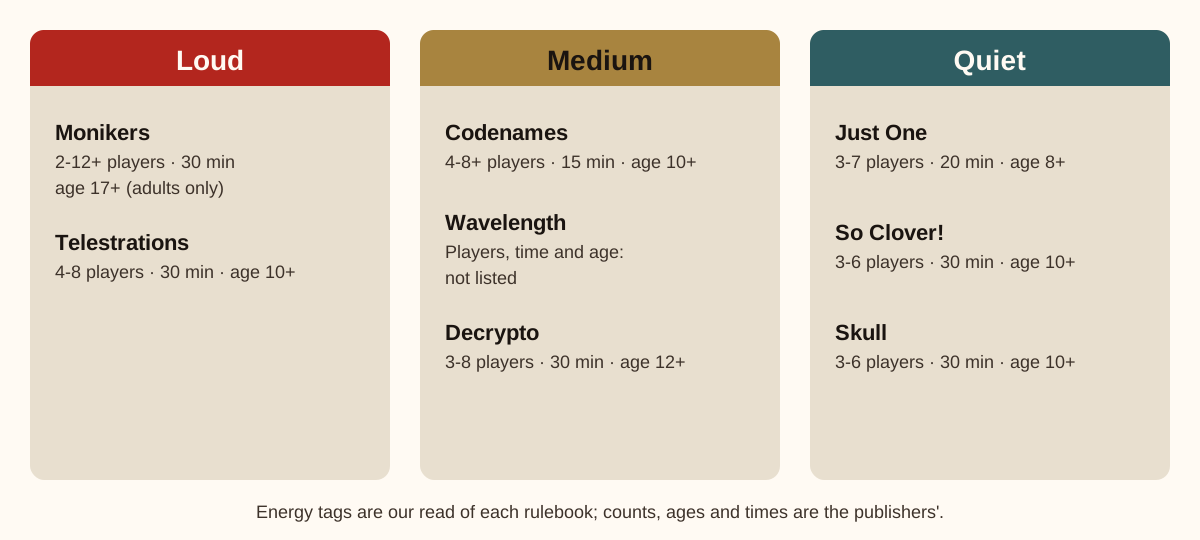
There are no drinking games and no apps here. Counts, ages and times come from each publisher's rules or pages, and where a publisher lists nothing (Wavelength), the table says so. The energy tags are our read of what each rulebook asks people to do: shout, draw, whisper or sit in silence.
Party games for adults, side by side
| Game | Players | Time | Age | Energy | Why it's here |
|---|---|---|---|---|---|
| Monikers | 2-12+ | 30 min | 17+ (adults only) | Loud | Same cards, three rounds, rising silliness |
| Telestrations | 4-8 | 30 min | 10+ | Loud | Draw-and-guess telephone, everyone at once |
| Codenames | 4-8+ | 15 min | 10+ | Medium | Two teams, one-word clues |
| Wavelength | Not listed | Not listed | Not listed | Medium | Guess where a clue sits on a spectrum |
| Decrypto | 3-8 | 30 min | 12+ | Medium | Clue your team without tipping off the other |
| Just One | 3-7 | 20 min | 8+ | Quiet | Co-op one-word clues; duplicates cancel |
| So Clover! | 3-6 | 30 min | 10+ | Quiet | Co-op word pairs on a clover board |
| Skull | 3-6 | 30 min | 10+ | Quiet | Bluffing with four discs |
Loud: games built for noise
Monikers (adults only, 17+)
Monikers is the loudest box here, and the reason is structural. Per CMYK's page, teams get one minute per turn to make teammates guess as many cards as possible, and the same cards come back for three rounds: any spoken clue in the first, a single word in the second, and charades in the third.
By round three everyone has heard every name twice, so the room's running jokes do half the work. That also makes it forgiving for nervous players: the first round is just describing, and by the time charades arrive, the answers feel familiar. CMYK lists 2 to 12+ players and about 30 minutes, and rates it 17 and up, so treat it as an adults-only pick. Alex Hague and Justin Vickers designed it.
Telestrations
Telestrations calls itself the visual version of the classic telephone game, and its rules keep everyone busy at once. Each player secretly writes a prompt in their own sketchbook. Then the books travel: whoever receives one either sketches the last guess or guesses the last sketch, and everyone passes at the same moment, so there are no turns to sit through.
With an odd number of players, you hand your prompt to the left before anyone draws, which makes every book end on a written guess. The payoff is the reveal, when each owner flips through how their word drifted. Scoring is optional, with friendly and competitive versions over three rounds, and the stated objective is simply to laugh a lot. The Op's game page lists 4 to 8 players, ages 10 and up, about 30 minutes for this box.
Medium: teams, clues and a little strategy
Codenames
Codenames is the safest first box for a mixed group, because each job is simple and teams carry anyone who's unsure. On CGE's page, two spymasters look at a grid of 25 word cards and know which ones belong to their team. A spymaster gives one word and a number, and teammates pick cards one at a time.
Hit a bystander or the other team's agent and your turn ends; pick the assassin and the game ends immediately. The tension lives in the clue. A spymaster linking three cards with one word is doing something genuinely hard, while the guessers simply talk it through, which is easy work for a newcomer. CGE lists 4 to 8+ players, about 15 minutes, ages 10 and up. Vlaada Chvátil designed it.
Wavelength
Wavelength is the friendliest way to argue about nothing. Per the game's own site, one teammate, the psychic, knows exactly where a hidden target sits on a spectrum between two opposites, like hot and cold, and gives one clue. The team then turns a dial to where they think that clue falls, and the closer they land to the center of the target, the more points they score. In the board game, the FAQ notes, two teams compete.
Nobody is ever wrong in a factual sense, only out of tune with the psychic, which is why it suits people who dread trivia. One caution: CMYK's pages don't list a player count, age or play time for the board game, so check the box before you plan around it. Wolfgang Warsch, Alex Hague and Justin Vickers designed it, and CMYK published the board game in 2019.
Decrypto
Decrypto is the sneakier cousin of Codenames. As Le Scorpion Masqué describes it, each team gives clues that must be clear enough for teammates to decode a secret code, but vague enough that the opposing team can't. Every clue has two audiences, the partners who need it and the rivals listening for a pattern, and balancing them is the whole game.
The box holds a sand timer, two screens, 110 keyword cards and 48 code cards, so the setup is modest even if the thinking isn't. It's the most strategic of the medium picks, and a good one for a group that already enjoys word games and wants more bite. The rulebook lists 3 to 8 players, ages 12 and up, and 30 minutes.
Quiet: low volume, high focus
Just One
Just One is cooperative, which takes the sting out of a bad round. In the rules, the guesser draws a card without looking and calls a number from 1 to 5, and everyone else secretly writes a one-word clue for that mystery word. Before the guesser opens their eyes, the clue-givers compare and cancel every identical clue.
So the obvious clue is a trap: if three of you write the same word, none of those clues survive. The guesser gets one guess or may pass, and a wrong guess costs two cards from the 13-card deck. With three or four players, everyone writes two clues on two easels. It won the Spiel des Jahres in 2019, and Repos lists 3 to 7 players, ages 8 and up, about 20 minutes on its game page. Ludovic Roudy and Bruno Sautter designed it.
So Clover!
So Clover! may be the quietest game here. Per the rules, each player places four keyword cards on a clover-shaped board, which makes four pairs of words, and privately writes one clue linking each pair. You then remove the cards, shuffle in one random decoy, and hand the stack to the team.
Taking turns as the "spectator," each player watches without communicating in any way while everyone else rebuilds their clover from the clues. A perfect first attempt scores 6 points; otherwise the spectator silently pulls the wrong cards, and the team gets a second try at 1 point per correct card. Repos lists 3 to 6 players, ages 10 and up, about 30 minutes on its game page. François Romain designed it.
Skull
Skull is a bluffing game with almost nothing to explain. Per the rules, everyone has four discs with identical backs: three flowers and one skull. On your turn you either add a disc face down to your mat or open the bidding by naming how many discs you think you can flip without hitting a skull, and the others outbid or pass.
The winning bidder must flip their own discs first, then choose from other mats. Succeed twice and you win. Hit a skull and its owner takes one of your discs at random, and a player who loses all four is out, so warn people about elimination up front. It's quiet in volume and loud in nerves. Space Cowboys lists 3 to 6 players and 30 minutes on its game page, Asmodee's Skull page gives ages 10 and up, and Hervé Marly designed it.
For the friend who says they hate games
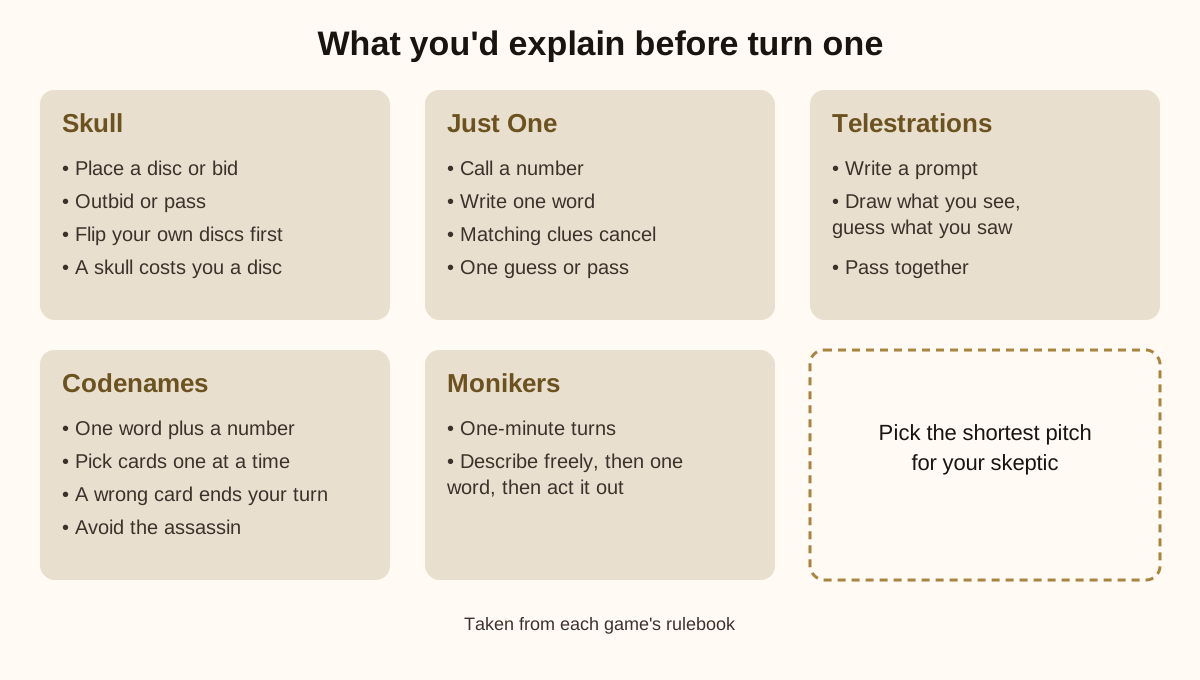
If a friend says they hate games, three things in the rules are worth checking: how much there is to explain, whether anyone loses in public, and whether anyone sits out. Here's what you'd have to explain before turn one, taken from each rulebook, so you can pick the shortest pitch for your skeptic.
- Skull: place a disc or bid; outbid or pass; flip your own discs first; a skull costs you a disc.
- Just One: call a number; write one word; matching clues cancel; one guess or pass.
- Telestrations: write a prompt; draw what you see, guess what you saw; pass together.
- Codenames: one word plus a number; pick cards one at a time; a wrong card ends your turn; avoid the assassin.
- Monikers: one-minute turns; describe freely, then one word, then act it out.
Two more filters from the rules. Just One and So Clover! are cooperative, so nobody loses to anybody. And of the eight, only Skull's rules knock players out. If your skeptic would rather judge than compete, the judge-based party games in our Apples to Apples list are another easy entry point.
Adult party games: quick questions
What about a larger group of adults? This list is built for four to eight, but Monikers lists 2 to 12+ players and Codenames 4 to 8+. For true crowds, our social deduction picks for big groups include Two Rooms and a Boom, and the Thanksgiving list has games that seat twenty.
Are there adult party games that aren't drinking games? All eight here. They run on words, drawing and bluffing, and nothing in the rules involves a drink.
Which ones fit at a small table at home? Skull and Just One need the least space: a mat and four discs each for Skull, and an easel and an erasable pencil each for Just One.
Sources
- Monikers game page (CMYK)
- Telestrations 8-player rules (The Op)
- Telestrations 8-player game page, age and time (The Op)
- Codenames game page (Czech Games Edition)
- About Wavelength (CMYK)
- Wavelength FAQ
- Decrypto game page (Le Scorpion Masqué)
- Decrypto rulebook (Le Scorpion Masqué)
- Just One rulebook (Repos Production)
- Just One game page (Repos Production)
- Just One named Spiel des Jahres 2019
- So Clover! rulebook (Repos Production)
- So Clover! game page (Repos Production)
- Skull rulebook (Space Cowboys)
- Skull game page (Space Cowboys)
- Skull age rating (Asmodee)